TL;DR: Affiliate marketing can help Amazon sellers extend product discovery beyond Amazon, but Amazon Associates is primarily an affiliate program for creators, publishers, and other eligible participants who earn commissions from qualifying purchases generated through approved links. For brands and sellers, the stronger strategy is to identify creators whose audiences match real Amazon demand, choose products with strong purchase intent and stable availability, measure external traffic where possible, and build compliance into every campaign from the beginning.
Key Takeaways
- ✓ Amazon Associates and seller affiliate marketing are related, but not identical. Associates is Amazon's affiliate program for eligible publishers and creators, while sellers usually approach affiliate marketing as an external traffic and creator-partnership strategy.
- ✓ The best affiliate product is not automatically the highest-priced or most popular ASIN. Audience fit, search demand, purchase intent, reviews, availability, price stability, and conversion friction all matter.
- ✓ Affiliate content performs better when it solves a buying problem through comparisons, use cases, objections, demonstrations, and decision criteria rather than simply dropping product links.
- ✓ Disclosure and measurement should be designed into the campaign from day one. Creators must follow applicable Amazon Associates and advertising-disclosure requirements, while sellers should measure whether external traffic actually contributes to meaningful Amazon activity.
Table of Contents
- Quick Answer
- What Is Amazon Associates?
- Why Affiliate Marketing Matters for Amazon Sellers
- Amazon Associates vs. Influencer and Seller Campaigns
- How to Choose Products for Affiliate Promotion
- Build Content Around Buyer Decisions
- The Metrics That Actually Matter
- A Practical Affiliate Research Workflow
- How SellerSprite Can Support the Workflow
- Compliance, Disclosure, and Trust
- Common Affiliate Marketing Mistakes
- The Bottom Line
- FAQs
- References
Marketplace note: This guide focuses primarily on the US Amazon marketplace and US-facing affiliate and creator campaigns. Amazon Associates rules, program availability, commission structures, and advertising requirements can vary by country and can change over time.
Quick Answer
Affiliate Marketing and Amazon Associates becomes useful for Amazon sellers when it is treated as a customer-acquisition system rather than simply a way to distribute links. Creators and publishers can use Amazon Associates links to earn commission income from qualifying purchases, while brands and sellers can use creator partnerships, external content, and measurable off-Amazon traffic to put their products in front of relevant audiences.
The core seller question is not, "How many affiliates can promote this ASIN?" It is, "Which audiences already have the problem this product solves, which creators can reach those audiences credibly, and which marketplace signals suggest shoppers will be ready to buy when they arrive on Amazon?"
The practical rule: Treat affiliates as a distribution layer for qualified demand. Audience fit and product-market fit should come before link volume.
What Is Amazon Associates?
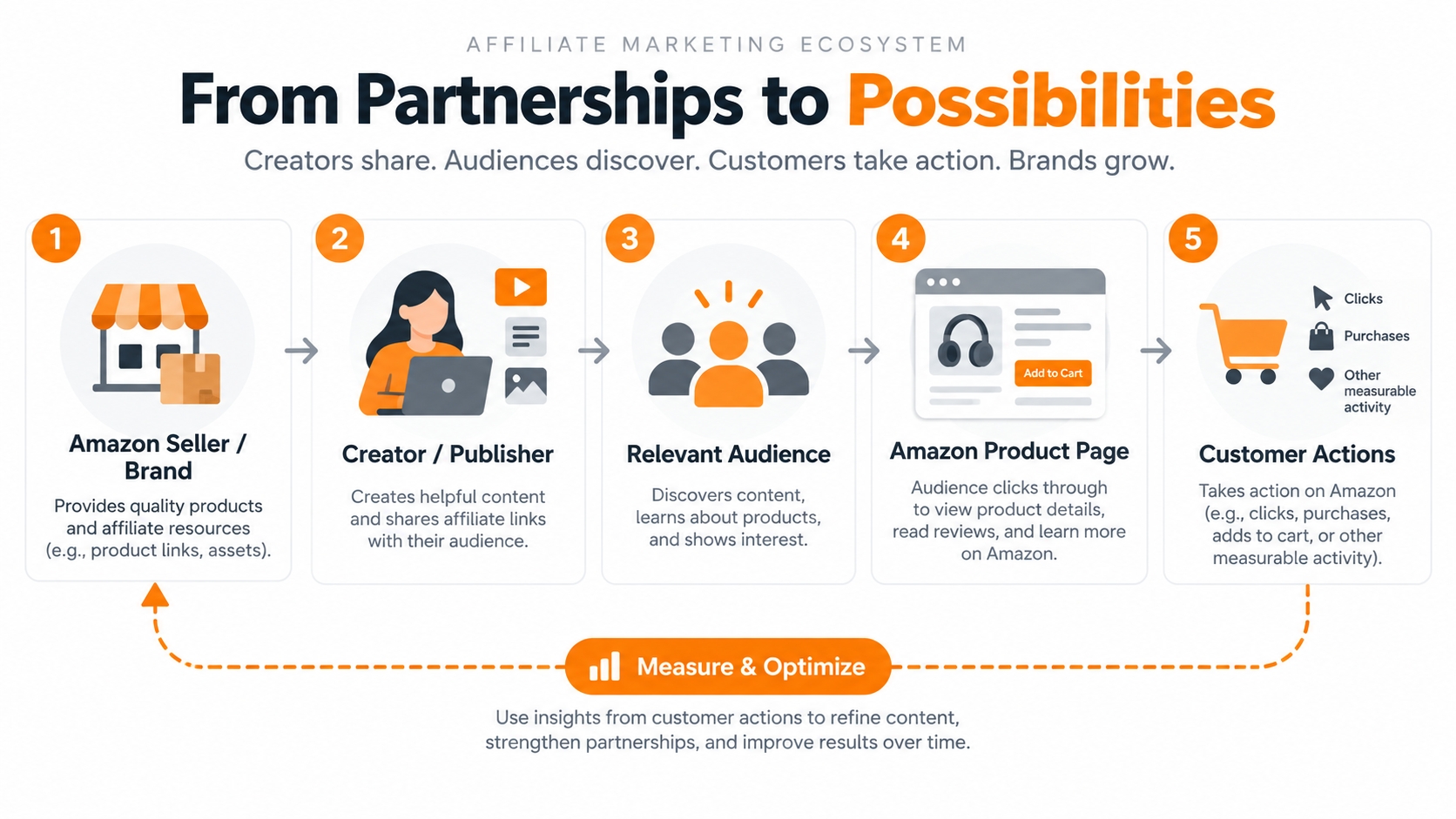
Amazon Associates is Amazon's affiliate marketing program. Eligible publishers, creators, websites, social media accounts, and other approved participants can place Amazon Special Links in their content and may earn commission income when customers complete qualifying purchases or actions under the program rules.
That makes it important to separate two roles that are often blended together in discussions about Amazon affiliate marketing:
- The Associate or creator creates content, recommends products, uses compliant affiliate links, and may earn commission income from qualifying activity.
- The Amazon seller or brand owns or sells the product and may work with creators to generate awareness, traffic, consideration, and sales.
The two roles can overlap in some situations, but Amazon Associates should not be viewed as a rebate mechanism for purchasing through your own links. Amazon states that personal-use purchases and certain related purchases are not eligible for referral commissions.
Amazon's separate Influencer Program also sits within the broader Associates ecosystem in supported markets. Eligible influencers can receive an Amazon-hosted page and participate subject to the applicable Associates and Influencer Program rules.
Why Affiliate Marketing Matters for Amazon Sellers
Amazon search captures shoppers who are already inside the marketplace. Affiliate and creator marketing can reach potential buyers earlier, while they are still researching a problem, comparing solutions, watching demonstrations, or asking for recommendations.
That makes external creators useful for more than direct conversion. Good affiliate content can introduce a new use case, explain why one product feature matters, compare alternatives, address objections, or make a niche product easier to understand before the shopper reaches Amazon.
For sellers, affiliate campaigns can support several goals:
- introducing a new product to an existing niche audience;
- expanding discovery outside Amazon search;
- supporting product launches with educational content;
- reaching buyers through comparison and review content;
- testing new audiences before committing to larger media budgets;
- generating measurable external traffic for eligible Amazon brands.
The important distinction is that external traffic is not automatically valuable traffic. A large creator can send thousands of clicks that convert poorly, while a much smaller niche publisher may send fewer visitors with stronger purchase intent.
Amazon Associates vs. Influencer and Seller Campaigns
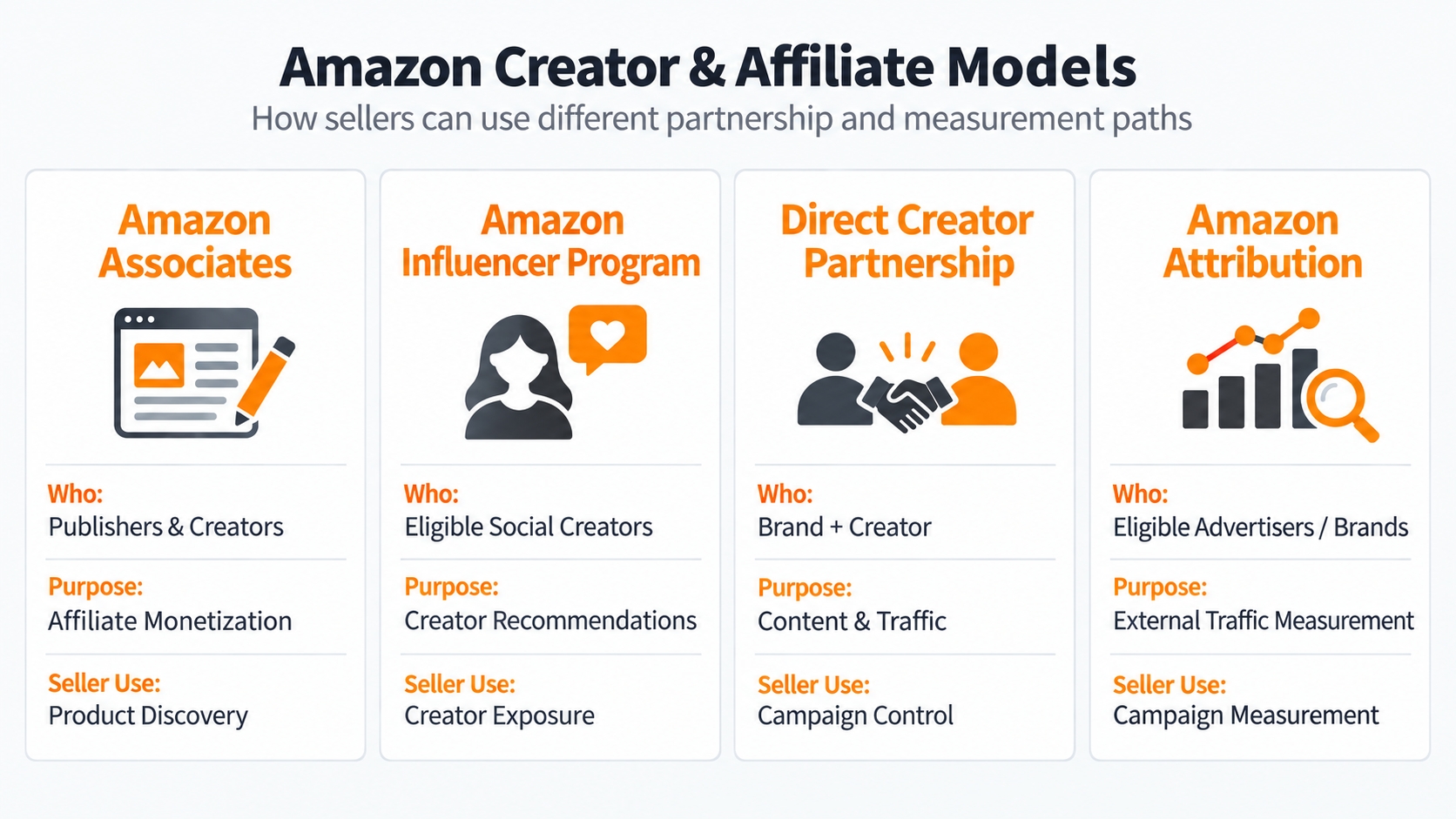
Amazon affiliate marketing involves several overlapping models, but they serve different purposes. Understanding the difference helps sellers avoid building the wrong measurement or incentive structure.
| Model | Primary Participant | Main Goal | Seller Relevance |
|---|---|---|---|
| Amazon Associates | Publishers and creators | Earn commission from qualifying purchases | Potential source of creator-led product discovery |
| Amazon Influencer Program | Eligible social creators | Recommend products through social content and Amazon-hosted experiences | Relevant for creator collaborations and product exposure |
| Direct Creator Partnership | Brand and creator | Generate content, reach, traffic, or sales | Seller controls the partnership structure and campaign goals |
| Amazon Attribution | Eligible advertisers and brands | Measure non-Amazon marketing impact | Helps connect external channels with Amazon shopping activity |
How to Choose Products for Affiliate Promotion
A strong Amazon product does not automatically make a strong affiliate product. Affiliate traffic arrives with its own expectations, and the product page still has to convert the interest created outside Amazon.
Before asking creators to promote an ASIN, evaluate the product from both a marketplace and content perspective.
1. Confirm Real Search Demand
Search volume cannot tell you whether an affiliate campaign will work, but it can show whether shoppers already use language that matches the problem or category a creator plans to discuss.
Start by identifying core category terms, use-case keywords, long-tail buying phrases, and adjacent problems. SellerSprite's Amazon Keyword Research workflow can help compare search demand, purchase-related signals, price ranges, ratings, and keyword patterns before a content angle is selected.
2. Match the Product to the Audience Problem
A creator's audience should have a natural reason to care about the product. A kitchen creator may be a logical fit for cookware, while a productivity creator may have a better audience for desk accessories or organizational products.
The strongest match is usually narrower than a broad demographic label. "Parents" is broad. "Parents preparing toddlers for their first flight" creates a much clearer content and product context.
3. Check Review Strength and Objections
Creators put their own credibility at risk when they recommend a product. Review count, rating, recurring complaints, product defects, confusing variations, and unanswered objections should therefore be evaluated before outreach begins.
4. Look for Stable Availability
Affiliate content can continue generating traffic long after publication. If an ASIN frequently goes out of stock, loses a key variation, or experiences major price swings, the creator's recommendation may quickly become less useful.
5. Evaluate the Product Detail Page
External content can create interest, but the Amazon listing still has to close the sale. Check whether the title, images, bullets, price, reviews, A+ Content, variations, and offer structure clearly support the claims or use cases the creator plans to communicate.
For broader product screening, SellerSprite's Product Research filters and historical data can help compare candidate ASINs before time is invested in creator outreach.
Build Affiliate Content Around Buyer Decisions
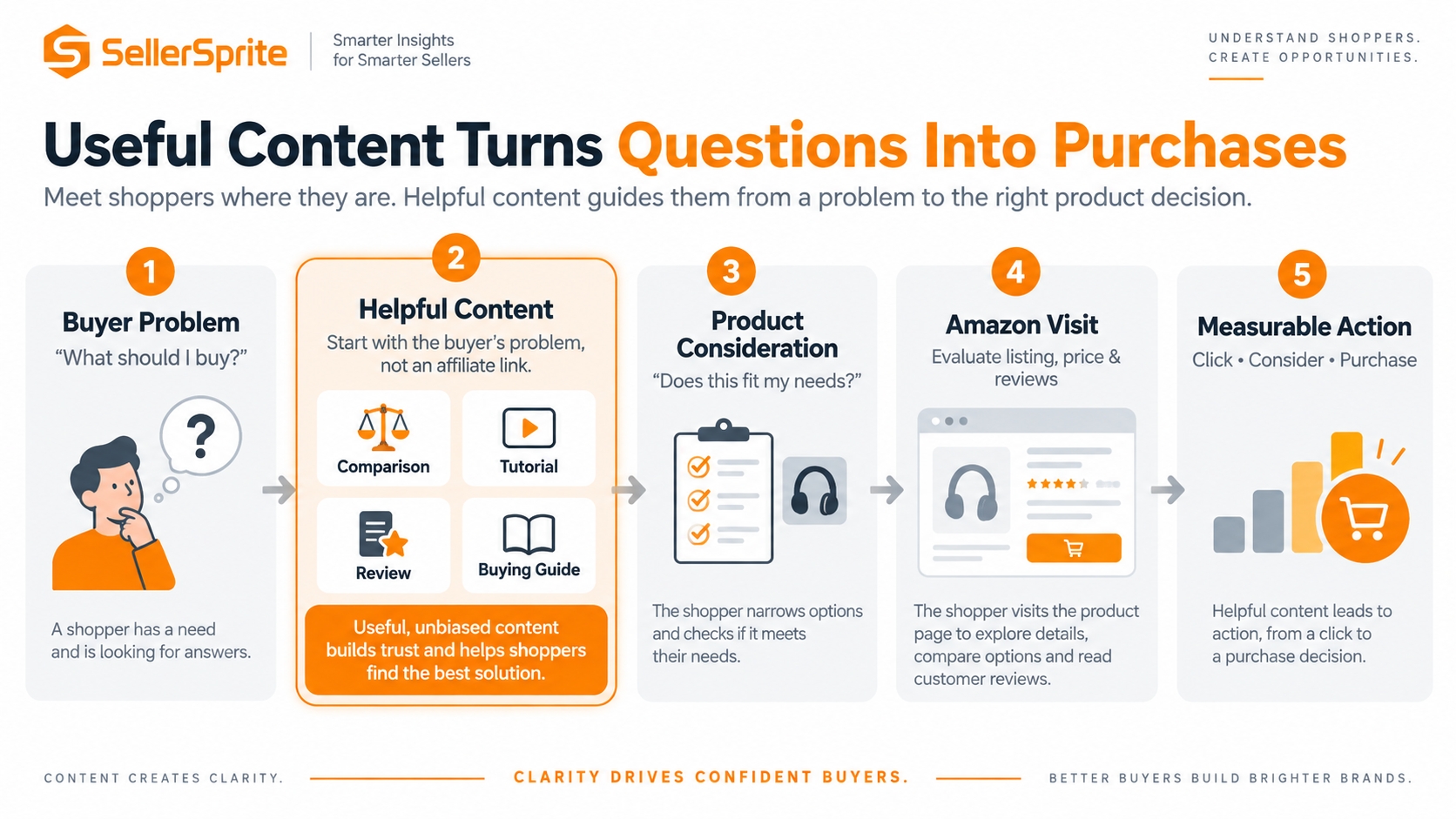
Product links are not a content strategy. The strongest affiliate content usually helps a shopper make a decision they were already struggling with.
That means the content angle should begin with the buyer's question rather than with the ASIN.
| Buyer Question | Useful Content Format | What the Content Should Clarify |
|---|---|---|
| Which option should I buy? | Comparison | Differences, trade-offs, and best-fit use cases |
| Does this solve my problem? | Demonstration or tutorial | How the product works in a real scenario |
| Is it worth the price? | Review or value breakdown | Benefits, limitations, alternatives, and value |
| Will it fit my situation? | Use-case content | Who the product is and is not designed for |
| What should I know before buying? | Buying guide | Decision criteria, specifications, and common mistakes |
The Metrics That Actually Matter
Affiliate campaigns can generate many visible numbers: followers, impressions, views, clicks, likes, comments, and revenue. The challenge is separating attention metrics from signals that actually help you decide whether a creator, product, or content format deserves more investment.
Sellers should evaluate performance across three layers: audience quality, marketplace response, and business economics.
| Metric | What It Helps You Understand | Do Not Read It Alone Because... |
|---|---|---|
| Search demand | Whether shoppers already search for the problem or category | High volume can still have weak purchase intent |
| Audience relevance | How closely creator followers match the product use case | Follower count does not equal buyer intent |
| Click-through activity | Whether content motivates people to investigate the product | Clicks do not guarantee qualified traffic or purchases |
| Amazon conversion activity | Whether external interest turns into shopping actions | Listing quality, price, reviews, and availability also affect results |
| Product availability | Whether traffic can reach an in-stock, purchasable offer | Traffic cannot compensate for repeated stockouts |
| Campaign economics | Whether creator cost and promotional spend are sustainable | Revenue without margin can still be a poor outcome |
A Practical Affiliate Research Workflow
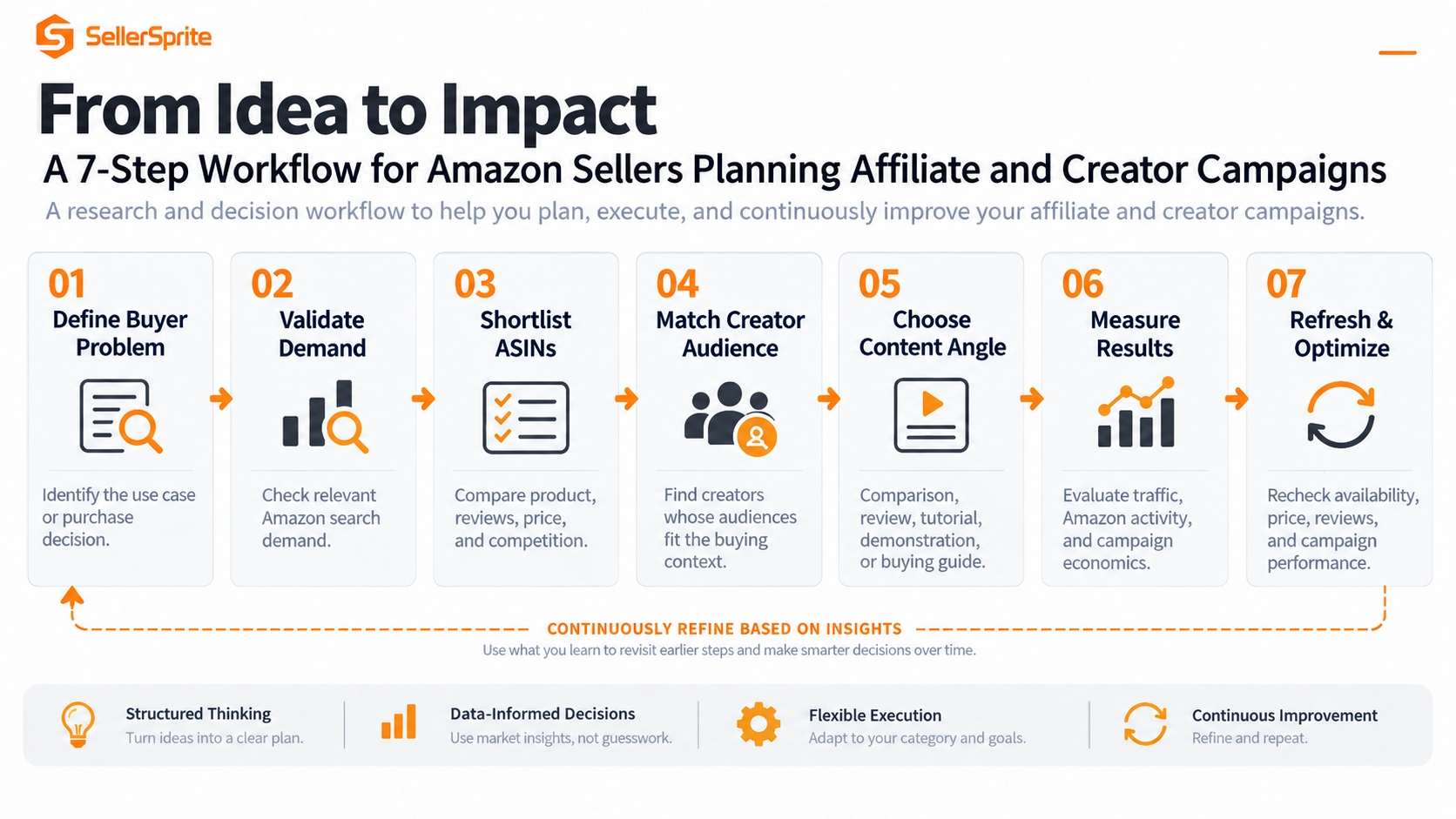
A good affiliate strategy does not start with creator outreach. It starts by deciding which product, audience, and buying problem are worth matching in the first place.
- Define the buyer problem.
Write down the problem, use case, or purchase decision the content should help solve. - Validate marketplace demand.
Research the keywords shoppers use for the category, problem, features, and alternatives. - Shortlist the right ASINs.
Compare reviews, ratings, price, sales history, availability, competition, and differentiation. - Identify creator-audience fit.
Look beyond follower size and evaluate whether the creator regularly reaches people with the same problem or buying context. - Choose a content angle.
Build around a comparison, tutorial, buying guide, demonstration, objection, or specific use case. - Define measurement before publishing.
Decide which clicks, Amazon activity, sales, creator costs, and downstream marketplace signals will determine whether the test worked. - Refresh and re-evaluate.
Affiliate content can stay live for months. Recheck product availability, price, reviews, listing quality, and campaign compliance periodically.
How SellerSprite Can Support the Workflow
SellerSprite does not replace creator judgment or affiliate-platform reporting. Its role in this workflow is to help sellers validate the Amazon marketplace side of the decision before and after creator content goes live.
Use Keyword Research to Validate the Content Topic
Compare category terms, product features, long-tail searches, purchase-oriented keywords, and related search patterns to see whether the creator's proposed topic maps to real Amazon demand.
Use Product Research to Shortlist Better ASINs
Compare price, estimated sales, ratings, reviews, historical performance, competition, and category conditions before selecting the product most suitable for a campaign.
Use Reverse ASIN to Understand Competitor Visibility
Reverse ASIN research can show which keywords already drive visibility for competing listings and whether your product has a meaningful search-positioning gap that content could help explain.
Monitor Marketplace Signals After the Campaign
External content should not be judged only by social views. Watch relevant product and keyword movement alongside creator or attribution data to understand whether the campaign coincides with meaningful marketplace changes.
Compliance, Disclosure, and Trust
Affiliate marketing works only when the commercial relationship is transparent. Disclosure should not be treated as a footer added after content is finished; it should be part of the content format itself.
Amazon's Associates Program requires participants to identify themselves appropriately as Associates, and Amazon provides additional guidance for affiliate-link disclosures. The FTC likewise says material connections between endorsers and marketers should be disclosed clearly and conspicuously.
For the current program language, disclosure requirements, prohibited practices, and other restrictions, review the Amazon Associates Program Operating Agreement before publishing or approving affiliate content.
For creators: make the affiliate relationship easy for the audience to notice and understand.
For brands: provide factual product information, avoid asking creators to make unsupported claims, and maintain a process for reviewing sponsored or compensated content.
For both: check the current Amazon program rules, applicable advertising law, and individual platform policies before publishing.
Common Affiliate Marketing Mistakes
Affiliate programs often underperform because teams optimize the easiest metric to see rather than the constraint that actually determines performance. More creators, more links, or more views can look productive while audience fit or Amazon conversion remains weak.
The following mistakes are especially common when Amazon sellers move from marketplace advertising into creator and affiliate acquisition.
Choosing Creators by Follower Count Alone
Reach is useful only when the audience and product fit. A smaller niche creator can be more strategically relevant than a much larger account with weak overlap.
Promoting a Product Before Checking Marketplace Readiness
If reviews are weak, the listing is unclear, stock is unstable, or price is uncompetitive, external traffic may simply expose those problems faster.
Writing Content Around the Link Instead of the Buyer
Content built only to place an affiliate link often lacks a real reason to exist. Useful affiliate content should answer a buying question even if the reader never clicks.
Ignoring Stock and Price Changes
Evergreen content can send traffic for months. A product that becomes unavailable or significantly changes price can quickly become a poor recommendation.
Using Social Engagement as the Final KPI
Views and likes can indicate content resonance, but they do not tell you whether the campaign generated useful Amazon shopping activity or acceptable economics.
Treating Disclosure as Optional
Affiliate and sponsored relationships should be disclosed in accordance with current program rules and applicable advertising requirements. Hiding the relationship can create both trust and compliance problems.
The Bottom Line
Affiliate Marketing and Amazon Associates should not be reduced to link placement. For creators, the program is a way to monetize useful product recommendations under Amazon's rules. For sellers and brands, affiliate and creator partnerships are a way to reach relevant audiences outside Amazon and guide qualified shoppers toward marketplace listings.
The strongest strategy connects five things: a real buyer problem, demonstrated Amazon demand, the right product, the right creator audience, and a measurement framework that distinguishes attention from business results.
SellerSprite can support the marketplace-research side of that process by helping sellers evaluate keywords, products, competitors, and historical signals before committing to a creator campaign and while monitoring what changes afterward.
FAQs
Is Amazon Associates the same as the Amazon Influencer Program?
No. The Amazon Influencer Program is a creator-focused program within the broader Associates ecosystem in supported markets. Eligible influencers can receive additional Amazon-hosted features, while the standard Associates Program supports approved affiliate linking through eligible websites, social content, and other properties.
How can Amazon sellers use affiliate marketing?
Sellers can work with relevant creators, publishers, and influencers to introduce products to external audiences, create educational or comparison content, and drive traffic to Amazon listings or Stores. The campaign should be built around audience relevance, marketplace readiness, compliance, and measurable business goals.
What metrics matter most for Amazon affiliate campaigns?
Useful metrics include audience relevance, search demand, content engagement, click-through activity, Amazon shopping activity where measurable, product availability, listing conversion conditions, campaign cost, and margin. No single metric should determine whether a partnership is successful.
Do Amazon affiliate links need a disclosure?
Yes. Amazon Associates participants must follow Amazon's current identification and disclosure requirements, and US-facing affiliate and influencer content may also be subject to FTC disclosure expectations. Disclosures should be clear, conspicuous, and easy for the audience to understand.
Can sellers measure traffic from creator or affiliate campaigns?
Eligible sellers and advertisers may be able to use Amazon Attribution to measure the impact of non-Amazon marketing channels. Campaign-level creator or affiliate reporting can also be combined with marketplace metrics to create a broader view of performance.
How can SellerSprite help with affiliate marketing research?
SellerSprite can help evaluate Amazon-side demand and competition before a campaign starts. Keyword Research can validate search demand, Product Research can help compare candidate ASINs, Reverse ASIN can reveal competitor keyword visibility, and tracking workflows can help monitor relevant marketplace changes over time.
References
- Amazon Associates Program Operating Agreement View
- Amazon Associates Program Policies View
- FTC Endorsement Guides: What People Are Asking View
- Amazon Ads: Guide to Amazon Attribution View
By SellerSprite Content Team
The SellerSprite Content Team combines Amazon marketplace research with practical data workflows to help sellers evaluate demand, competition, keywords, product opportunities, and growth strategies using marketplace intelligence.
Last updated: September 23, 2026