TL;DR: Amazon product review and testing opportunities should be approached as a review-health and product-learning strategy, not as a shortcut to generate ratings. Sellers can use genuine customer feedback, compliant review reque sts, Amazon Vine, product testing insights, and competitor review analysis to improve products and listings. What they should not do is offer money, refunds, discounts, free products, warranties, or other benefits in exchange for an Amazon review or a specific rating.
Key Takeaways
- ✓ Product testing and Amazon review generation are not the same thing. A seller can test products and collect product feedback, but compensation or free products must not be conditioned on posting an Amazon review.
- ✓ Amazon Vine is a structured Amazon program for eligible products to receive honest reviews from invited Vine Voices. Sellers should not recreate a similar "free product for review" arrangement outside Amazon's permitted mechanisms.
- ✓ Review health is more than average star rating. Review count, recency, negative themes, product expectations, competitor gaps, BSR, price, and product changes should be read together.
- ✓ The most useful review strategy turns recurring customer feedback into better product design, packaging, listing content, customer support, and marketplace positioning.
Table of Contents
- Quick Answer
- What Does Amazon Product Review and Testing Opportunities Mean?
- Product Testing vs. Incentivized Reviews
- Compliant Ways to Build Review Health
- The Review Signals Sellers Should Watch
- Turn Competitor Reviews Into Product Insights
- A Practical Review and Testing Workflow
- How SellerSprite Can Support the Workflow
- Common Mistakes to Avoid
- Compliance and Trust Checklist
- The Bottom Line
- FAQs
- References
Policy note: Amazon review policies and program eligibility can change. This guide focuses on the US marketplace and should be used alongside the latest Amazon Community Guidelines, Seller Central policies, and program documentation.
Quick Answer
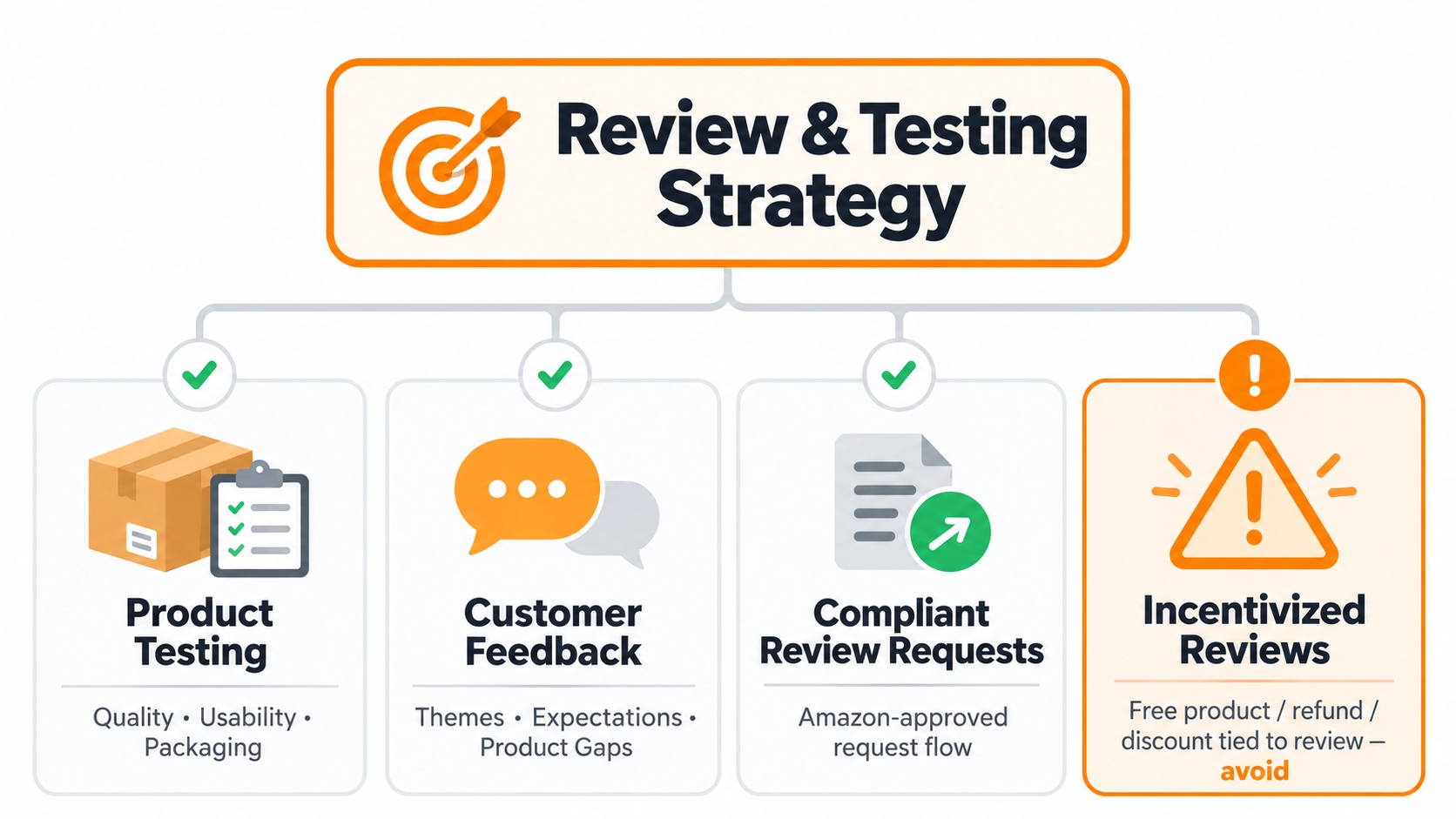
For Amazon sellers, Amazon product review and testing opportunities should mean finding compliant ways to learn from customers, improve products, build legitimate review history, and identify gaps in competing products. It should not mean giving shoppers a free product, refund, discount, gift card, warranty, or other reward in exchange for an Amazon review.
The strongest strategy separates three activities that are often confused: product testing, which helps identify usability or quality problems; customer review management, which helps sellers understand public buyer feedback; and review acquisition, which must follow Amazon's review policies.
The practical rule: Improve the product and customer experience first. Let legitimate reviews reflect that experience rather than trying to engineer the rating itself.
What Does Amazon Product Review and Testing Opportunities Mean?
The keyword is broad because people searching it may have different goals. A consumer may be looking for ways to test products. A creator may be looking for products to review. A seller may be trying to understand how to generate legitimate customer feedback for a new ASIN.
For Amazon sellers, the useful interpretation is narrower: how can you collect better product insights and develop review health without manipulating customer reviews?
That question matters because reviews sit at the intersection of customer trust, listing conversion, product development, customer service, and brand reputation. A low rating may indicate a product defect, but it can also point to confusing instructions, inaccurate sizing expectations, poor packaging, misleading imagery, or a variation mismatch.
The objective should therefore be to understand why customers react the way they do and then improve the underlying experience.
Product Testing vs. Incentivized Reviews: Know the Difference
Product testing can be a legitimate product-development activity. A brand may evaluate prototypes, packaging, instructions, usability, durability, or customer expectations before or after launch.
The problem begins when that testing arrangement is tied to an Amazon review. Amazon's Community Guidelines prohibit creating, editing, or removing a review in exchange for compensation such as payments, refunds, discounts, products, gift cards, warranties, or services.
| Activity | Purpose | Review Relationship | Seller Approach |
|---|---|---|---|
| Product testing | Improve quality, usability, or packaging | Should remain separate from Amazon review requirements | Use feedback for product development |
| Standard review request | Invite genuine buyer feedback | Must not pressure for a positive rating | Use Amazon-approved review request tools |
| Amazon Vine | Help eligible products receive authentic early feedback | Reviews are honest and can be positive or negative | Use Amazon's official program and current eligibility rules |
| Free product for a required review | Artificially generate reviews | Compensation is tied to the review | Avoid |
Compliant Ways to Build Review Health
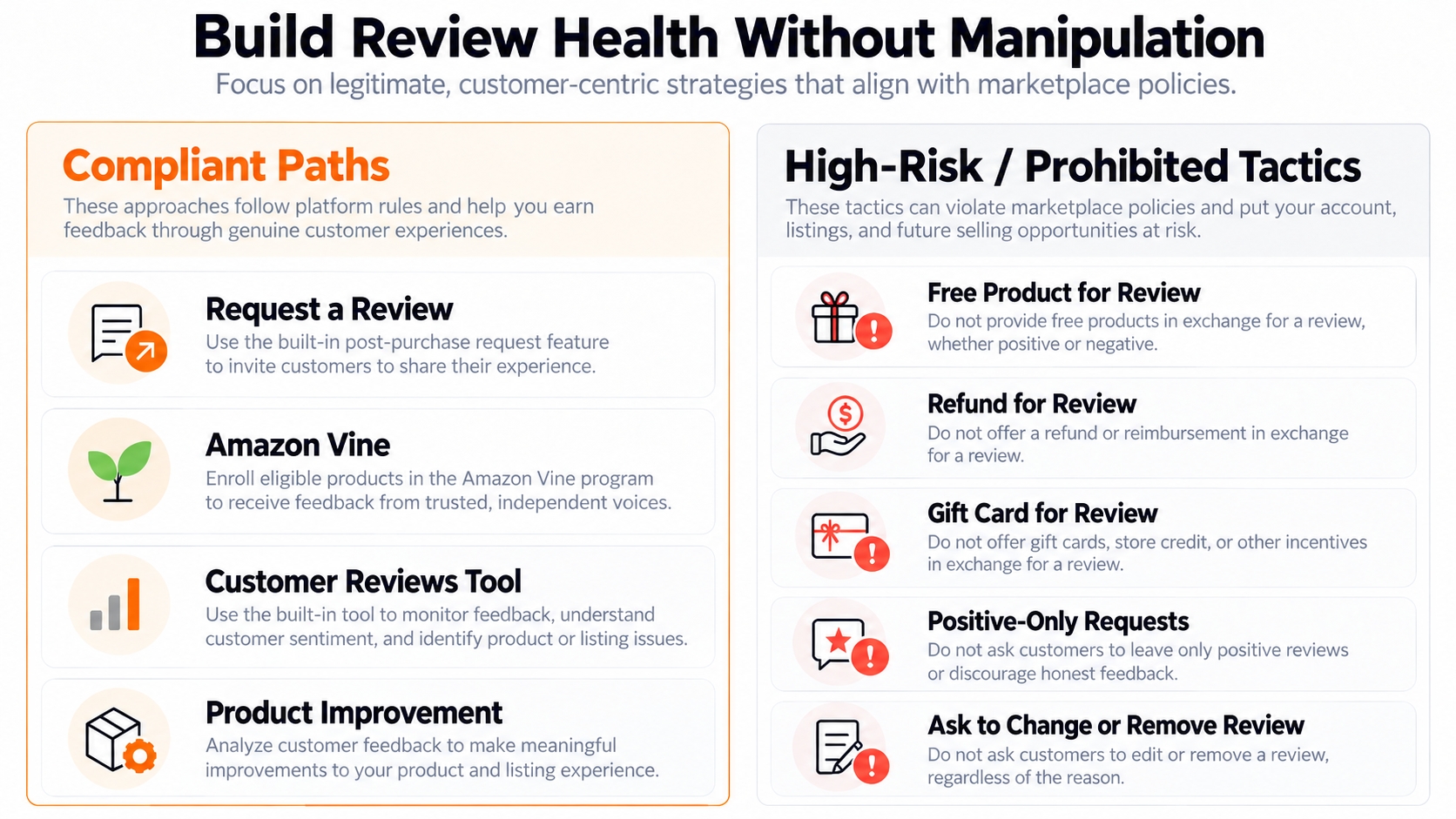
A sustainable review strategy does not try to control what customers say. Instead, it creates more opportunities for genuine customers to have a good experience and makes it easier for the seller to learn from the feedback that follows.
The following approaches serve different purposes and should not be treated as interchangeable.
1. Use Amazon's Request a Review Function
Seller Central provides a standardized Request a Review option for eligible orders. The important advantage is that the request is structured by Amazon rather than written to pressure customers toward a particular rating.
2. Consider Amazon Vine for Eligible Products
Amazon Vine connects eligible products with invited Vine Voices who receive products through Amazon's program and provide honest opinions. A Vine review is not guaranteed to be positive, which is exactly why product readiness matters before enrollment.
Before using Vine, check current eligibility, enrollment requirements, product availability, and program terms directly in Seller Central or Amazon's current Vine documentation.
3. Use Customer Reviews as a Feedback System
For eligible brands, Amazon's Customer Reviews tool can help surface recent feedback and customer issues. Rather than treating a negative review only as a reputation problem, ask what operational issue sits behind it.
A complaint about "poor quality," for example, may actually relate to weak packaging, incorrect expectations, fit, assembly difficulty, instructions, or the wrong product variation.
4. Keep External Product Testing Separate From Amazon Reviews
Brands can conduct product research to understand usability, packaging, feature preferences, or instructions. But if participants receive compensation or free products, do not condition that benefit on posting, changing, or removing an Amazon review.
The Review Signals Sellers Should Watch
Average star rating is visible and easy to track, but it rarely explains the whole story. Review health becomes more useful when sellers connect rating changes with review volume, recency, customer themes, product changes, pricing, BSR, and competitor activity.
The table below shows the signals that can help turn public reviews into operational insight.
| Signal | What It Can Reveal | Check Alongside |
|---|---|---|
| Average rating | Overall customer sentiment | Review count, recency, and theme mix |
| Review growth | How quickly social proof is accumulating | Sales trend, launches, and promotions |
| Negative theme frequency | Recurring product or expectation gaps | Product version, packaging, listing claims |
| Review recency | Whether older reputation still reflects the current product | Recent product and listing changes |
| BSR movement | Relative marketplace sales movement | Price, keyword visibility, and inventory |
| Competitor complaint patterns | Potential differentiation opportunities | Keyword demand and product feasibility |
Turn Competitor Reviews Into Product Insights
Competitor reviews are useful because they show how customers describe problems in their own words. Those complaints can reveal gaps that are not obvious from a listing title, price, or product images.
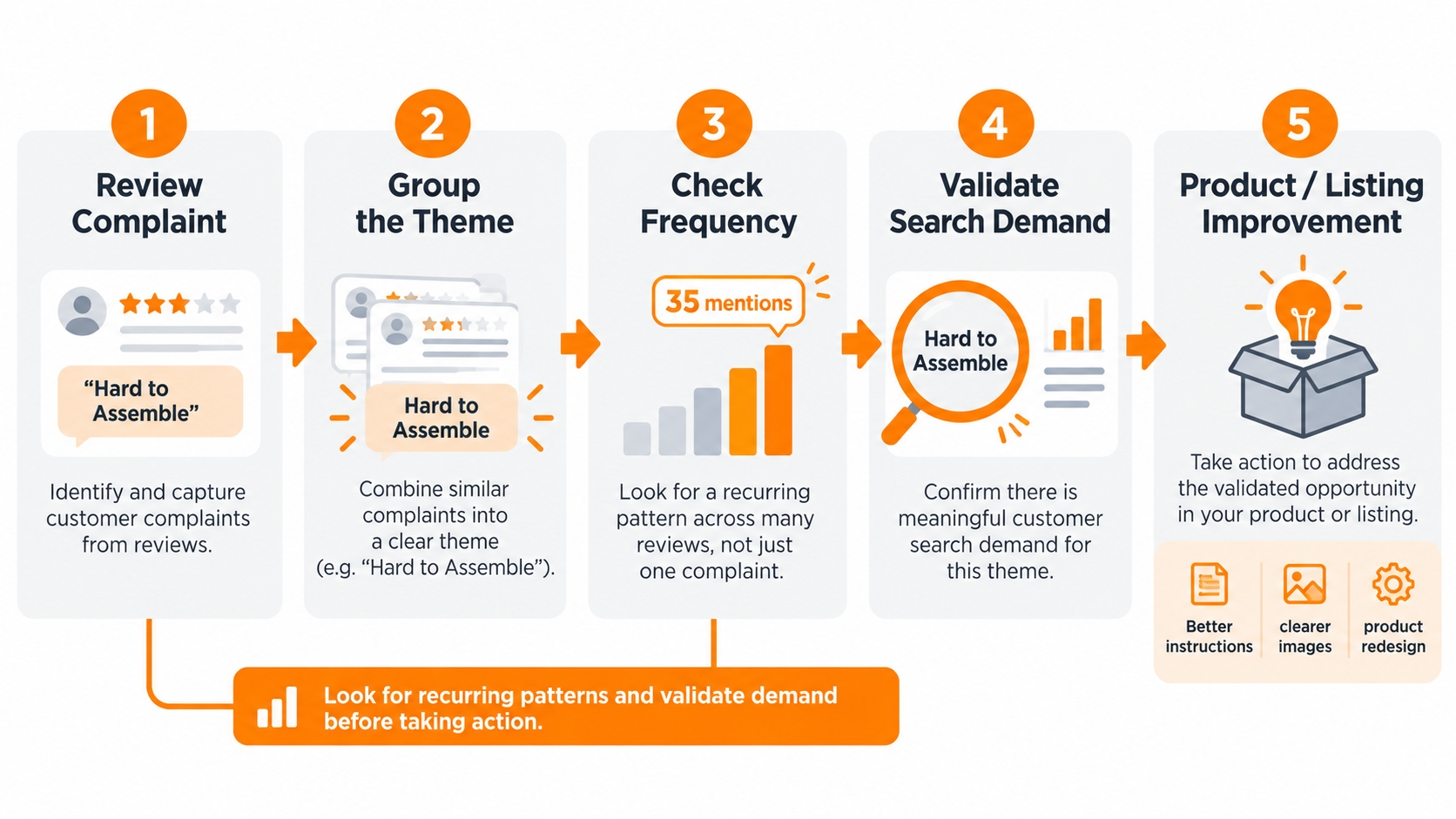
Instead of simply counting one-star reviews, group complaints into repeatable themes such as durability, sizing, assembly, instructions, packaging, comfort, compatibility, missing features, or expectation mismatch.
Then ask four questions:
- How frequent is the problem? One unusual complaint is different from a repeated pattern.
- Is the problem fixable? Some issues require redesign; others can be solved with clearer instructions or better listing expectations.
- Do customers actively search for the solution? A repeated complaint becomes more valuable when related keyword demand also exists.
- Can the improvement be communicated clearly? A feature only creates differentiation if customers understand why it matters.
A Practical Review and Testing Workflow
The most useful review workflow starts with customer evidence and ends with a measurable product or listing change. It does not start with the goal of obtaining a specific star rating.
Use the following sequence to keep product research, review monitoring, and compliance connected.
- Collect recent review evidence.
Review your own feedback and representative competitor reviews, focusing on recent and repeated themes. - Separate symptoms from root causes.
"Bad quality" may actually mean weak materials, poor packaging, unclear setup, or expectations that the listing failed to manage. - Prioritize recurring themes.
Focus on problems appearing across multiple reviews rather than redesigning a product around one exceptional complaint. - Validate market relevance.
Check competitor behavior, search demand, product positioning, price, and marketplace trends before investing in a fix. - Choose the correct intervention.
Decide whether the problem requires product development, packaging, instructions, listing content, customer support, or inventory changes. - Use compliant review mechanisms.
Keep review requests neutral and use current Amazon-approved mechanisms rather than rewards or selective requests. - Monitor what changes afterward.
Compare rating trends, review themes, BSR, product performance, and keyword movement after the intervention.
How SellerSprite Can Support the Workflow
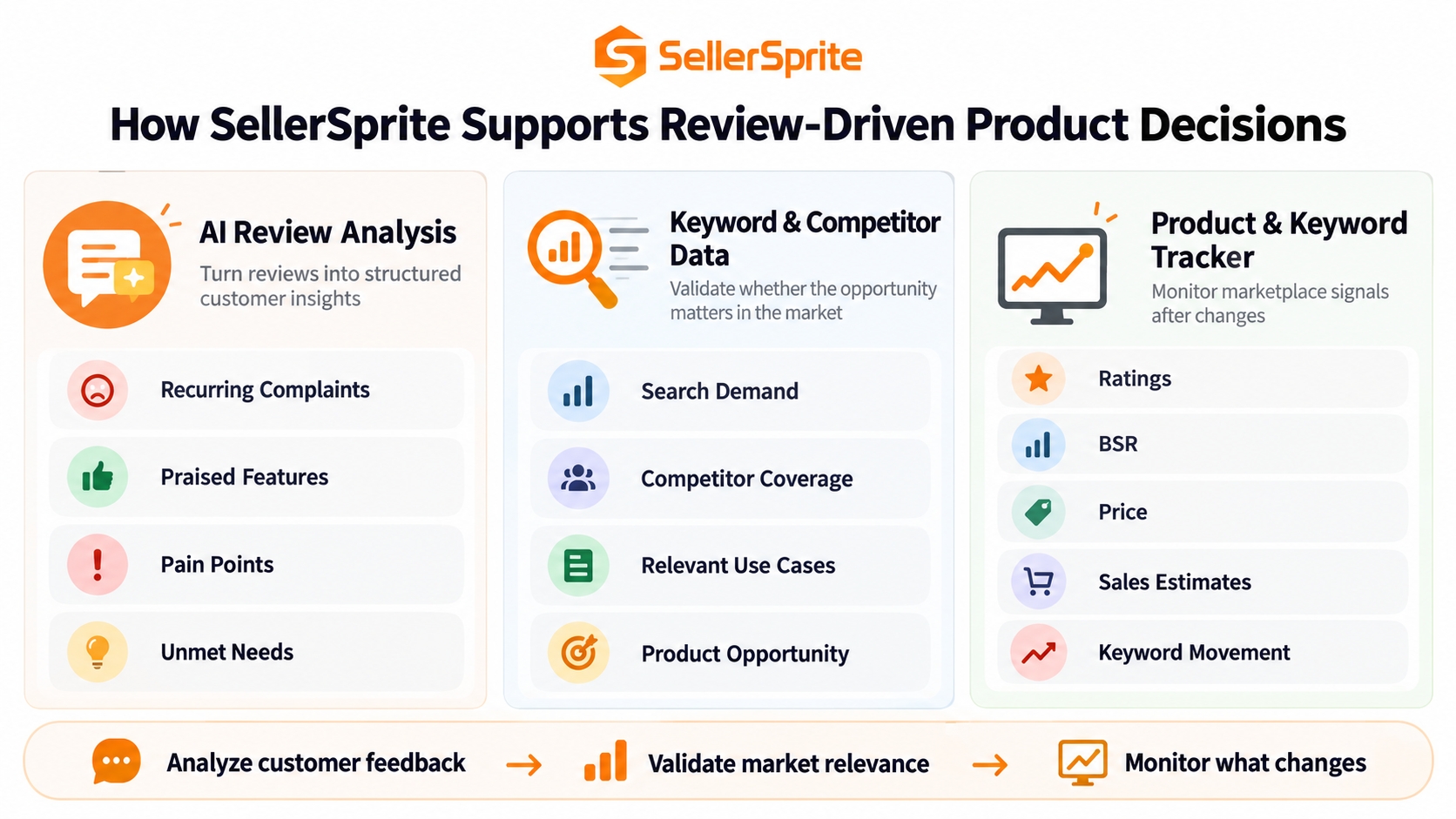
SellerSprite can support different stages of the review-analysis workflow, from identifying recurring customer feedback to validating whether a potential product improvement has broader marketplace relevance and monitoring what changes after action is taken.
Analyze Review Themes With AI Review Analysis
SellerSprite's AI Review Analysis can help organize large volumes of customer reviews into structured insights, including recurring complaints, praised features, customer pain points, unmet needs, and expectation gaps. This makes it easier to move beyond individual reviews and identify patterns that may deserve product, packaging, listing, or positioning changes.
Validate Whether the Opportunity Has Marketplace Demand
A repeated complaint does not automatically make a good product opportunity. Sellers can combine review insights with SellerSprite keyword and competitor data to check whether shoppers actively search for the desired feature, use case, or solution and whether competing ASINs already address that demand.
Monitor Product and Rating Movement Over Time
After changing the product, packaging, instructions, listing content, or positioning, use SellerSprite Product & Keyword Tracker to follow relevant signals such as ratings, BSR, price, sales estimates, and keyword movement over time. This helps sellers evaluate broader marketplace changes instead of judging an improvement from only a handful of new reviews.
Common Mistakes to Avoid
Review strategy becomes risky when sellers focus on the number of reviews rather than the integrity of the process that produces them. The same mistake can also make product research less useful by pushing teams to chase ratings instead of fixing the customer experience.
The following mistakes are especially important to avoid when product testing, review monitoring, and customer communication overlap.
Giving Free Products in Exchange for Amazon Reviews
A free product tied to a required Amazon review creates an incentivized-review problem. Using the word "honest" does not automatically make the arrangement compliant.
Offering Refunds, Discounts, or Gift Cards for Reviews
Compensation does not need to be cash to influence a review. Refunds, reimbursements, future benefits, discounts, products, gift cards, warranties, or services can create the same issue when they are conditioned on review activity.
Only Asking Happy Customers for Reviews
Selectively directing satisfied buyers toward Amazon while diverting dissatisfied customers elsewhere manipulates the review process and can create a misleading picture of customer experience.
Asking Customers to Change or Remove Negative Reviews
Customer support should focus on resolving the underlying issue, not negotiating the customer's rating. If a review violates Amazon's Community Guidelines, sellers can use the relevant reporting process rather than pressuring the reviewer.
Treating Average Rating as the Only Metric
A rating can improve while the same product problem continues appearing in new reviews. Read average rating together with recency, review themes, product versions, competitor feedback, sales movement, and customer expectations.
Copying a Competitor's Review Strategy
You usually cannot see the complete process behind another listing's review history. Copying inserts, outreach language, or off-Amazon tactics without checking current Amazon rules can create unnecessary account risk.
Compliance and Trust Checklist
- Do not pay, refund, discount, reimburse, or provide other benefits in exchange for an Amazon review.
- Do not require product testers to post an Amazon review.
- Do not ask specifically for positive reviews.
- Do not selectively ask only satisfied customers for Amazon reviews.
- Do not ask customers to change or remove reviews in return for support, compensation, or refunds.
- Use Amazon-provided review request mechanisms where appropriate.
- Use Amazon Vine only according to the program's current eligibility and participation rules.
- Recheck Amazon's current review, communication, and community policies before launching a new review-related process.
The Bottom Line
Amazon product review and testing opportunities can create real value for sellers, but only when the objective is learning rather than manipulating reputation.
Product testing can reveal usability and quality issues. Customer reviews can reveal expectation gaps. Competitor reviews can uncover differentiation opportunities. Amazon-approved review mechanisms can help legitimate buyers share their experiences.
The strongest strategy connects those insights back to the product itself: fix recurring problems, clarify the listing, improve packaging or instructions, monitor marketplace performance, and allow authentic customer feedback to reflect the result.
FAQs
What does Amazon product review and testing opportunities mean for sellers?
For sellers, it is best understood as a combination of compliant review management, customer-feedback analysis, product testing, and marketplace research. The objective should be improving the product and customer experience rather than generating a predetermined rating.
Can sellers give customers a free product for an Amazon review?
Sellers should not offer free products or other compensation in exchange for an Amazon review. Amazon's Community Guidelines prohibit compensated or incentivized reviews. Amazon Vine is a separate Amazon-operated program in which eligible products can be provided to invited Vine Voices under the program's rules.
Can a seller ask customers for an honest Amazon review?
Amazon provides mechanisms such as Request a Review for eligible orders. Sellers should avoid language that asks specifically for positive feedback, pressures customers, offers compensation, selectively targets satisfied buyers, or asks customers to change or remove an existing review.
What is Amazon Vine?
Amazon Vine is an Amazon program that allows eligible products to be provided to invited Vine Voices, who share honest and unbiased product opinions. Participation does not guarantee positive reviews, and sellers should check current eligibility and enrollment requirements before using the program.
Which review metrics matter most for Amazon sellers?
Useful signals include average rating, review count, review recency, review growth, recurring negative themes, competitor complaint patterns, BSR movement, price, inventory, and keyword visibility. Sellers should avoid making decisions from one metric in isolation.
How should sellers use negative reviews?
Negative reviews are most useful when grouped into recurring themes. Sellers can use those patterns to identify product defects, unclear instructions, packaging issues, feature gaps, listing expectation problems, or customer-support opportunities.
How can SellerSprite help with Amazon review strategy?
SellerSprite can help connect review observations with marketplace signals. Product and Keyword Tracker can monitor ratings, BSR, price, sales estimates, and keyword movement, while keyword and competitor research can help validate whether customer complaints or desired features also appear in marketplace search behavior.
How often should sellers review customer feedback?
There is no universal schedule. Review feedback more frequently after launches, product revisions, packaging changes, major promotions, or unusual rating movement. Stable products can be reviewed periodically, with additional attention when recurring negative themes emerge.
References
- Amazon Community Guidelines View
- Amazon Vine View
- Amazon Customer Reviews Tool View
- Amazon: How to Use Customer Reviews as a Growth Tool View
By SellerSprite Content Team
The SellerSprite Content Team combines Amazon marketplace research with practical data workflows to help sellers understand product demand, competition, keyword visibility, review health, customer feedback, and marketplace opportunities.
Last updated: September 24, 2026