GLOBAL SELLING / MARKET ENTRY
By SellerSprite Content Team | Reviewed October 31, 2026 | Primary market: United States
Vender en Amazon simply means "to sell on Amazon" in Spanish. The phrase sounds straightforward, but the business behind it can take several forms. A seller in Mexico may want to reach customers on Amazon.com. A US brand may be considering Amazon Mexico or Spain. Someone starting from scratch may simply be trying to understand what opening an Amazon seller account actually involves.
Those situations share a platform, not necessarily the same requirements. Registration, product eligibility, competition, fulfillment, taxes and customer expectations can change substantially depending on where the seller operates and where the buyer lives.
This guide focuses on the decisions that matter before the first meaningful inventory purchase. It covers the US marketplace as the main point of reference, with Mexico and Spain as useful examples of how cross-border selling changes the equation.
Short answer: To start selling on Amazon, choose your destination marketplace, register an eligible seller account, confirm that you can legally sell the product, validate local customer demand, calculate the complete cost of each sale, and select a fulfillment method you can operate reliably. Expanding internationally requires repeating these checks for each destination rather than assuming that one successful listing will work everywhere.
Key Takeaways
- Start with the destination store. Amazon.com, Amazon.com.mx and Amazon.es are distinct selling environments, even when account-management tools connect them.
- Account approval is not product approval. Category eligibility, intellectual property rights, safety documentation and applicable national requirements still need to be checked.
- Research local shoppers, not just translated keywords. Search demand, competitor maturity, product expectations and price tolerance should be assessed separately for each marketplace.
- Calculate contribution margin before ordering inventory. Selling fees, fulfillment, imports, advertising, returns and currency conversion can materially change the economics.
- Test one manageable opportunity first. A small, measurable launch is more informative than committing inventory to multiple countries based on assumptions.
Table of Contents
- What Does Vender en Amazon Actually Mean?
- Choose Where You Want to Sell
- Register Your Account and Check Eligibility
- Find a Product Opportunity in the Local Market
- Calculate What Each Sale Will Actually Earn
- Plan Fulfillment and Localize Your Offer
- Build a Controlled First-Month Launch
- Where SellerSprite Fits Into the Research
- The Right Market Is the One Your Business Can Actually Serve
- FAQs
- References
What Does Vender en Amazon Actually Mean?
In practical terms, vender en Amazon means becoming a third-party seller who offers products through an Amazon marketplace. Amazon provides the storefront infrastructure, while the seller remains responsible for the commercial and operational decisions associated with the products.
These decisions include sourcing, pricing, listing accuracy, product compliance, inventory, and the costs that sit behind each order. Amazon offers fulfillment and advertising services, but using those services does not eliminate the seller's underlying responsibilities.
Selling to the US and selling from the US are different projects
Consider two businesses:
SCENARIO A
A Mexico-based business wants to sell on Amazon.com
Its primary questions concern eligibility to register, selling to US customers, import arrangements, competitive US pricing, fulfillment, and receiving payments.
SCENARIO B
A US brand wants to sell on Amazon.es
It must assess Spanish shopper demand, European account requirements, applicable VAT obligations, product regulations, translated content, and a suitable fulfillment arrangement.
Both are examples of international Amazon selling, but their operational questions are not interchangeable.
The keyword itself is not proof of product demand
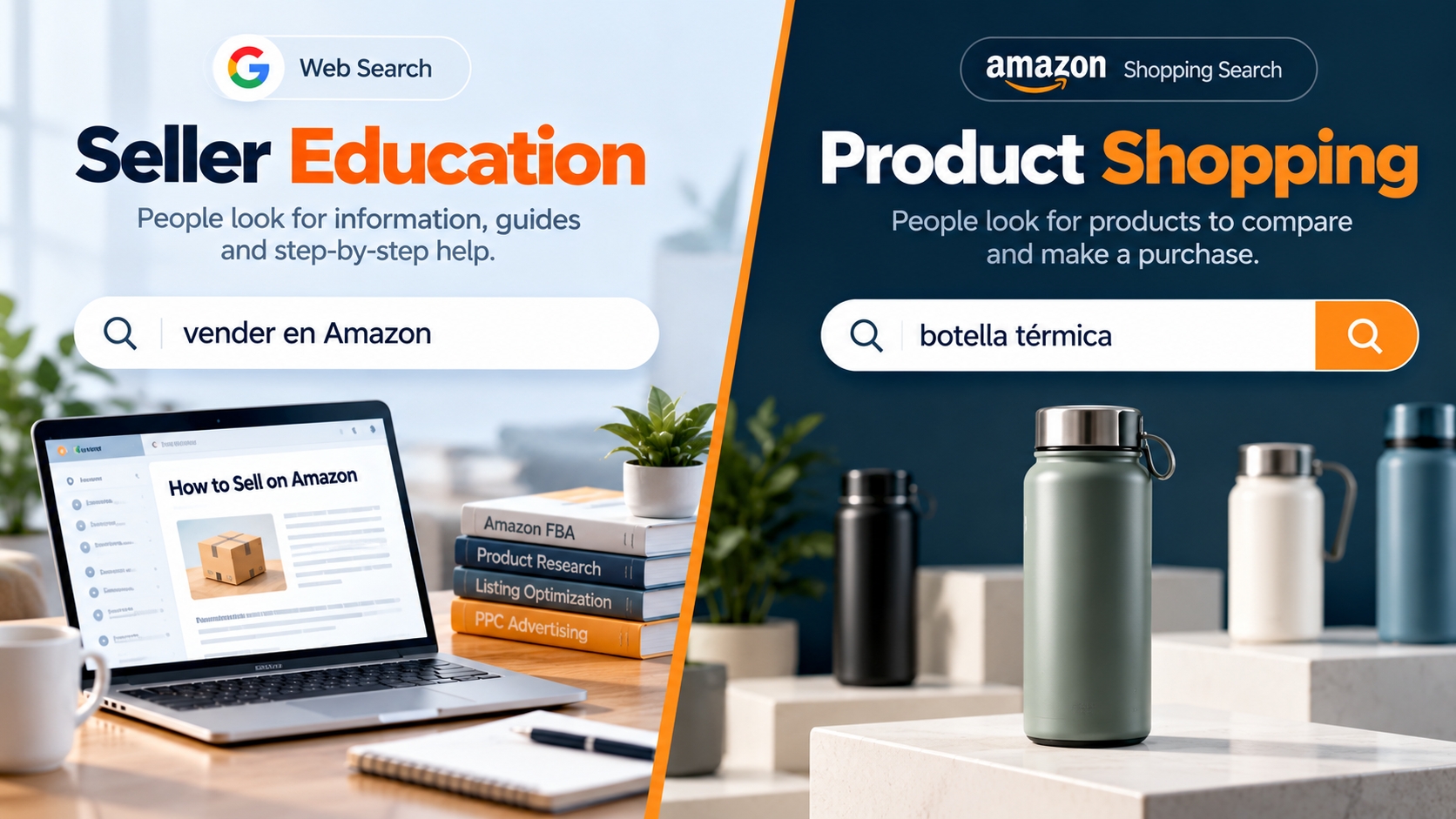
There is an important distinction between someone searching Google for "vender en Amazon" and someone searching Amazon for a particular product.
The first search usually reflects an interest in becoming a seller. The second may reveal shopping intent for a product. Search volume for a seller-education topic should never be treated as evidence that customers are ready to buy a particular ASIN.
Keeping these two forms of demand separate is essential. Otherwise, a seller may mistake interest in Amazon entrepreneurship for an actual product opportunity.
Choose Where You Want to Sell Before Choosing What to Sell
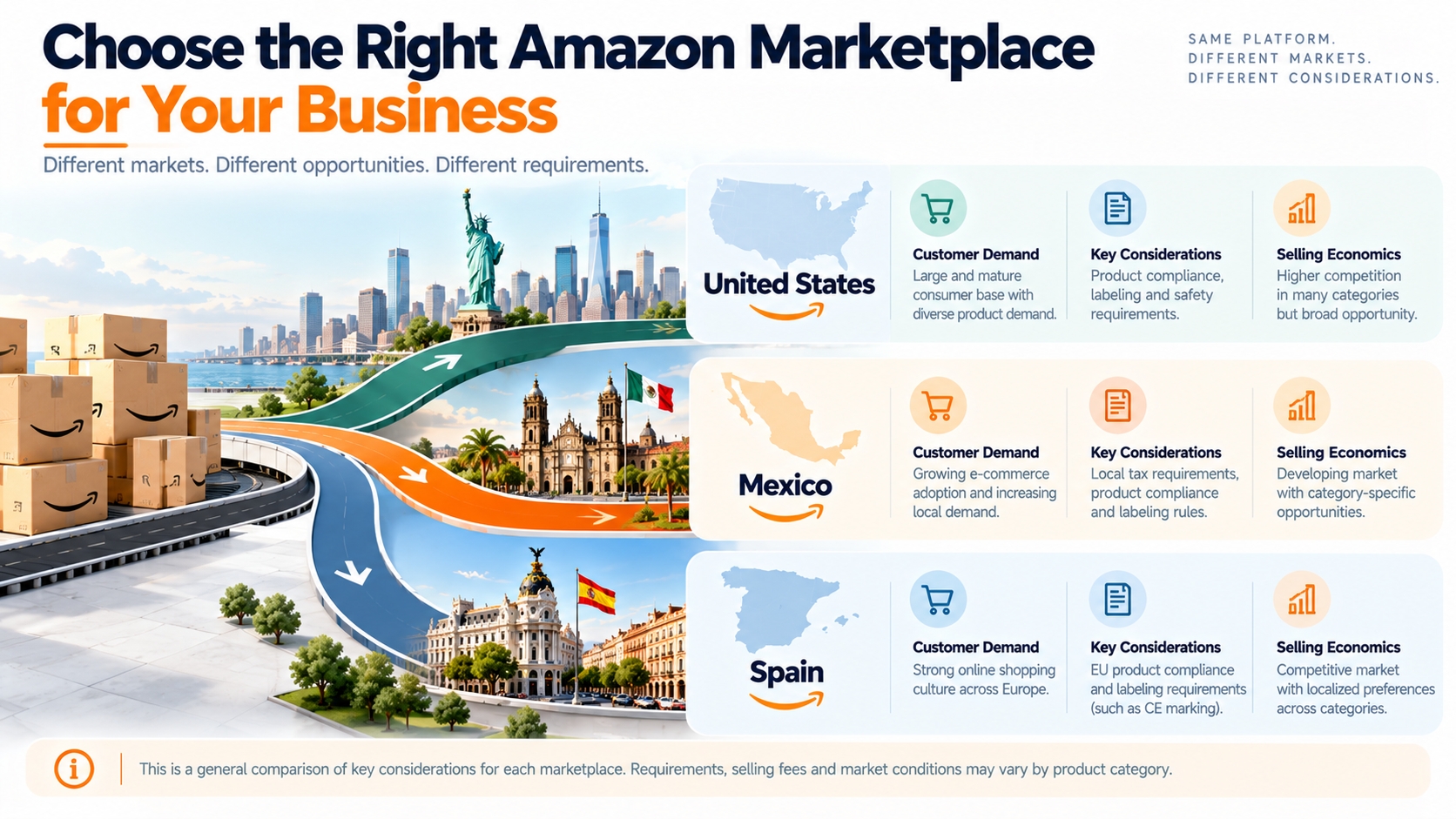
Amazon has tools for managing international expansion, but every destination market has its own buying patterns, product requirements and operating costs. The first decision is therefore which marketplace deserves your attention.
| Marketplace | Typical objective | Account considerations | What needs local verification |
|---|---|---|---|
| Amazon.com United States | Reach US customers from within or outside the country | North America and Brazil unified selling account | US product eligibility, import costs, USD pricing and fulfillment |
| Amazon.com.mx Mexico | Reach Mexican customers or expand from the US | Supported within Amazon's North America and Brazil unified selling account structure. | Mexican tax and import requirements, local prices, Spanish content and delivery |
| Amazon.es Spain | Reach customers in Spain through Amazon's European selling infrastructure | European selling account and applicable regional arrangements | VAT, EU product compliance, Spanish localization and EUR-based economics |
Account structures are based on Amazon's public Global Selling documentation reviewed in October 2026. Availability of particular services, account permissions and fee arrangements must be confirmed for the seller's actual circumstances.
A larger market is not automatically a better first market
Amazon.com offers access to a large US customer base, but that does not make every product opportunity attractive. Some categories are crowded with established brands, substantial review histories and aggressive advertising.
A smaller destination marketplace may have fewer competitors in a particular niche, but could also have less demand, different consumer preferences or higher costs relative to the achievable selling price.
The useful question is not simply where Amazon has the most customers. It is where your specific product has enough validated demand, an achievable competitive position and a workable fulfillment and compliance model.
Register Your Seller Account, Then Confirm What You Can Sell
Seller registration is the administrative starting point. It establishes who is operating the business and provides access to Amazon Seller Central, where sellers manage listings, orders, inventory and account settings.
Before registering, decide which selling plan and account region fit your intended operation. Prepare consistent, verifiable information rather than opening accounts before the business details are settled.
Understand the Individual and Professional plans
For the US store, Amazon publicly lists two standard selling plans. As of the October 2026 editorial review, the Individual plan costs $0.99 per item sold, while the Professional plan costs $39.99 per month. Applicable referral fees and other selling costs are additional.
INDIVIDUAL
$0.99 per unit sold
May suit lower-volume or exploratory selling when advanced account features are not needed.
PROFESSIONAL
$39.99 per month
Provides additional capabilities such as bulk listing tools and access to eligible advertising and business programs.
These are US selling-plan prices, not universal prices for every Amazon marketplace. Plans, eligibility and applicable charges should be confirmed on Amazon's current pricing pages.
What you generally need for registration
Amazon's registration process involves business and seller details, billing information, store information and identity verification. Depending on the applicant's circumstances, preparation generally includes:
- Accurate personal and business identification details.
- A valid government-issued identity document.
- Proof of residential or business address where required.
- Accepted payment-card and bank-account information.
- Relevant tax information and business registration documents, where applicable.
- Information about the products and brands you intend to sell.
Amazon allows eligible individuals to register without first establishing an LLC or other incorporated business. It also supports receiving US selling proceeds through certain non-US bank accounts using supported payment arrangements. Neither point removes tax, legal or identity-verification obligations.
For the current sequence of verification steps and document requirements, consult Amazon's official seller registration guide before submitting your application.
An approved account does not make every product eligible
A seller can complete registration and still discover that a product requires additional approval, documentation or changes before listing. The restrictions may relate to the category, brand, manufacturing standards, safety, labeling or local regulations.
Before committing inventory, establish four things:
- Listing permission: Can your account offer this specific product, brand and category?
- Source legitimacy: Can you substantiate where the goods came from and your right to sell them?
- Product compliance: Are the required safety, labeling, testing and other documents available for the destination market?
- Import readiness: If inventory crosses a border, who is responsible for customs, duties, documentation and delivery?
A product that cannot pass these checks is not a viable opportunity, regardless of its apparent sales volume or competitor performance.
Find a Product Opportunity That Works in the Local Market
Once account and product eligibility look realistic, the next question is whether local shoppers want the product at a price that supports the business. This requires more than checking a best-seller list or translating a successful US listing.
Start with how customers describe the product, then examine what they are actually buying and which competitors satisfy that demand.
Research the language shoppers use, not a literal translation
Consider a seller researching insulated drinkware. "Insulated water bottle" may be a useful starting phrase in the US. Spanish-language seed terms could include "botella térmica" or "botella de agua térmica," depending on the destination market and product.
These are illustrative research terms, not verified high-volume keywords. The seller still needs to check which variations local shoppers use, how the resulting products differ and whether those searches represent the intended product.
Examine the products already winning customer attention
A useful competitor review goes beyond identifying the top-selling ASINs. Examine a manageable sample of relevant listings, then compare the following evidence:
- Price positioning. Identify the range customers encounter for genuinely comparable products. Separate budget products from premium offers rather than averaging them together.
- Review maturity. Look at review counts, rating patterns and recent customer complaints. A high review count indicates an established listing but does not reveal whether a newer offer can compete.
- Product differentiation. Compare materials, sizes, features, packaging, warranties and use cases. Ask what the buyer is paying extra to receive.
- Search visibility. Distinguish organic placement from Sponsored Products advertising. Paid visibility should not be mistaken for proven organic ranking strength.
- Demand consistency. Review historical price, estimated sales and Best Sellers Rank (BSR) trends where reliable data is available. A short sales spike may reflect a promotion or seasonal event.
- Offer-level competition. Check whether the product is controlled by a single brand, sold by multiple merchants, or subject to brand authorization and sourcing constraints.
Read the metrics together
High search volume does not guarantee profitable demand. A low review count does not automatically indicate weak competition. BSR is a category-relative ranking signal, not a direct report of units sold.
A credible market assessment asks whether several independent signals tell a consistent story. For example, relevant local search terms, stable product demand, meaningful customer complaints and an achievable price point may collectively support a test.
A useful research stopping point
Stop collecting more competitor data when the remaining uncertainty is something that only a real test, supplier quotation or compliance review can resolve. Research should narrow the decision, not postpone it indefinitely.
Calculate What Each Sale Will Actually Earn
A product can have attractive demand, competitive differentiation and steady orders while producing less profit than expected. Cross-border selling adds expenses that are easy to miss when calculations focus only on purchase cost and Amazon referral fees.
Before investing in inventory, calculate the expected contribution from one sale using the destination marketplace's prices and cost assumptions.
UNIT ECONOMICS
Contribution per unit = Selling price - Product cost - Marketplace fees - Fulfillment - Inbound costs - Advertising - Returns and other variable costs
A worked example for a hypothetical US listing
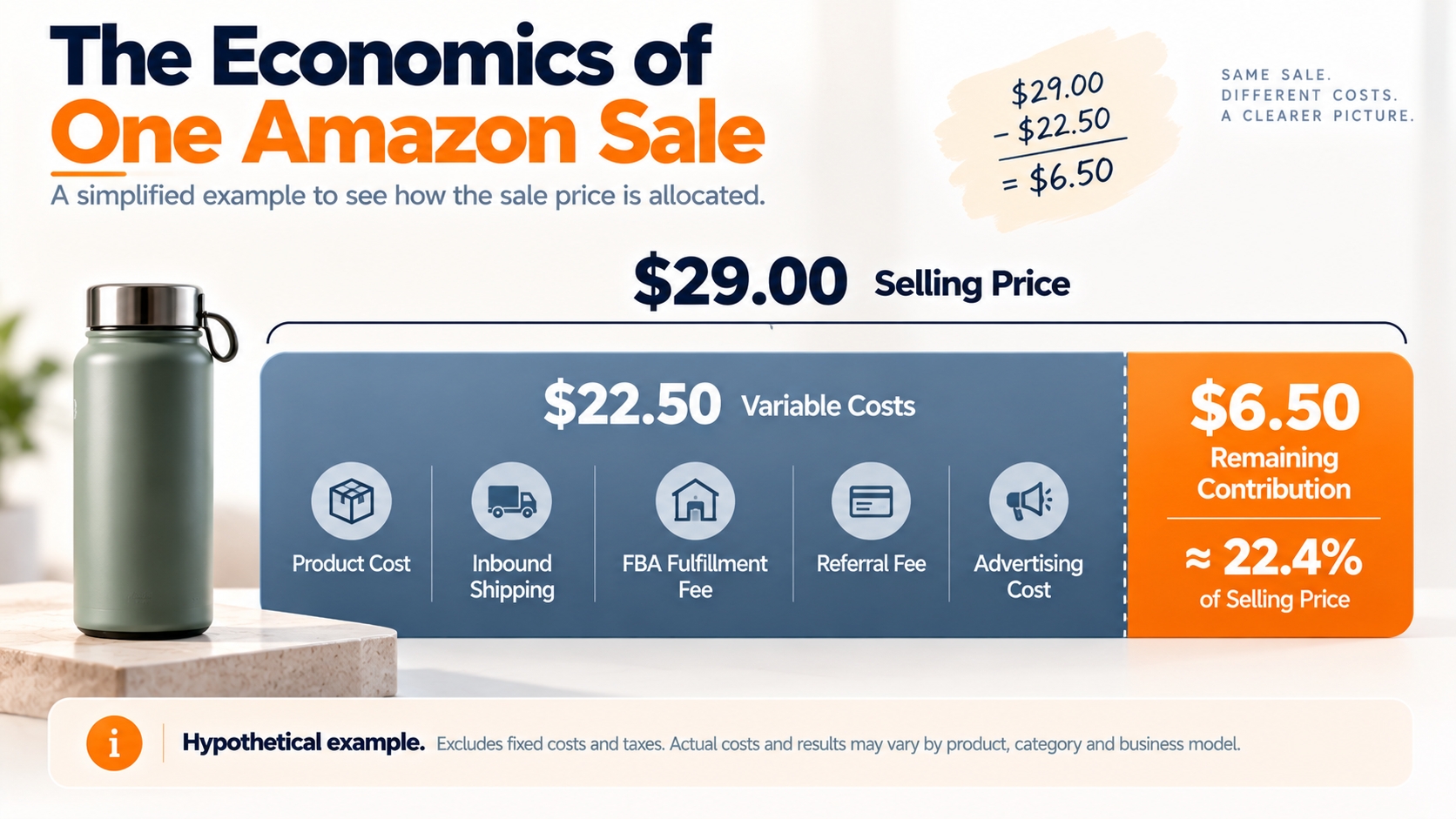
Suppose an imported product is offered on Amazon.com for $29.00. The seller plans to use FBA and allocate part of the selling price to advertising.
The following numbers are illustrative assumptions, not live Amazon fee quotes or the economics of a real ASIN.
| Item | Assumption | Per unit |
|---|---|---|
| Selling price | Customer-facing product price | $29.00 |
| Product cost | Product and packaging | -$7.50 |
| Referral fee | Illustrative 15% of selling price | -$4.35 |
| FBA fulfillment | Illustrative estimated fee | -$4.80 |
| Inbound and import costs | Allocated freight and import expenses | -$1.20 |
| Storage and returns | Estimated per-unit allowance | -$1.30 |
| Advertising | Allocated Sponsored Products spend | -$3.00 |
| Other variable costs | Illustrative currency conversion and miscellaneous expenses | -$0.35 |
| Contribution per unit | Before fixed overhead, subscription allocation and applicable taxes | $6.50 |
In this hypothetical example, the product produces a $6.50 contribution per sale, equivalent to approximately 22.4% of the selling price. This is not net profit. It excludes fixed business overhead, selling-plan subscription allocation and applicable income taxes. Additional costs or different tax treatment could reduce the result.
Stress-test the margin before ordering stock
A single optimistic calculation is not enough. Re-run the model against conditions that could realistically affect the product:
- Lower selling price: What happens if an established competitor reduces its price or you need to discount?
- Higher acquisition cost: How much contribution remains if advertising becomes more expensive?
- Slower inventory turnover: Can the margin absorb additional storage costs and delayed capital recovery?
- Cross-border cost changes: What if freight, duties, currency conversion or local tax treatment differ from the initial assumptions?
For marketplaces where VAT applies, carefully distinguish tax-inclusive customer prices from revenue available to cover business costs. Consult a qualified local professional for the correct tax treatment. Use current Amazon fee estimates and actual supplier or logistics quotations whenever possible.
Fulfillment and Localization Are Part of the Product Offer
Customers do not evaluate a product solely by its specifications. Delivery reliability, clear information, returns and post-purchase support influence whether the offer is competitive.
These expectations become more complicated when the seller and customer are located in different countries.
Choose FBA or FBM based on operating fit
Fulfillment by Amazon (FBA) lets eligible sellers use Amazon's fulfillment network for storage, order processing, shipping and associated customer service and returns. It can reduce day-to-day fulfillment work, but involves fulfillment fees, inventory requirements and potentially additional storage or inbound charges.
Fulfilled by Merchant (FBM) means the seller manages fulfillment directly or through a logistics partner. This offers more control over inventory and delivery operations, but also creates responsibilities for shipping performance, customer service and returns.
Neither arrangement is universally cheaper. Product dimensions, order volume, return frequency, storage time, warehouse location and customer-service capacity can change the answer. For a more detailed decision framework, see SellerSprite's FBA and FBM cost comparison.
Cross-listing does not eliminate local responsibilities
Amazon provides international listing tools that can help sellers replicate product information across stores and, in some situations, translate or synchronize listing information and prices.
However, a translated listing is not necessarily an effective local offer. Sellers should manually review the details customers rely on when deciding whether to purchase.
Local listing review
- Use product terminology that local buyers recognize, rather than mechanically translated keywords.
- Verify measurements, sizing conventions, compatibility information and included accessories.
- Ensure imagery accurately represents the product and its intended use.
- Review safety claims, labeling, manuals and mandatory disclosures for the destination market.
- Confirm delivery promises, return arrangements, customer support and warranty descriptions.
- Ensure pricing and currency conversion rules preserve the intended economics.
An offer can appear attractive in the original marketplace but become confusing or uncompetitive after localization. The goal is not merely to make the listing readable in another language. It is to make the product and customer promise accurate for that market.
Build a Controlled First-Month Launch
A first launch should answer a specific question, such as whether the product can attract relevant shoppers and generate acceptable contribution at the expected price.
Avoid expanding into several markets simultaneously unless the business already has the resources to monitor each one independently. A controlled test creates more useful evidence and makes operational problems easier to isolate.
BEFORE LAUNCH
Set the conditions for a valid test
Confirm seller and product eligibility, record the cost assumptions, choose a limited test quantity, prepare accurate listings and verify fulfillment readiness.
Write down the minimum contribution and operational standards that would justify continuing.
INITIAL SELLING PERIOD
Observe what customers actually do
Track offer availability, real selling price, order volume, returns, customer questions and advertising performance if ads are being used.
Record whether meaningful search terms are producing qualified traffic. Do not treat initial BSR movement or a small number of orders as definitive evidence of long-term demand.
FIRST REVIEW POINT
Choose scale, revise or pause
Compare observed demand, contribution, fulfillment reliability and customer feedback with the original expectations.
Scale when the evidence supports additional inventory. Revise when a specific listing, price or operational issue can be corrected. Pause when compliance, economics or demand remain unfavorable.
The first month is a suggested operational review window, not an Amazon requirement or a guaranteed period for reaching reliable conclusions. Slow-moving, seasonal or newly launched products may require a longer observation period.
Keep a record that separates assumptions from results
A simple decision record should retain the marketplace, ASIN or SKU, research period, initial selling price, fee estimates, product costs, advertising assumptions, measured results and the next decision date.
This prevents the team from rewriting its original expectations after seeing the outcome. It also makes a later comparison between the US, Mexico or Spain more meaningful because each market can be evaluated on documented assumptions.
Where SellerSprite Fits Into the Research
Marketplace research is one of the stages where specialized data tools can reduce manual work. SellerSprite can help sellers examine product demand, keyword behavior and competitor patterns in supported Amazon marketplaces.
The important starting point is selecting the actual destination marketplace and research period. US keyword results should not be treated as a substitute for Spanish-market research, and one market's competitor estimates should not be projected mechanically into another.
A focused research sequence
- Start with Product Research. Select a supported marketplace and examine relevant product listings, competition patterns, pricing and available historical signals. Use these results to shortlist products for closer inspection.
- Move to Keyword Research. Select the correct marketplace and time period, then investigate product-related queries, search demand and competitive context. Keep local buyer terminology separate from literal translations.
- Inspect competitor ASINs. Use Reverse ASIN or other applicable competitor-research tools to understand the keywords associated with relevant listings, rather than copying competitor content indiscriminately.
- Investigate customer concerns. Where supported, review customer feedback and recurring complaints to identify product expectations, quality issues and potential differentiation opportunities.
- Monitor a short list. Use available tracking tools to observe changes in product and keyword performance, while continuing to validate critical commercial decisions against actual orders and costs.
SellerSprite supports its full range of tools across 10 Amazon marketplaces: the US, Japan, UK, France, Germany, Italy, Spain, Canada, India, and Mexico. This includes all three markets discussed in this article: the US, Mexico, and Spain. Selected features are also available in additional Amazon marketplaces.
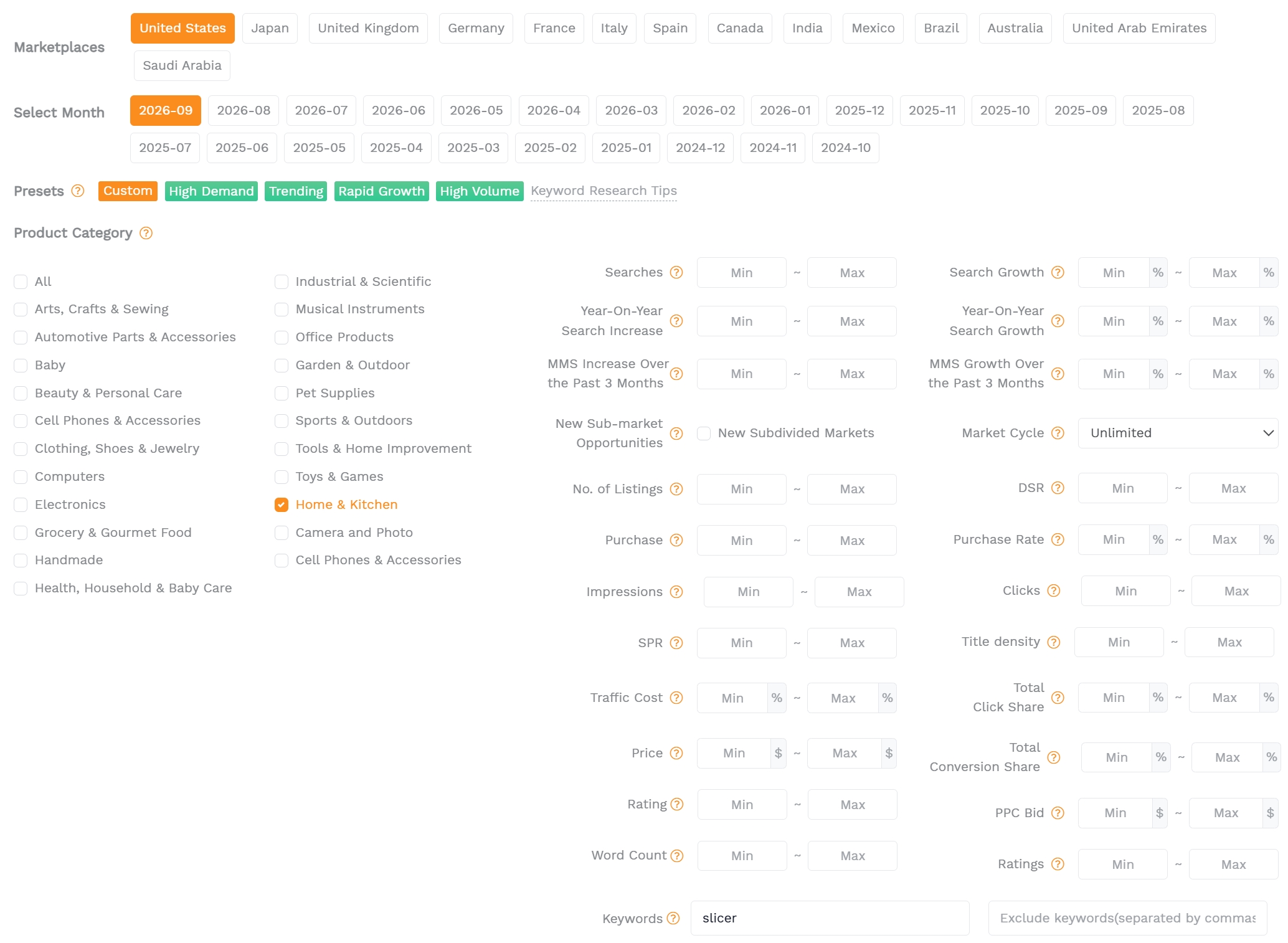
Once a product moves toward listing preparation, the keyword findings can help organize the title, product details and supporting search terms. SellerSprite's article on Amazon keyword mining for listings explains how sellers can translate research into relevant listing terminology.
Research software cannot authorize product sales, establish tax compliance or guarantee profitable demand. Its value is in helping sellers organize and evaluate market evidence before committing more resources.
The Right Market Is the One Your Business Can Actually Serve
Vender en Amazon is often presented as a straightforward progression from account registration to product listings and sales. In practice, the difficult decisions happen before the first order: identifying the right market, determining whether the product is eligible, understanding local competition and making sure the expected price can support all the costs involved.
International expansion adds another layer. A product that succeeds in one country has earned consideration in another, but not automatic approval. Differences in language, regulation, fulfillment and customer preferences can change both its commercial appeal and its operating risks.
A sensible next move is to select one destination, identify a small group of realistic product opportunities and document the evidence needed to approve or reject each one. The objective is not to enter every Amazon marketplace quickly. It is to build a repeatable selling operation that can withstand a more demanding review than the initial product idea.
FAQs
What does "vender en Amazon" mean?
"Vender en Amazon" is Spanish for "to sell on Amazon." It generally refers to becoming an Amazon seller, listing products and managing sales through an Amazon marketplace. It is not the name of a separate Amazon selling program or research feature.
Can I sell on Amazon.com if I live outside the United States?
Yes, eligible businesses and individuals based outside the US can register to sell to customers on Amazon.com. Registration requirements, supported countries, product eligibility, identity verification, taxes and cross-border fulfillment arrangements must still be confirmed for the specific seller.
Do I need a US LLC or US bank account to start selling?
Amazon does not generally require sellers to form an LLC to register for the US store. Eligible individuals can register in their own name. A US bank account is also not universally required because Amazon supports certain international disbursement arrangements. However, sellers must independently meet applicable business, tax, banking and verification requirements.
Can I use the same Amazon seller account for the US, Mexico and Spain?
Amazon's North America and Brazil unified selling account supports selling across the US, Canada, Mexico and Brazil, subject to applicable requirements. Selling in Spain generally involves Amazon's European account structure. Access to a regional account does not mean that every product is automatically eligible to sell in each country.
How much does it cost to start selling on Amazon?
For the US store, Amazon listed an Individual selling plan at $0.99 per item sold and a Professional plan at $39.99 per month at the time of this review. Additional costs can include referral fees, fulfillment, inventory, storage, advertising, returns and optional services. The total investment depends on the product and business model, and fees should be checked against current official rates.
Can I translate my US listing and sell the same product in Spain or Mexico?
Translation alone is not sufficient. Sellers need to review local keyword relevance, product requirements, labeling, customer expectations, pricing, taxation, fulfillment and returns. The destination marketplace may also impose different category or product eligibility rules.
What should I research before choosing a product to sell internationally?
Prioritize product eligibility, local keyword demand, the quality and maturity of competing listings, realistic selling prices, customer expectations and total landed costs. Historical sales and BSR trends can provide additional context, but no single marketplace metric is sufficient to confirm a viable opportunity.
How can SellerSprite help with international Amazon selling?
In supported 14 marketplaces, SellerSprite can help sellers research products, examine keyword demand, compare competitors and monitor selected market signals. Available features and country coverage vary by tool. SellerSprite provides research support rather than account approval, legal advice or guaranteed sales forecasts.
References
- Amazon: How to Sell on Amazon (Spanish). View
- Amazon: Seller Registration Guide. View
- Amazon: Global Selling. View
- Amazon: How to Sell to the US From Another Country. View
- Amazon: How to Sell Globally From the US. View
- Amazon: Selling Fees and Pricing. View
- Amazon: Fulfillment by Amazon. View
- SellerSprite: Amazon Keyword Research: New User Guide. View
Source and accuracy note: Public documentation was reviewed on October 31, 2026. Amazon may change fees, regional programs, account requirements and product policies. The financial example and operational testing framework are illustrative, not reports of actual seller performance. Country-specific tax and regulatory questions should be verified with authoritative local sources or qualified advisers.
ABOUT THE AUTHOR
SellerSprite Content Team
We develop educational resources informed by Amazon product research, keyword intelligence and marketplace analysis workflows. The coverage examines how sellers can interpret competitive data, identify meaningful changes in customer search behavior and distinguish measurable market signals from assumptions.
Across international selling topics, our editorial approach emphasizes source transparency and the limits of available data. Market estimates are treated as research inputs, while account eligibility, regulations, taxes and other binding requirements are checked against primary documentation rather than inferred from software metrics.