TL;DR: Effective Amazon advertising and PPC strategies connect a relevant product to a specific buying decision at a cost the order can support. Start with product fit and a researched keyword or ASIN list. Give discovery, brand defense, competitor targeting, and specific-use-case searches distinct objectives. Set bids from your economics, use search term reports to improve targeting, and evaluate results after allowing for attribution delays. A lower account-wide ACOS is useful only when you understand which traffic produced it.
Key Takeaways
- Research produces candidates, not guaranteed winners. A competitor appearing for a keyword does not reveal its actual CPC, conversion rate, or profitability.
- Suggested bids are market guidance, not your spending limit. Work backward from the contribution available per order and a realistic conversion assumption.
- Match the intervention to the problem. Irrelevant searches need exclusions. Relevant but expensive traffic may need a bid, placement, or offer adjustment.
- Keep brand defense separate from customer acquisition. Efficient branded traffic can make the account average look healthy while non-brand campaigns remain expensive.
Table of Contents
- Start with the Product and the Buying Decision
- Work Backward from the Order, Not the Suggested Bid
- Research Targets Without Copying a Competitor's Campaign
- Give Launch, Defense, Conquest, and Long-Tail Tests Different Jobs
- Let Discovery Feed Manual Campaigns
- A Higher Bid and a Bigger Budget Solve Different Problems
- The Search Term Report Is Where Strategy Gets Specific
- Do Not Let Branded Sales Hide Expensive Acquisition
- What to Change This Week
- Put the Next Dollar Where the Evidence Is Strongest
- FAQs
- References
Scope: This guide centers on Sponsored Products campaigns for Amazon US sellers. Sponsored Brands and Display have additional billing, targeting, and measurement considerations. Campaign structures and test procedures below are operating recommendations, not Amazon-mandated settings. All numerical examples are hypothetical.
Start with the Product and the Buying Decision
A seller advertising a clamp-on cable tray is not trying to reach everyone searching for office accessories. The useful prospect has a desk, needs cable storage, and wants a mounting method the product actually supports. That distinction should shape the target list before the first bid is entered.
Sponsored Products are cost-per-click ads for individual products. They can appear in Amazon shopping results, on product pages, and in supported external placements, with clicks leading to the product detail page. Product availability and advertising eligibility therefore matter before campaign optimization begins.
Choose the ad format for the job
Sponsored Products suits the individual-product tests in this guide. Sponsored Brands can introduce a brand or product collection through creative formats and Store or detail-page destinations. Display campaigns offer other audience and placement options. Do not treat all Amazon advertising as PPC: billing can depend on clicks, viewable impressions, or the selected campaign arrangement.
Check the offer before paying for more visitors
Confirm advertising eligibility, stock availability, Featured Offer status where applicable, a competitive delivered price, and accurate product information. Amazon's own preparation guidance emphasizes the detail page and the offer, not just campaign settings.
For the cable tray, that means showing the mounting method, dimensions, included hardware, and desk compatibility. Buying more traffic will not resolve an unclear fit claim. Do not add unsupported features to the listing merely because a high-volume keyword mentions them.
Work Backward from the Order, Not the Suggested Bid
A suggested bid describes auction conditions. Your affordable click price depends on what an order leaves after its other costs and how often a click becomes a purchase.
Amazon defines advertising cost of sales, or ACOS, as ad spend divided by ad-attributed sales. ROAS reverses that calculation. Neither metric includes every cost of supplying the product, so an attractive ROAS is not automatically a profitable order.
ACOS = ad spend ÷ ad-attributed sales × 100
ROAS = ad-attributed sales ÷ ad spend
Planning CPC ceiling = allowable advertising cost per purchase × expected purchases per click
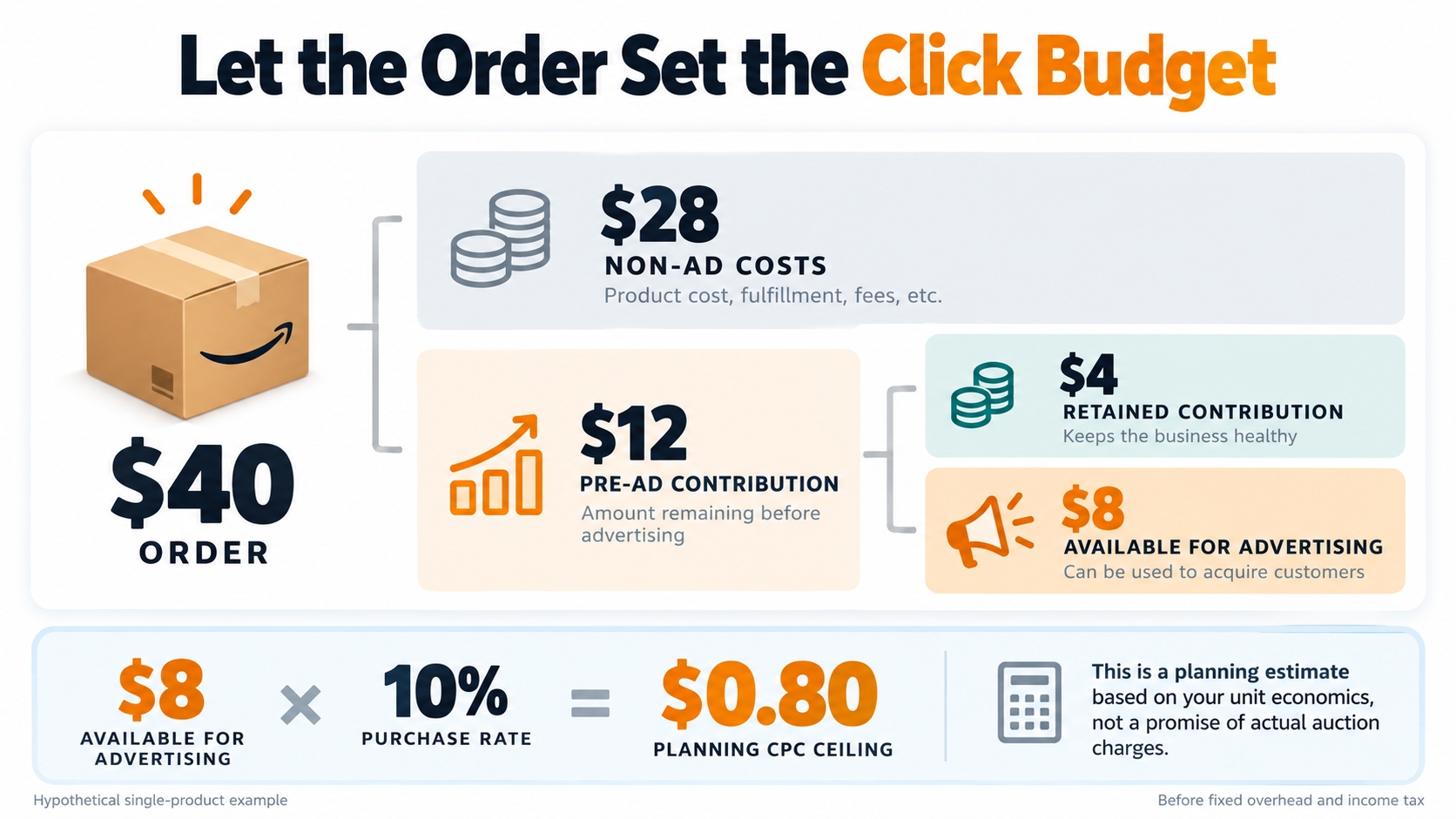
A $40 order does not give you $40 to acquire the buyer
Assume a $40 sale leaves $12 after $28 in product, fulfillment, selling, and expected post-sale costs, but before advertising. To retain $4 contribution, the seller can spend $8 to acquire that purchase.
That gives a 20% target ACOS and 5.0 ROAS. At a 10% purchase rate, the planning CPC ceiling is $0.80. The advertising break-even point is 30% ACOS, or $1.20 per click under the same conversion assumption, leaving nothing toward fixed overhead.
These assumptions describe one unit per purchase, one selling price, and sales of the advertised product only. Actual reports can include other purchased products, so do not apply one ASIN's margin to a different sales mix.
If the purchase rate falls to 5%, the $0.80 ceiling becomes $0.40. Use a measured rate from a comparable traffic segment when available; marketplace-wide purchase data is not your own advertising conversion rate.
Treat suggested bids as a feasibility check
Amazon's suggested bids use recent winning-bid information for similar ads. They can help you assess auction competitiveness, but they do not know your acceptable margin.
When the market appears too expensive, investigate a better-fitting query, a different placement, stronger conversion, or better product economics. Raising the bid to match a recommendation does not solve the gap.
Research Targets Without Copying a Competitor's Campaign
Start with the customer's task, then find products that genuinely compete for that purchase. A clamp-on tray, a screw-mounted tray, and a pack of cable ties may appear in related searches, but they do not solve the problem in the same way.
Select a small set of comparable ASINs and record the reason each belongs. Check the exact variation, mounting method, price range, capacity, and delivery offer. A broad category bestseller is not automatically the best advertising reference.
Use Reverse ASIN to separate organic and sponsored visibility
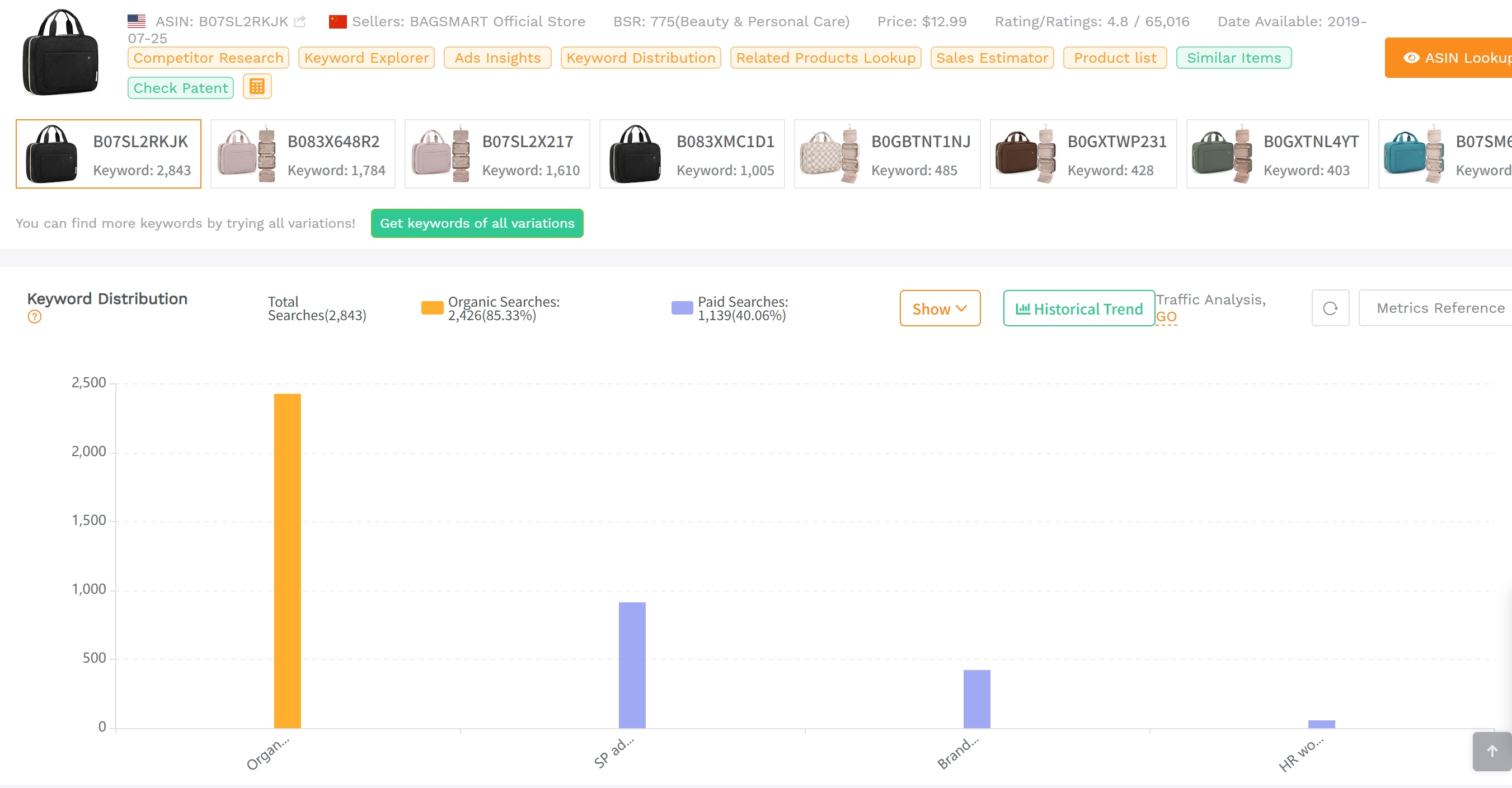
SellerSprite Reverse ASIN provides keyword and traffic information associated with a selected ASIN, including organic and sponsored visibility and variation-specific analysis. Compare relevant competitors to identify recurring search terms and differences in how they appear.
Label candidates as observed organically, observed in sponsored placements, or observed in both. A term with sponsored visibility but no observed organic presence deserves investigation; it is not proof of an "ad-only" strategy across all dates and placements. None of these observations reveals a competitor's actual ACOS.
Use Keyword Research to check demand and the likely cost of testing
Select the United States marketplace and a consistent period in SellerSprite Keyword Research. Examine search volume, growth, purchase-related indicators, and estimated PPC bids. The SellerSprite Keyword Research guide explains the filters and metric columns.
A large search volume can indicate a broad audience rather than a good fit. A smaller query such as "no drill under desk cable tray" may better describe the product, but specificity does not guarantee a lower CPC or higher conversion.
Record the metric period as well as the export date. SellerSprite updates different datasets on different schedules; running a report today does not turn every monthly metric into real-time data.
Keep a target list with a reason for every row
Record the keyword or ASIN, intended customer need, advertised product, research source and period, observed competitor visibility, proposed campaign role, and test limit. Add an exclusion reason for rejected targets. This turns an export into a set of decisions rather than a bulk upload.
Give Launch, Defense, Conquest, and Long-Tail Tests Different Jobs
These labels describe business purposes, not four campaign types supplied by Amazon. They help explain why a target exists and what would justify giving it more money.
They can overlap: a long-tail keyword can belong to a launch test or an established acquisition campaign. Separate campaigns when different budgets, bidding policies, or reporting decisions require it, rather than creating a new campaign for every label.
| Role | Typical target group | What earns more budget? |
|---|---|---|
| Launch and discovery | Relevant automatic groups and researched manual terms that test the new offer. | Useful query or ASIN evidence within an agreed learning budget. |
| Brand defense | Your brand and branded product searches, evaluated separately from generic traffic. | A defensible visibility or sales objective, not simply the lowest ACOS. |
| Competitor conquest | Relevant competitor ASINs and searches where your product is a credible alternative. | Acceptable acquisition economics against that specific competing offer. |
| Long-tail acquisition | Specific use-case and configuration terms that accurately describe the product. | Repeatable purchases and enough additional demand to support expansion. |
A small account may need only a controlled discovery campaign and a tightly grouped manual campaign initially. Add separate brand or competitor budgets when those activities exist and need independent decisions. Excessive fragmentation can leave too little spend in each group to learn anything useful.
Do not let every campaign inherit the same target ACOS. A launch test can have an explicitly approved learning allowance; an established profit-focused campaign should earn its spend from measured economics. "Learning" still needs a limit and a decision date.
Let Discovery Feed Manual Campaigns
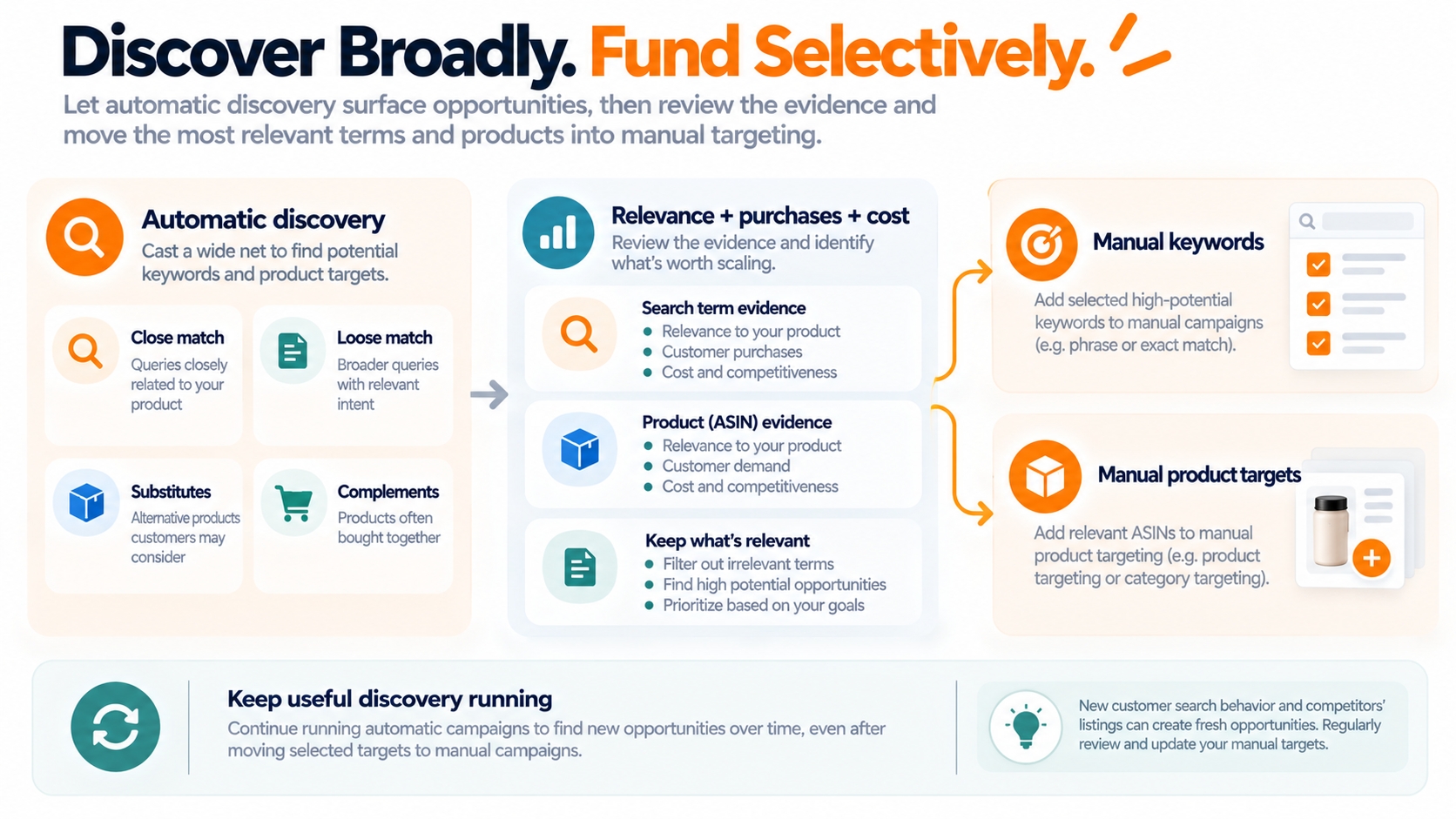
Automatic targeting and manual targeting are complementary tools. Automatic campaigns can reveal useful traffic; manual campaigns give you more direct control over the targets you choose to fund.
Sponsored Products automatic targeting has four groups: close match, loose match, substitutes, and complements. They cover different query and product relationships. Review their results separately rather than assuming they deserve identical bids.
Match types control reach, not the purpose of a campaign
Manual keyword targeting supports broad, phrase, and exact match. Broad can reach related language beyond the literal keyword; phrase constrains the match more closely; exact is the most restrictive option. Match types can still include close variants, so exact match is not a character-for-character lock.
Use phrase targeting when several relevant queries share a useful phrase. Use exact when a particular query deserves closer bid control. Product targeting serves a different purpose: selecting products or categories against which to compete.
Promote a promising target, then verify the new route
When a relevant search term produces purchases at an acceptable cost, add it to the appropriate manual structure and assign its own test limit. One conversion is evidence to examine, not enough to label a target permanently profitable.
Do not automatically exclude the query from its discovery campaign the moment you create an exact target. First confirm the manual target is eligible, funded, and receiving traffic. Review overlapping match routes; an exact target does not automatically receive every matching opportunity.
For the initial setup, see SellerSprite's first Sponsored Products automatic campaign walkthrough. Adapt its sample configuration to your product economics instead of treating an example budget as a required starting amount.
A Higher Bid and a Bigger Budget Solve Different Problems
When a campaign is not growing, identify the constraint before changing a setting. Limited auction competitiveness, an exhausted budget, and poor conversion require different responses.
Increasing both bid and budget at once may buy more traffic, but it also makes the result harder to explain. Start with the smallest change that addresses the observed problem.
Bids: inspect every adjustment above the base amount
Sponsored Products offers fixed, dynamic, and eligible rule-based bidding options. Down-only dynamic bidding can reduce bids for less promising opportunities; up-and-down bidding can also raise them. Choose the strategy with its possible auction exposure in mind.
Placement adjustments work alongside the bidding strategy. For example, a $0.60 base bid with a 50% top-of-search adjustment becomes $0.90 for that placement. Under current up-and-down rules, a further increase could bring it to $1.80 before considering other applicable adjustments.
Those are potential bids, not guaranteed charges. They still matter when your planning CPC ceiling is $0.80. Inspect active placement, audience, and other applicable modifiers instead of assuming the base bid is the maximum possible exposure.
Budgets: fund good traffic before adding more expensive traffic
A campaign that meets its economic objective but repeatedly runs out of budget may deserve more allocation. A campaign that spends fully on poorly matched searches needs targeting work first. Budget exhaustion alone is not evidence of profitable demand.
Amazon's daily budget is an average over the calendar month, not necessarily a hard daily cap. Current settings can allow unused budget to support spending up to 100% above the daily amount on higher-traffic days, subject to Amazon's monthly charging rules. Review the account's budget settings before defining a test.
Placements: a campaign average can conceal the costly area
Review top-of-search, rest-of-search, and product-page performance where available. A placement adjustment affects the eligible traffic within its campaign, so group targets with reasonably similar economics before applying a large increase.
Before increasing spend: Is the campaign short of budget, short of relevant opportunities, or short of conversion? More budget addresses only the first problem directly.
The Search Term Report Is Where Strategy Gets Specific
The keyword you bid on and the customer context that triggered the ad are not always the same. Use the Sponsored Products search term report to examine the traffic your campaign actually received.
The report includes terms with at least one click. Some entries are ASINs associated with product-page placements; in non-search contexts, a term may be inferred rather than typed by a shopper. Preserve that distinction when interpreting the report.
Three rows can require three different decisions
Return to the hypothetical $40 cable tray and its 20% target ACOS. Assume the following report period is old enough for its attribution window to finish, and each purchase contains one advertised unit. The seller does not sell replacement clamps separately.
| Search term | Clicks | Spend | Purchases | Sales | ACOS |
|---|---|---|---|---|---|
| no drill cable tray | 40 | $28.00 | 5 | $200.00 | 14% |
| under desk cable management | 60 | $54.00 | 3 | $120.00 | 45% |
| replacement cable tray clamps | 9 | $4.50 | 0 | $0.00 | Not defined |
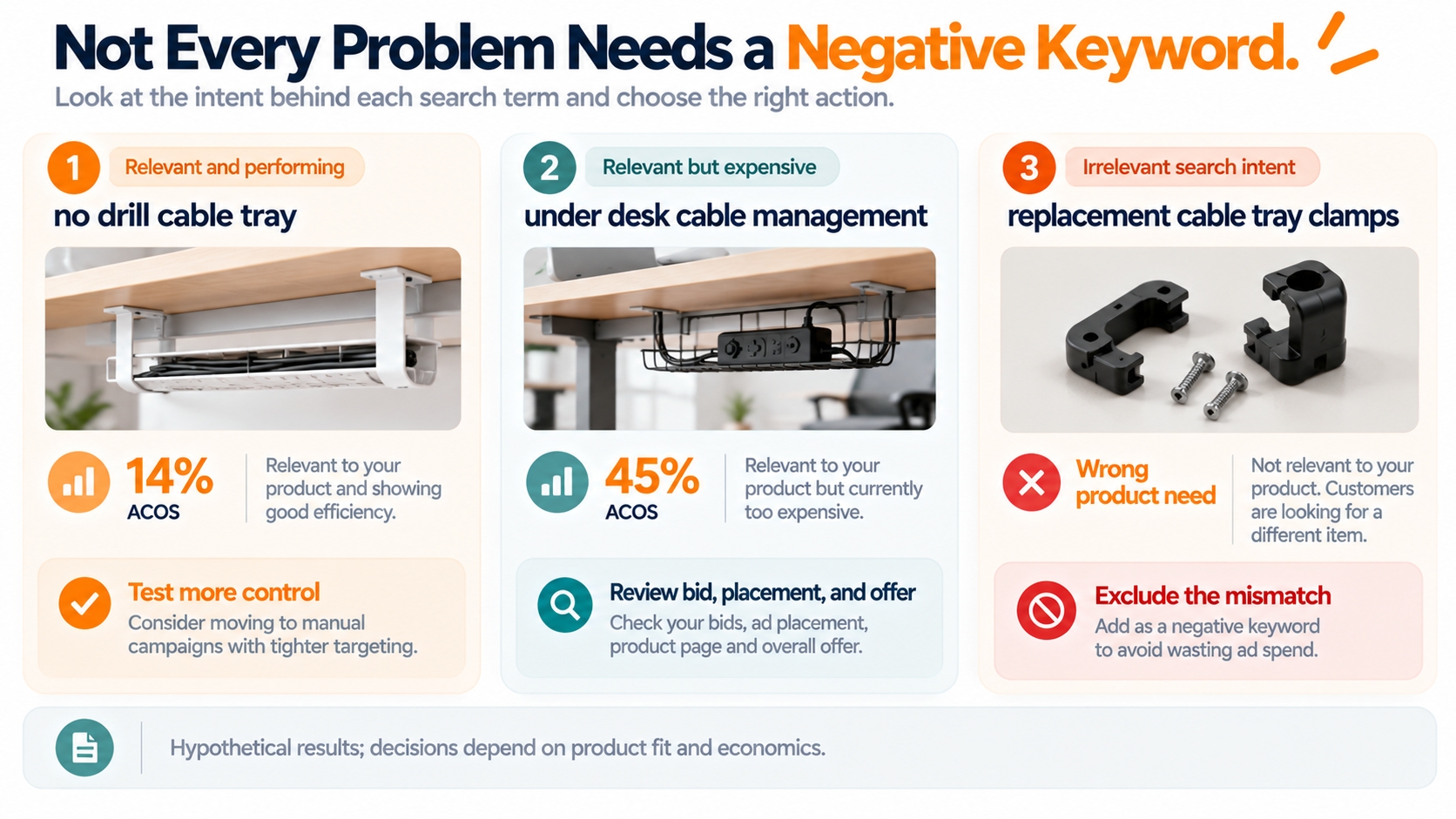
The first term merits closer control. Its observed acquisition cost is $5.60, below the $8 allowance. Test it as an explicit target or review whether its current route is budget-constrained. Five purchases still do not guarantee the next fifty.
The second term is relevant but currently too expensive. Check placement performance, actual CPC, competing offers, and conversion before deciding whether to reduce the bid or pause the test. Three purchases show that the query is not simply incapable of converting.
The third term asks for a product you do not sell. That mismatch supports an exclusion without buying more clicks merely to reach a fixed threshold. Zero sales makes ACOS undefined, not 0%.
Use the narrowest negative that solves the mismatch
Negative exact excludes the specified query and eligible close variants; negative phrase can exclude a wider group containing the phrase or its close variants. Check campaign versus ad-group scope before saving an exclusion so it does not block useful traffic for another product.
An unwanted ASIN placement needs the appropriate negative product target, not a keyword containing that ASIN. Allow for processing time before deciding an exclusion failed; Amazon documents separate implementation buffers for negative keywords and product targets.
For a relevant term with no purchases, separate uncertainty from spending permission. You can reduce or pause spending at the agreed test limit while waiting for results to mature. You do not have to keep funding a test simply because the evidence is not yet conclusive.
Do Not Let Branded Sales Hide Expensive Acquisition
An account can reach its average ACOS target while missing its acquisition goal. Before calling an improvement successful, check whether performance changed within the campaigns or whether the mix simply shifted toward easier traffic.
For example, $40 spent on $400 in branded attributed sales gives 10% ACOS. Another $80 spent on $200 in non-brand sales gives 40% ACOS. Together they produce 20% ACOS, even though the non-brand activity is twice the earlier example's target.
Read the attribution window before judging recent results
Sponsored Products seller attribution uses a seven-day click window under Amazon's current documentation. Other advertiser types and campaign formats can differ. Attributed conversions can appear later against the ad-interaction date, so recent report dates remain incomplete until the applicable window closes.
Keep purchases, units, and sales separate. One purchase can contain multiple units, and attributed sales can include products other than the advertised SKU. Match the revenue and cost assumptions to the report fields you are actually using.
Use TACOS for context, not proof of organic growth
A commonly used operational ratio is TACOS: ad spend divided by total sales for the same defined business scope. It can show how much of overall revenue is being spent on advertising. State the period, ASIN coverage, and sales basis whenever you report it.
A falling ratio does not prove PPC caused more organic sales. Price changes, seasonality, branded demand, inventory availability, and attribution timing can all affect the comparison. Do not label total retail sales minus ad-attributed sales as an exact count of organic sales when the dates and attribution scope differ.
Treat attributed revenue as a reporting result, not proof that every sale was incremental. Use controlled comparisons or experiments where practical, and judge expansion by the additional contribution it produces rather than the neatness of one ratio.
What to Change This Week
A weekly search-term review should end with a small number of actions, not a complete rebuild of the account. Check live spending and stock more frequently, then use mature performance data for larger decisions.
PROTECT
Correct obvious targeting mismatches, check unexpected spend, and review offers approaching stock or eligibility problems. Do not wait for a weekly meeting to stop a clearly inappropriate expenditure.
REFINE
Promote supported search terms, review expensive placements, and apply narrowly scoped negatives. Record whether the decision comes from relevance, economics, or a deliberately limited experiment.
REALLOCATE
Shift budget toward targets that can use more spend at an acceptable return. Confirm stock coverage, expected delivery, and the next replenishment before encouraging faster sales.
Keep a change log with the campaign, target, previous setting, new setting, reason, date, and review condition. Where practical, avoid changing the bid, placement multiplier, price, and listing at the same time. Otherwise, the next report may show a difference without explaining what caused it.
The account does not need to spend the entire available budget. If no additional traffic meets the business's requirements, leaving money unspent is a valid decision.
Put the Next Dollar Where the Evidence Is Strongest
Start with a product that fits the search. Use research to build a credible target list, decide what an order can afford, and give each campaign a reason to exist. Then let actual traffic and purchase data determine what receives more control or more budget.
The next useful action might be an exact-match test, a narrower negative, a lower placement adjustment, or a product-page correction. It is not always a bid increase, and it is rarely explained by the account average alone.
FAQs
What should an Amazon advertising and PPC strategy include?
Define the advertised product, customer need, target keywords or ASINs, campaign purpose, affordable acquisition cost, and review process. Include exclusions and a test limit before launch. A strategy should explain which result earns more budget and which result ends the test.
What is a good ACOS for Amazon PPC?
There is no universal target. Start with the contribution available before advertising, decide what must remain afterward, and match that calculation to the products included in attributed sales. A campaign can have low ACOS without demonstrating incremental sales.
Should I start with automatic or manual targeting?
Automatic targeting can help discover queries and product opportunities. Manual targeting suits researched candidates and targets that need individual control. They can run together; neither is a requirement to complete before the other.
How much should I budget for a new campaign?
Choose a test amount the business can afford using expected CPC, the evidence needed, and the acceptable loss. Do not adopt another category's budget without checking your economics. Amazon's daily amount is an average, so review its spending settings as well.
When should I add negative keywords?
Exclude a clear product-intent mismatch without waiting for unnecessary spend. For relevant but nonconverting traffic, examine cost, reporting maturity, and the offer first. Choose negative exact or phrase carefully; use negative product targeting for unwanted ASIN placements.
Why does my recent campaign performance keep changing?
Purchases can be attributed after the click and reported against the earlier interaction date. Sponsored Products seller campaigns currently use a seven-day click window. Recent periods are incomplete until that window ends, and later adjustments can also affect results.
Can SellerSprite reveal a competitor's profitable PPC keywords?
SellerSprite can help identify observed keyword visibility and provide demand and estimated bid information. That supports target selection, but does not expose a competitor's private advertising costs or profitability. Validate your own targets through actual campaign performance.
Should I raise the bid or the budget when sales stop growing?
Raise budget only when acceptable traffic is being limited by allocation. Review bids and placements when auction access is the constraint. When relevant clicks do not convert, investigate the offer instead. The campaign's limiting factor should determine the change.
References
- Amazon Ads: Sponsored Products Best Practices View
- Amazon Ads: Targeting with Sponsored Products View
- Amazon Ads: ACOS, ROAS, and Break-Even Considerations View
- SellerSprite: Keyword Research New User Guide View
- SellerSprite: Reverse ASIN for Beginners View
- SellerSprite: Data Update Frequency View
- Amazon Ads: Keyword Match Types View
- Amazon Ads: Bidding Strategies for Sponsored Products View
- Amazon Ads: Sponsored Products Bid Adjustments View
- Amazon Ads: Sponsored Ads Budgets View
- Amazon Ads: Sponsored Products Search Term Report View
- Amazon Ads: Negative Keyword and Product Targeting View
- Amazon Ads: Campaign Attribution View
- Amazon Ads: Sponsored Brands Formats and Billing View
- Amazon Ads: CPC, vCPM, and Suggested Bids View
- SellerSprite: Sponsored Products and Your First Auto Campaign View
- Amazon Ads: Sponsored Products Targeting Report and Metric Definitions View
By SellerSprite Content Team
SellerSprite's Content Team works across Amazon marketplace research, keyword analysis, and e-commerce education. Our advertising research examines shopper search behavior, competitor visibility, targeting decisions, and the relationship between ad spend and product economics. We focus on making research usable for marketplace managers and advertising teams, with particular attention to metric definitions, data freshness, and the distinction between competitor observations and a seller's own campaign results.
Last reviewed: October 22, 2026