TL;DR: Amazon and AWS AI and Machine Learning are connected, but they are not interchangeable. Amazon uses AI in shopping discovery, listing creation, seller assistance, and advertising. AWS provides services such as Amazon Bedrock and Amazon SageMaker AI for businesses that want to build their own AI applications or predictive models. Most Amazon sellers should begin with available marketplace tools, trusted product and performance data, and a small workflow that saves measurable time. Custom AWS development makes sense when a business has a recurring problem that existing tools cannot handle, the necessary data and technical resources, and a clear way to evaluate results.
Key Takeaways
- Amazon AI and AWS AI serve different users. Seller Assistant helps merchants operate their Amazon businesses, while AWS gives developers the infrastructure to create and deploy applications.
- Amazon's AI capabilities changed substantially in 2026. Rufus became Alexa for Shopping, while Seller Assistant gained broader workflow automation and new integrations.
- Generative AI is not a forecasting engine by default. Drafting a listing and estimating future inventory demand are different technical problems that require different evidence.
- Reliable automation begins with reliable inputs. Marketplace estimates, actual Seller Central performance, supplier information, and Amazon policies must be distinguished.
- Human approval is part of the design. AI can prepare recommendations, but high-impact changes to prices, inventory, advertising, or compliance-sensitive content need defined controls.
Table of Contents
- Three Layers Behind Amazon and AWS AI
- Generative AI Writes. Predictive ML Estimates.
- What Amazon Already Gives Sellers in 2026
- Where AWS Fits Into a Seller's Technology Stack
- The Build-or-Buy Test: Four Seller Decisions
- An AI Recommendation Is Only as Good as Its Evidence
- Worked Example: An Inventory Alert That Deserves a Human Decision
- Before an AI Agent Can Act, Define What It Cannot Do
- Measure Accepted Decisions, Not Generated Answers
- Where SellerSprite Fits Into an AI-Assisted Workflow
- Build Only What Your Business Can Explain
- FAQs
- References
Scope: This article focuses on US Amazon sellers evaluating AI-assisted marketplace operations. It distinguishes publicly available marketplace intelligence from seller-authorised account data and developer services. Product availability, prices, account permissions, and integrations should be checked against the current Amazon and AWS documentation before implementation.
Three Layers Behind Amazon and AWS AI
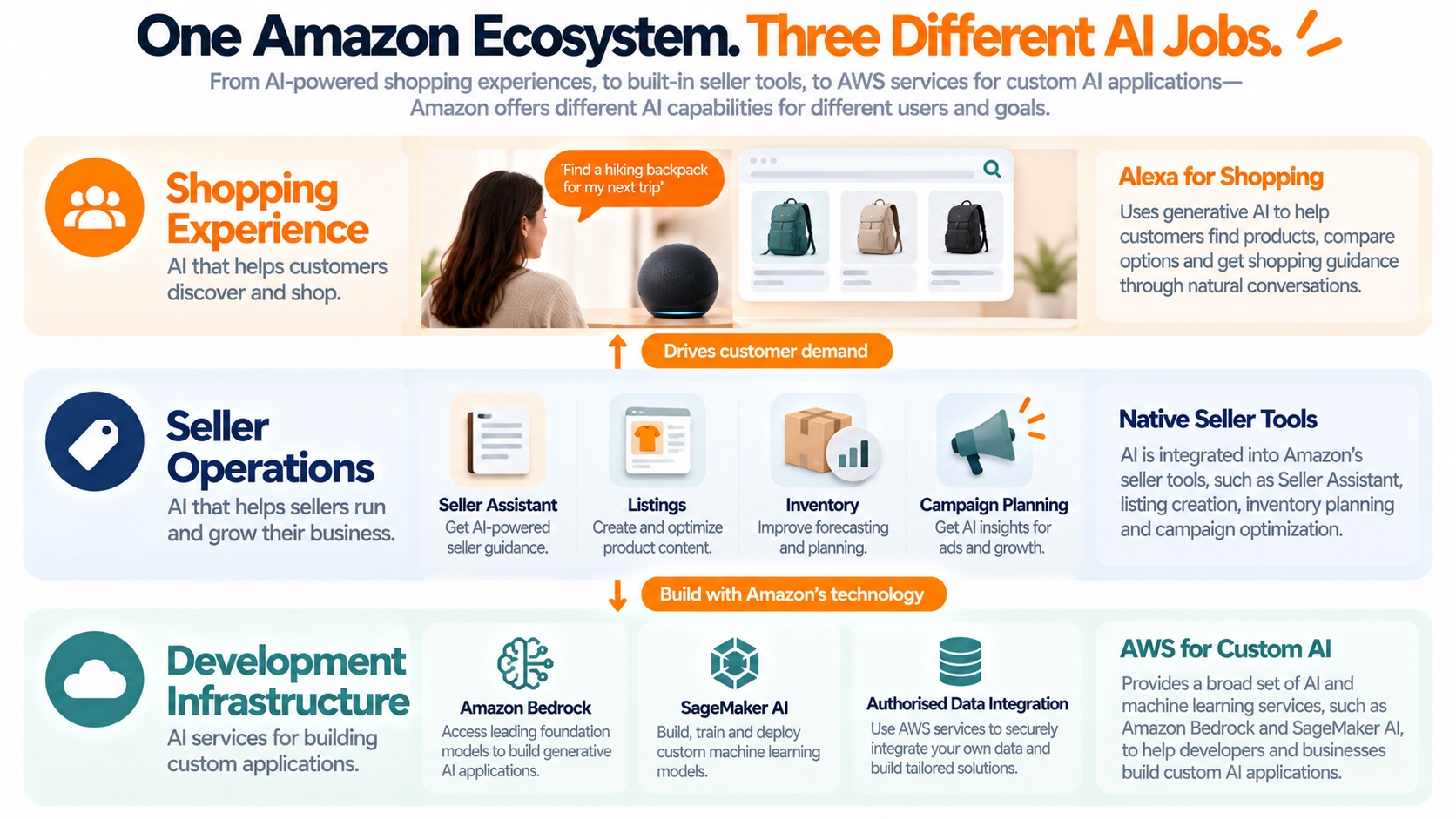
A seller researching Amazon and AWS AI and Machine Learning is likely to encounter several products that share the Amazon name but solve very different problems.
Some AI operates inside the shopping experience. Other tools assist merchants in Seller Central. AWS serves businesses and developers building applications for their own data and workflows. Understanding which layer owns a task is more useful than starting with a long list of AI product names.
LAYER 01
AI for Shoppers
Example: Alexa for Shopping, formerly Rufus.
Helps customers discover, compare, and understand products through conversational shopping experiences.
LAYER 02
AI for Sellers
Example: Seller Assistant and AI listing tools.
Helps sellers interpret business information, prepare content, review operations, and perform supported tasks.
LAYER 03
AI Development on AWS
Example: Amazon Bedrock and SageMaker AI.
Provides infrastructure and services to build customised AI applications and machine-learning systems.
These layers are connected. Amazon's Seller Assistant, for example, uses Amazon Bedrock as part of its underlying technology. However, a seller using Seller Assistant does not need to develop a Bedrock application or operate an AWS account simply to receive the native assistant's supported capabilities.
Conversely, creating an AWS account does not give a developer automatic access to private Seller Central data or the ability to change Amazon listings. Those permissions must come through the appropriate authorised integration.
Generative AI Writes. Predictive ML Estimates.
A listing description and a replenishment forecast may both be described as AI outputs. That does not mean they require the same kind of model or should be judged by the same criteria.
Generative AI produces content such as text, images, summaries, or recommendations. Predictive machine learning uses patterns in relevant data to estimate a future value, classification, or probability. AWS distinguishes these approaches according to their outputs and practical uses.
When Generative AI Fits the Task
A generative model can group keyword phrases by apparent buyer intent, turn inspection notes into a readable report, draft product bullets from verified specifications, or summarise recurring complaints in a review dataset.
The output still needs factual verification. A model can write a convincing product claim without knowing whether the claim is supported. Fluent language is not evidence that a specification, compatibility statement, or compliance assertion is accurate.
When Predictive Machine Learning Fits Better
Forecasting weekly unit demand, estimating the likelihood of a stockout, or identifying unusual changes in an established time series is a different problem. It requires historical observations, relevant features, a baseline method, and a way to measure errors against actual outcomes.
A language model can explain a forecast or help write the code for one. That does not mean the language model itself is a validated demand-forecasting system.
A useful division of labour: Use a statistical or forecasting method to estimate quantities, and generative AI to explain assumptions, surface exceptions, and draft a recommendation. Keep both connected to the underlying data rather than allowing a persuasive explanation to replace a measured prediction.
What Amazon Already Gives Sellers in 2026
Many sellers should investigate their existing Amazon tools before commissioning a custom AI project. The native environment already supports several tasks that previously required manual analysis or separate software.
These products do not all serve the same purpose. The customer-facing shopping assistant influences how people explore products, while seller-facing tools help merchants prepare information and operate their accounts.
Alexa for Shopping: AI at the Customer's Side
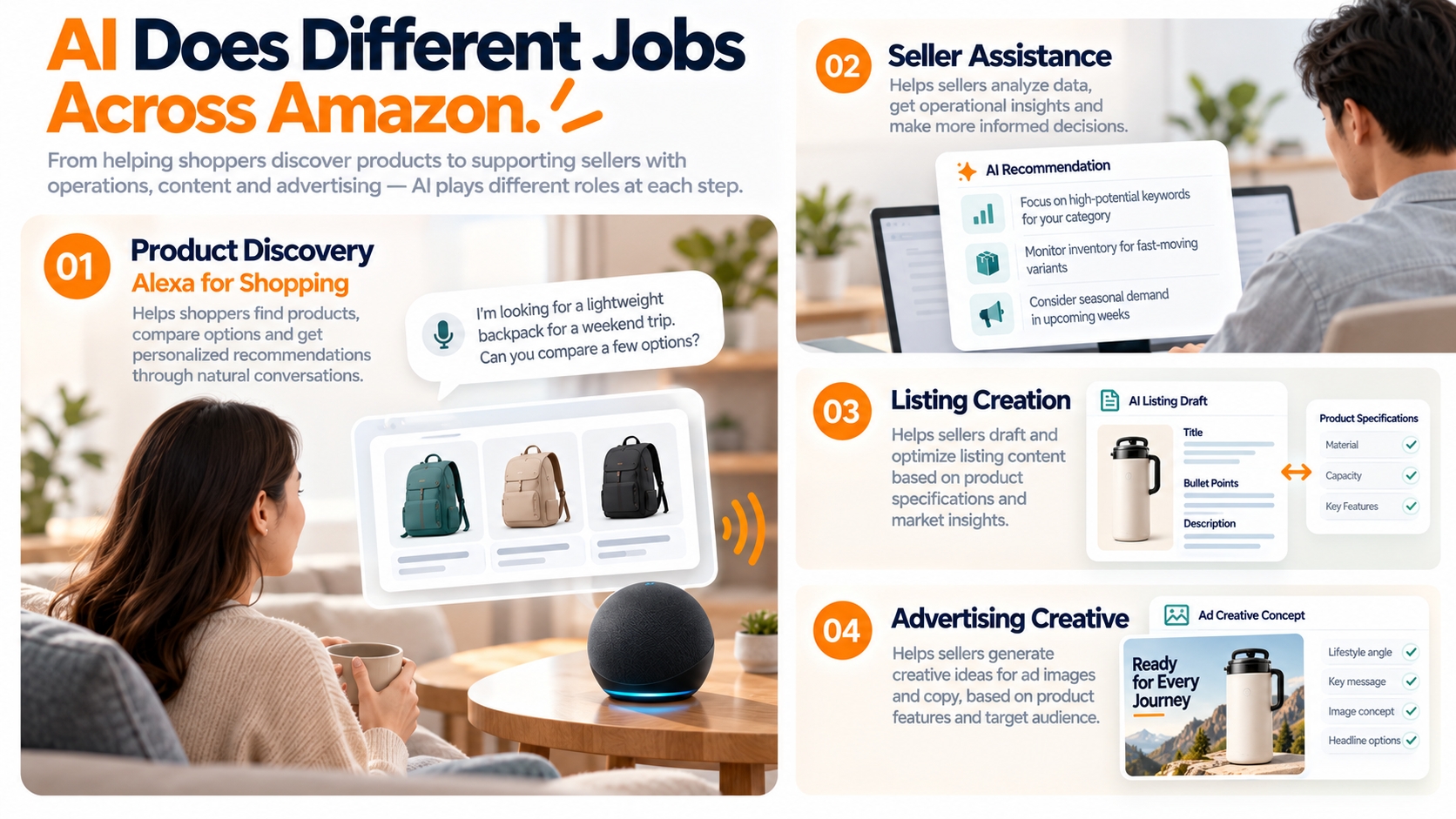
On May 13, 2026, Amazon renamed its Rufus shopping assistant Alexa for Shopping. Amazon describes the assistant as helping customers explore products through natural-language questions, comparisons, recommendations, and shopping-related actions.
A shopper may ask which product fits a specific task rather than search using one short keyword phrase. That creates a practical reason for sellers to make product attributes, compatibility information, dimensions, and use cases clear and accurate.
However, sellers should not assume there is a publicly documented formula for ranking specifically in Alexa for Shopping. Amazon has not provided a universal list of keywords, review counts, or content elements that guarantees an AI recommendation.
The defensible action is to improve factual product information and customer relevance, rather than chase claims about an undisclosed AI-shopping algorithm.
Seller Assistant: From Answers to Supported Actions
Amazon expanded Seller Assistant with agentic AI capabilities in 2025. In September 2026, it announced additional functionality including persistent business context, configurable recurring workflows, and integrations designed to bring seller data and recommendations into other AI environments.
Amazon describes workflows that can monitor inventory, pricing, account-health conditions, and business opportunities. Sellers can define boundaries and, for supported actions, choose whether the system should prepare a recommendation or seek approval to act.
The September announcement also introduced an Amazon Selling Partner plugin for Amazon Quick and, in beta, Anthropic's Claude. Amazon said the plugin was launching in beta for sellers in its US stores, with availability expanding over time.
For details on the current feature direction, see Amazon's September 2026 Seller Assistant update. Availability and supported actions should be checked in the individual seller account rather than inferred from the announcement alone.
AI Listing Tools: Faster Drafting, Not Automatic Verification
Amazon offers generative AI tools that help eligible sellers create listing information from inputs such as a short description, product image, or existing website URL. Amazon states that these capabilities can reduce the work involved in drafting product attributes and descriptions.
A seller still needs to verify the exact model, size, material, intended use, safety-related statements, and marketplace-specific requirements. AI-generated text should not invent product certifications, unsupported performance claims, or accessories that are not included.
Advertising: Useful Creative Assistance, Different Performance Questions
Amazon has also introduced AI-assisted creative capabilities for advertisers, including conversational tools in Creative Studio. These can help turn a product and campaign brief into advertising concepts and assets.
Creative production and advertising optimisation are separate decisions. A generated image can be visually effective but inaccurate. A professionally written campaign concept does not establish that its targeting or bidding strategy will improve return on ad spend.
Review creative outputs against the real product and Amazon's applicable ad policies. Evaluate campaign performance using actual advertising results, not the apparent quality of the generated concept.
Where AWS Fits Into a Seller's Technology Stack
AWS becomes relevant when a seller, agency, or software provider wants to develop a customised application, integrate several authorised data sources, or operate a prediction system that existing tools do not adequately support.
AWS supplies development services, not a ready-made Amazon seller dashboard. Choosing a service depends on the task, data available, engineering resources, operating costs, and required level of control.
Amazon Bedrock: Build with Foundation Models
Amazon Bedrock is a managed service for developing generative AI applications using a selection of foundation models. It provides capabilities for model invocation, knowledge retrieval, application workflows, and configurable safeguards.
A marketplace operator might use Bedrock to create a tool that summarises approved internal reports, explains unusual inventory changes, or drafts a product-issue brief using verified source documents.
Amazon Bedrock Knowledge Bases can retrieve relevant material from connected data sources to support retrieval-augmented generation (RAG). That can make a response more relevant to a company's own documents, but it does not independently confirm that those documents are current, correct, or complete.
AWS provides further details in its Amazon Bedrock documentation and FAQs. The service is most useful when the business knows what information the model may access, what output it should produce, and who is responsible for validating the result.
Amazon SageMaker AI: Train and Deploy Machine-Learning Models
Amazon SageMaker AI supports machine-learning workflows such as preparing data, training models, evaluating predictions, and deploying models for inference.
This may be relevant to a business with enough reliable historical data to model demand, classify operational exceptions, or identify patterns across a large product catalogue. The model must still be validated against data it has not seen during training.
SageMaker AI is not required for every forecasting task. A simple statistical baseline may perform adequately for a small catalogue. A technically sophisticated model that is less accurate, harder to maintain, or more expensive than a baseline is not an improvement.
Amazon Quick: Business Workflows and Connected Context
Amazon Quick is an AI work environment designed to support research, documents, business applications, and connected workflows. Its relationship with seller operations became more direct through the September 2026 Amazon Selling Partner plugin announcement.
A seller using a supported plugin may be able to bring authorised Amazon business information into a broader workflow alongside other connected tools. That is different from developing and hosting a custom machine-learning model with SageMaker AI.
| Service or tool | Appropriate use | Important limitation |
|---|---|---|
| Seller Assistant | Supported seller-account recommendations and authorised operational workflows. | Features and actions depend on account access and rollout status. |
| Amazon Bedrock | Custom generative AI applications, document-based assistants, and managed model inference. | Developers must supply data, permissions, application logic, testing, and controls. |
| SageMaker AI | Building, training, evaluating, and deploying custom machine-learning models. | Model quality depends on data coverage, validation, maintenance, and operating cost. |
| Amazon Quick | Connected business assistance and supported agentic workflows. | Integrations require available connectors, authorised access, and appropriate approvals. |
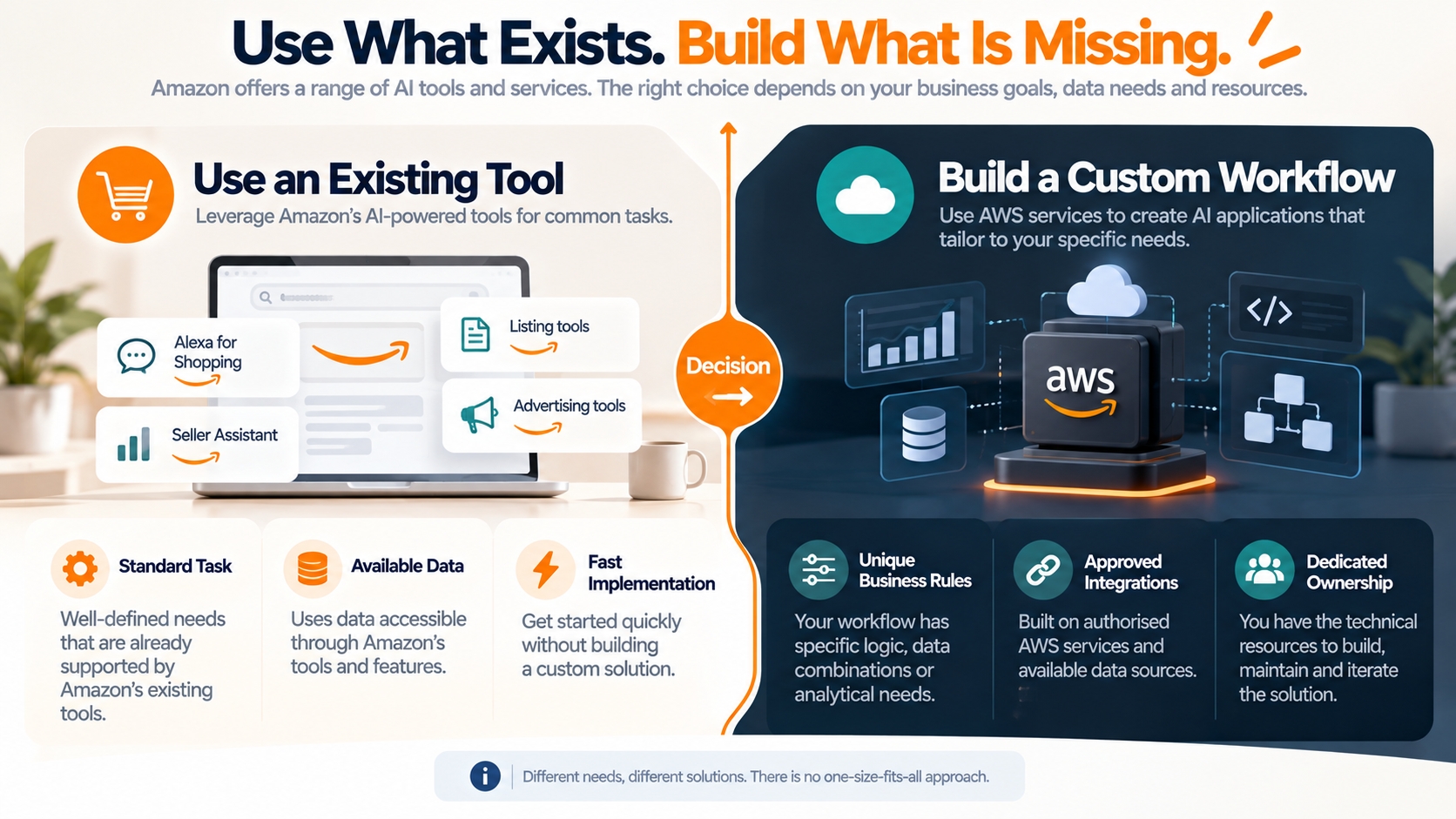
The Build-or-Buy Test: Four Seller Decisions
The question is not whether custom AI is more advanced than a marketplace tool. It is whether the additional control is worth the engineering work, data requirements, ongoing maintenance, and operating risk.
Start by describing the decision in one sentence. If you cannot state what the workflow should improve, what data supports it, and who approves the result, building software will not resolve the uncertainty.
TASK 01 / LISTING COPY
Do We Need to Draft Product Descriptions Faster?
Start with: Amazon's native listing tools or an established listing-writing workflow.
Custom development becomes more reasonable only if the business has a repeated requirement involving its own approved product database, multiple languages, specific content approvals, or internal publishing systems that available tools cannot support.
TASK 02 / MARKETPLACE RESEARCH
Do We Need to Understand a Product Niche?
Start with: Relevant Amazon research tools and established product, keyword, and competitor datasets.
AI can help group observations and prepare a research brief. Building a custom application makes sense only when the necessary permitted data is available and the research process is sufficiently different from what existing tools already provide.
TASK 03 / INVENTORY PLANNING
Do We Need Better Replenishment Decisions?
Start with: Seller Central inventory data, existing replenishment tools, and a simple forecasting baseline.
A custom predictive model becomes worth investigating when the catalogue has enough reliable history, multiple lead-time constraints, and persistent forecasting errors that simpler approaches cannot resolve.
TASK 04 / CROSS-SYSTEM OPERATIONS
Do We Need to Combine Amazon, Finance, and Supplier Data?
Start with: Supported integrations, authorised connectors, existing reports, and available business assistants.
A custom AWS application may be justified when the company needs a repeatable process across several systems, with its own business rules, approval hierarchy, and audit requirements.
A useful stopping rule: If the task is infrequent, the data is incomplete, and an experienced employee can complete it reliably with an existing tool, do not start by building a custom AI application. Document the workflow first, then automate only the repetitive parts that have a measurable cost.
An AI Recommendation Is Only as Good as Its Evidence
Many disappointing AI implementations begin with a data problem rather than a model problem. A system may combine product estimates, current sales reports, supplier lead times, and historical information without preserving their definitions or timestamps.
When the inputs describe different things, the AI can produce a polished recommendation that no one can adequately verify.
Separate Four Sources of Business Evidence
| Data source | Appropriate use | Important caution |
|---|---|---|
| Seller Central account data | Actual orders, inventory records, fulfilment and available campaign performance. | Access is account-specific; reports and update times may differ. |
| Marketplace research data | Estimated competitor performance, keyword trends, category comparisons, and historical signals. | Estimates are not the competitor's actual Seller Central reports. |
| Supplier and operations records | Lead times, purchase costs, production schedules, minimum order quantities, and product specifications. | Supplier estimates and confirmed commitments must be distinguished. |
| Official policies and product documentation | Current marketplace requirements, product restrictions, API rules, and technical definitions. | Documents may be updated; retrieve the applicable version and date. |
A useful AI workflow should retain the ASIN or SKU, marketplace, source, observation date, metric definition, and calculation method for important inputs. When the system produces a recommendation, the reviewer should be able to trace the claim back to an authorised source.
AWS Hosting Does Not Authorise Amazon Seller Data Access
Developers using Amazon's Selling Partner API (SP-API) must follow the appropriate application registration, authorisation, and role requirements. Operations require approved access to the relevant resources. Some sensitive data operations carry additional restrictions.
AWS infrastructure and Amazon marketplace permissions are separate. Running a Bedrock application does not grant unrestricted rights to customer information, advertising reports, product listings, or account-management functions.
Use only data and API operations the business is authorised to access. Restrict credentials, review permissions, and avoid transferring personal data into a workflow that does not need it.
A Source Timestamp Is Not the Same as a Model Run Timestamp
An AI-generated report completed at 9:00 a.m. may rely on inventory data exported yesterday, a competitor estimate updated earlier, and supplier information entered last week. The freshness of the report does not make its underlying observations equally current.
For time-sensitive decisions, define the maximum acceptable age of each input. If a required value is stale or missing, the system should show that limitation rather than confidently fill the gap.
Worked Example: An Inventory Alert That Deserves a Human Decision
Consider a hypothetical US Amazon seller managing a product catalogue with several suppliers. The team wants to identify items at risk of running out before a replenishment shipment arrives.
Rather than build a complex forecasting model immediately, the seller begins with one SKU and a simple inventory-coverage rule.
Hypothetical Inventory Snapshot
Available stock
120 units
Recent sales pace
8/day
Estimated coverage
15 days
Supplier lead time
18 days
Illustrative assumptions only. Coverage is calculated as 120 available units divided by a recent average of 8 units sold per day. It assumes a constant sales pace and excludes uncertain inbound shipments, reservations, seasonality, and changes in demand.
First, Let a Simple Rule Find the Exception
Under the simplified assumptions, the product has about 15 days of coverage, while the supplier needs 18 days to replenish it. That mismatch is enough to raise an inventory exception.
The rule does not need a large language model. It needs accurate inventory, a clearly defined demand measure, and a reasonable lead-time assumption.
Then Let AI Prepare the Questions for the Planner
A generative AI assistant could turn the exception into an internal brief. It might ask whether additional stock is already inbound, whether recent sales were unusually high, whether the supplier's lead time has changed, and whether the product is entering a seasonal peak.
The assistant should identify which answers are supported by connected records and which require human confirmation. It should not silently invent an inbound shipment or assert that a new purchase order is necessary.
Keep the Purchase Decision with the Responsible Team
The inventory planner verifies the actual on-hand quantity, supplier commitment, minimum order quantity, available cash, storage constraints, and contribution margin.
Only then does the business decide whether to expedite inventory, adjust an existing purchase order, change advertising, or accept a temporary stockout risk.
Why start here? A useful alert with a documented calculation can be tested immediately. A more sophisticated forecasting model is justified only if it materially improves the decisions that the simpler method cannot handle.
Before an AI Agent Can Act, Define What It Cannot Do
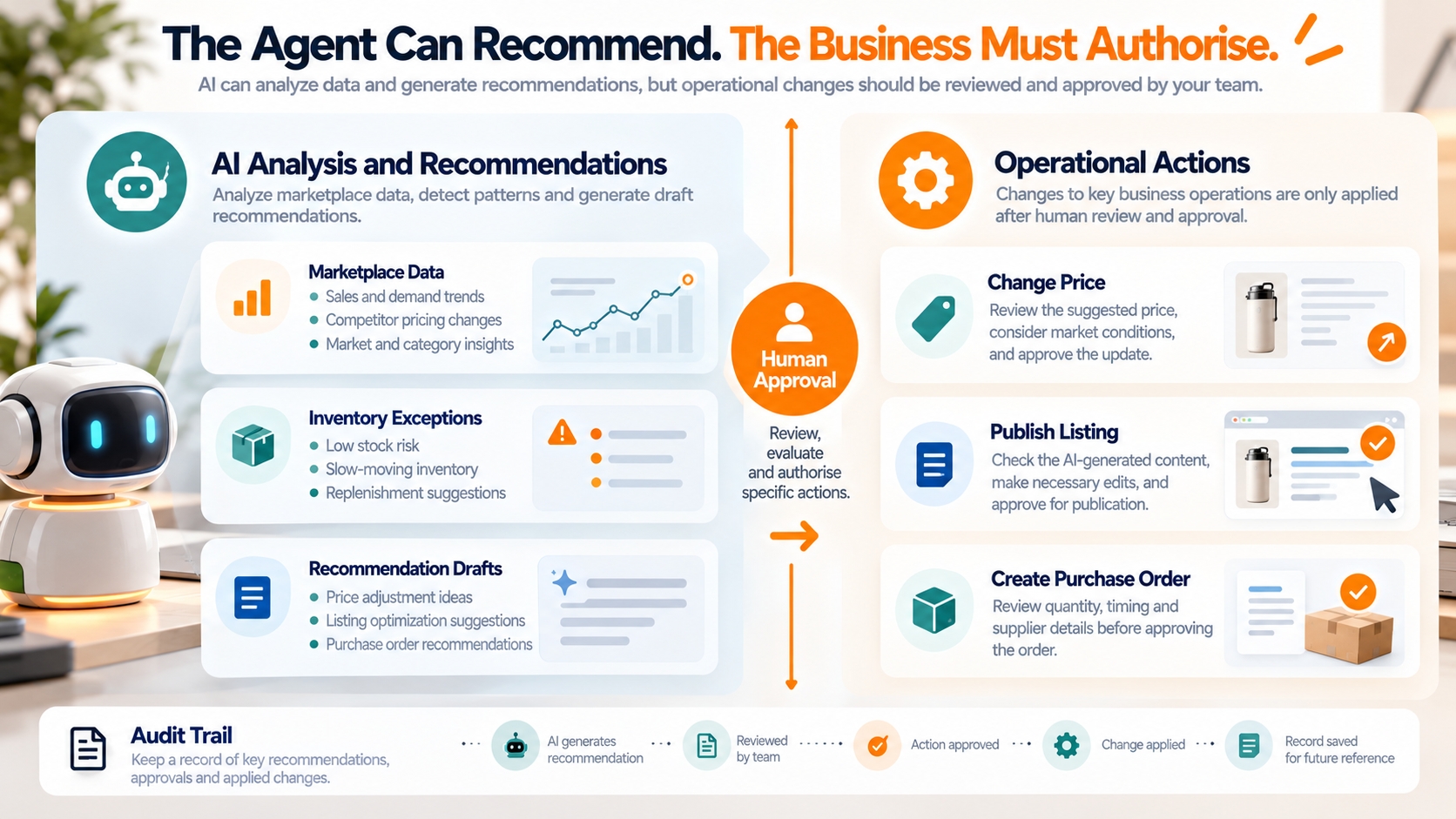
Automating a summary and automating a business action carry different risks. A mistaken summary wastes time. An incorrect inventory update, pricing change, or compliance-sensitive listing edit can affect actual orders and account operations.
Amazon's 2026 Seller Assistant announcement emphasises seller-defined guardrails, approval, and audit trails for supported workflows. A custom AWS application needs its own equivalent operational controls.
Three Levels of Automation Authority
LEVEL 01
Read and Summarise
Prepare reports, categorise observations, and surface exceptions using approved data.
LEVEL 02
Draft for Approval
Propose a revised listing, replenishment plan, or campaign action for a designated reviewer.
LEVEL 03
Execute Authorised Actions
Perform explicitly permitted actions within defined limits, with approvals, monitoring, and recovery procedures.
Moving a workflow from the first level to the third should be a separate business decision. It requires evidence that the system can handle exceptions reliably, permissions are correctly restricted, and an operator can review what happened.
Controls That Should Be Designed Before Deployment
- Permissions: Limit data access and allowed actions to what the workflow genuinely needs.
- Approval boundaries: Require review for listing claims, major pricing changes, inventory purchases, and sensitive account decisions.
- Input validation: Reject missing, stale, contradictory, or incorrectly scoped data instead of guessing.
- Execution limits: Restrict which ASINs, budgets, marketplaces, and operations a workflow may affect.
- Auditability: Retain the source references, recommendation, approval record, action, and resulting status.
- Rollback and escalation: Define how a failed or inappropriate change is stopped, investigated, and corrected.
AWS provides configurable Bedrock Guardrails for supported model interactions. Depending on configuration, these can evaluate inputs and responses for certain content risks and sensitive information.
Guardrails are not substitutes for verifying a product specification, checking an Amazon policy, or requiring financial approval. A response can pass a content filter and still contain a commercially wrong recommendation.
Measure Accepted Decisions, Not Generated Answers
An AI system can produce dozens of reports per day without improving a single operational decision. The value lies in whether its outputs are correct enough, useful enough, and inexpensive enough to justify their place in the workflow.
The measurement framework should compare the AI-assisted process with the business's previous method or a simple alternative. Do not assume the time saved by producing a draft is the same as the time saved after reviewing and correcting it.
Evaluate Five Different Outcomes
| Measure | Useful question | What to record |
|---|---|---|
| Data reliability | Did the workflow use appropriate, current information? | Source coverage, timestamps, missing fields, and rejected inputs. |
| Decision quality | Were the recommendations supported and useful? | Accepted, revised, and rejected recommendations with reasons. |
| Time saved | Did the complete task become faster? | Previous total task time versus generation, review, and correction time. |
| Operational safety | Were inappropriate actions prevented? | Approval exceptions, failed actions, policy corrections, and incident records. |
| Total operating cost | Is the improvement worth maintaining? | Tool fees, model usage, engineering, data processing, and human oversight. |
AWS Costs Extend Beyond a Model Call
Amazon Bedrock pricing depends on the models, regions, usage modes, and supporting capabilities selected. Model inference can be billed according to input and output token usage, while additional features and infrastructure may have separate charges.
A production application may also require storage, retrieval, logging, evaluation, access management, monitoring, incident handling, and continued engineering support.
Use the current AWS pricing pages and set an appropriate cost budget or alert before a pilot expands. AWS Budgets supports monitoring actual and forecasted costs, but the organisation still needs to define acceptable usage and take action when limits are approached.
A better productivity calculation: Compare the fully reviewed human workflow with the fully reviewed AI-assisted workflow. Include correction time, cloud usage, integration maintenance, and error handling. The number of reports generated or prompts completed is not a business outcome.
Start with a Small, Reproducible Test
Choose a defined set of ASINs, one reporting interval, and a repeatable task. Record how the team performs it today. Test the AI-assisted process against the same business question and compare output accuracy, human effort, and cost.
Keep source data, evaluation criteria, and review decisions consistent. If the workflow repeatedly invents missing facts, requires more corrections than it saves, or cannot be maintained within budget, stop or redesign the pilot before granting it further operational authority.
Where SellerSprite Fits Into an AI-Assisted Workflow
Amazon's native AI tools focus on shopping and seller-account operations, while AWS provides infrastructure for building custom AI applications. SellerSprite occupies a different part of the workflow: AI-powered Amazon market intelligence, product analysis, and listing optimization.
Rather than simply displaying marketplace metrics, SellerSprite's AI features interpret category data, identify relevant competitors, explain historical product performance, extract insights from customer reviews, and assist with listing creation. These capabilities support decisions across the selling lifecycle, from evaluating a market to refining an existing product.
Five AI Capabilities Across the Amazon Seller Workflow
01 / MARKET OPPORTUNITY
Category AI Insights: Understand Where the Opportunities Are
Category AI Insights uses AI to interpret SellerSprite's category-level data across market size, demand trends, seasonality, brand and seller concentration, product characteristics, and competitive risks. It connects these findings into a structured report covering potential opportunities, differentiation strategies, SWOT analysis, and category entry considerations.
Sellers can generate reports from Category Insights, Amazon Best Sellers categories, or a custom group of ASINs saved in My Product List. This allows the analysis to focus on either a broader category or a specifically selected competitive segment.
Best used for: Comparing potential niches, evaluating market saturation, identifying product differentiation opportunities, and deciding which categories deserve deeper research. See the Category AI Insights guide for the available report methods and analysis dimensions.
02 / COMPETITIVE INTELLIGENCE
Competitor AI Insights: Find Products That Actually Compete
Competitor AI Insights starts with a target ASIN and uses AI to identify products that serve similar customer needs. Instead of relying only on category rankings, matching keywords, or visual similarity, it focuses on functional substitutes that buyers might realistically compare.
Its AI-generated report labels competing ASINs by market positioning, price tier, and product attributes, while summarizing their main features and differentiators. Sellers can use the resulting competitor set to study pricing strategies, identify product gaps, or shortlist relevant ASINs for Sponsored Products product targeting.
Best used for: Building a more relevant competitor set, identifying alternative product positioning, researching direct substitutes, and supporting ASIN-based advertising decisions.
03 / HISTORICAL PRODUCT INTELLIGENCE
Keepa AI Insights: Turn Historical Charts Into Product Insights
Keepa AI Insights combines historical product data with AI-generated interpretation. It examines signals such as price changes, Best Sellers Rank (BSR), review growth, stock availability, and seasonal patterns to explain how a product's marketplace performance has evolved.
Its reports highlight important lifecycle events, pricing patterns, possible promotional triggers, stockout periods, and shifts in competitive positioning. The feature is accessible through SellerSprite's web tools and browser extension, making it useful when investigating an individual ASIN rather than reviewing an entire category.
Best used for: Evaluating whether a competitor's growth appears sustainable, examining product lifecycle stages, understanding historical price competition, and investigating potential seasonal or promotional patterns.
04 / CUSTOMER INTELLIGENCE
AI Review Analysis: Understand Why Customers Buy and Complain
AI Review Analysis transforms available Amazon customer reviews into structured insights about buyer profiles, usage scenarios, purchase motivations, product strengths and weaknesses, and unmet expectations. It helps sellers move beyond overall star ratings to understand the actual experiences behind customer feedback.
SellerSprite's browser extension provides AI-generated review insights based on a sample of up to 300 reviews, while its web-based Review Analysis offers broader multidimensional analysis, including variation-level review information and sentiment trends. These findings can help identify recurring product complaints, feature opportunities, and potential improvements to product positioning.
Best used for: Researching customer pain points, identifying potential product improvements, evaluating competitor weaknesses, and translating buyer language into more relevant selling points.
05 / LISTING CONTENT GENERATION
AI Listing Builder: Turn Research Into Listing Content
SellerSprite's AI Listing Builder helps sellers generate Amazon listing content using verified product characteristics, a prepared keyword bank, target-audience information, brand details, and a selected writing tone. Keywords can be gathered from SellerSprite tools such as Keyword Mining and Reverse ASIN before being incorporated into the listing workflow.
The AI generation feature can draft product titles, bullet points, and other listing content. Sellers can then review keyword coverage, edit the wording, and check whether the generated claims accurately describe the product.
Best used for: Creating new listing drafts, rewriting existing content, incorporating researched keywords naturally, and adapting product messaging to verified customer needs.
How These AI Tools Work Together
The advantage becomes clearer when the tools are used as connected stages of research and optimization rather than isolated AI reports. Consider a hypothetical seller exploring a new insulated lunch bag product.
Example: From Market Research to an AI-Assisted Listing
- Assess the market with Category AI Insights. Examine category demand, price positioning, seasonality, concentration, and potential entry risks before committing to a product direction.
- Identify direct substitutes with Competitor AI Insights. Start with a representative lunch bag ASIN and distinguish competing lunch bags from complementary products such as ice packs. Add selected competitors to My Product List to create a more focused comparison group and, if useful, generate a custom Category AI Insights report.
- Examine product history with Keepa AI Insights. Investigate how shortlisted products' prices, BSR, reviews, and availability have changed over time instead of judging the opportunity from current performance alone.
- Explore customer expectations with AI Review Analysis. Look for recurring feedback about capacity, cleaning, durability, or insulation performance, then determine which concerns are relevant to the proposed product.
- Draft the listing with AI Listing Builder. Combine relevant keyword research with confirmed product specifications and useful customer insights to generate content for human review before publication.
This workflow connects market opportunity, competitor identification, historical validation, customer intelligence, and content creation within the same research process. Each AI feature addresses a different question, helping sellers move from scattered marketplace observations toward a more coherent product strategy.
Where AI Assistance Ends: SellerSprite's AI tools interpret marketplace information and generate research or listing outputs; they do not automatically execute inventory purchases, advertising changes, or seller-account actions simply because an AI report recommends them. Historical correlations are not proof of causation, AI-generated category opportunities are not guaranteed forecasts, and competitor estimates should not be confused with first-party Seller Central data. The seller remains responsible for validating product facts, reviewing recommendations, and making the final business decision.
Build Only What Your Business Can Explain
Amazon and AWS are making more sophisticated AI capabilities accessible to businesses of different sizes. That does not mean every seller needs a custom AI agent, a trained forecasting model, or an automated system with permission to change account settings.
Begin with the decision. Identify the available evidence, the current manual process, and the cost of getting that decision wrong. Use native seller tools when they adequately solve the problem. Consider AWS development when the workflow is sufficiently specialised, repeatable, and valuable to justify the added responsibility.
The strongest AI workflow is not necessarily the one that performs the most actions. It is the one whose data, recommendations, approvals, and outcomes can be explained by the people responsible for the business.
FAQs
What is the difference between Amazon AI and AWS AI and machine learning?
Amazon offers AI-powered shopping and seller features as part of its commerce ecosystem. AWS provides development services such as Amazon Bedrock and SageMaker AI for organisations building their own applications and machine-learning systems. Amazon may use AWS technology to power its native services, but using those services does not necessarily require a separate AWS implementation.
What happened to Amazon Rufus in 2026?
Amazon renamed Rufus to Alexa for Shopping on May 13, 2026. The shopping assistant supports conversational product discovery, comparisons, and shopping-related actions. Sellers should focus on accurate product information rather than assume a guaranteed formula for appearing in its recommendations.
What can Amazon Seller Assistant do in 2026?
Amazon has expanded Seller Assistant to support business analysis, recommendations, and authorised agentic workflows across areas such as inventory, pricing, listings, and account operations. Its September 2026 update introduced additional persistent context and supported integrations with Amazon Quick and, in beta, Claude. Availability and actions depend on the account and rollout.
Do Amazon sellers need an AWS account to use Seller Assistant?
No separate AWS development account is required simply to use supported Seller Assistant features within the Amazon seller environment. AWS is relevant when the business wants to develop its own application or operate additional cloud-based AI infrastructure.
Is Amazon Bedrock the same as Amazon SageMaker AI?
No. Amazon Bedrock provides managed foundation-model capabilities for generative AI applications. SageMaker AI supports broader machine-learning workflows, including model training, evaluation, and deployment. The right choice depends on whether the business needs generative content and reasoning, customised predictive modelling, or a combination.
Can AWS automatically access my Amazon Seller Central data?
No. Access to seller-account data requires the appropriate authorised application or supported integration. Selling Partner API operations are governed by application registration, seller authorisation, roles, and other requirements. Hosting an application on AWS does not bypass these permissions.
Can generative AI predict Amazon sales accurately?
A generative model can discuss market scenarios or explain a statistical forecast, but fluent output is not evidence of forecasting accuracy. Reliable predictions require suitable historical data, an appropriate method, validation against actual outcomes, and ongoing monitoring. Forecast errors and uncertainty should be measured explicitly.
How can AI help optimise Amazon product listings?
AI can draft titles, bullet points, and descriptions using verified product information and relevant customer language. Sellers should check specifications, compatibility, marketplace rules, product claims, and keyword relevance before publishing. AI-generated copy does not guarantee better organic rankings or conversions.
When should an Amazon seller build a custom AI application?
Consider custom development when an important, recurring workflow cannot be handled adequately by existing tools, the company has authorised and reliable data, and the expected benefit justifies engineering, cloud, security, testing, and human-review costs. Begin with a small pilot against a documented baseline.
What metrics should sellers use to evaluate AI automation?
Measure data reliability, recommendation quality, accepted and rejected outputs, end-to-end time saved, operational incidents, and total cost. For forecasting, include appropriate prediction-error measures. For listings and campaigns, assess actual Amazon performance while accounting for changes in price, traffic, advertising, and seasonality.
How does SellerSprite fit into Amazon and AWS AI workflows?
SellerSprite provides marketplace research data and analysis functions for product, keyword, competitor, and customer-review decisions. Its findings can inform an AI-assisted research or content workflow. They should be interpreted according to their metric definitions and update periods, and should not be confused with authorised first-party Seller Central performance data.
References
- Amazon: Introducing Agentic AI Across the Seller Experience View
- Amazon: Seller Assistant, Amazon Quick and Claude Integration Update, September 2026 View
- AWS: Generative AI vs. Predictive AI View
- Amazon: Alexa for Shopping, Formerly Rufus View
- Amazon: How to Use AI to Create Product Listings View
- AWS: Amazon Bedrock FAQs View
- AWS Documentation: Amazon Bedrock Knowledge Bases View
- AWS Documentation: Amazon SageMaker AI Model Training View
- Amazon Developer Documentation: Selling Partner API Roles View
- AWS Documentation: How Amazon Bedrock Guardrails Works View
- AWS: Amazon SageMaker AI Features View
- AWS Documentation: Managing Costs with AWS Budgets View
By SellerSprite Content Team
The SellerSprite Content Team works across Amazon marketplace research, ecommerce data analysis, and technical content development. Its areas of study include product and keyword intelligence, ASIN-level competitive data, marketplace performance signals, and the practical application of AI-assisted research workflows.
Last reviewed: October 22, 2026