TL;DR: Amazon advertising and marketing agencies can manage campaigns, improve product content, support marketplace operations, or combine these services. Before hiring, define which work you are handing over and which decisions remain yours. Ask shortlisted agencies to explain a real product opportunity, itemize their fees, and show how their reports connect spending to business results. Keep account access, approvals, and exit arrangements explicit. A persuasive sales presentation is not a substitute for a deliverable you can inspect.
Key Takeaways
- Buy a defined service, not "growth." Campaign management, creative production, and Seller Central operations need separate responsibilities and deliverables.
- Evaluate the people who will run the account. Partner credentials and case studies help with screening; the assigned team still needs to explain its decisions.
- Compare the full invoice at different spending levels. Minimums, software charges, creative fees, and the definition of performance can change the apparent price.
- Keep the business in control. Require appropriate access, spending approvals, readable reporting, and a documented handover before the engagement begins.
Table of Contents
- What Amazon Advertising and Marketing Agencies Actually Manage
- Verify the Team Behind the Proposal
- Give Finalists the Same Product Brief
- Compare the Full Invoice at Two Spending Levels
- Ask for a Report You Can Reconcile
- Put Permissions and Exit Terms in the Agreement
- Make the First 90 Days an Acceptance Test
- Sign for the Work You Can Recognize
- FAQs
- References
Scope: This guide is for Amazon US sellers and brands selecting an external service provider. It is not a ranking of named agencies. Pricing examples and suggested evaluation periods are illustrative; contract requirements should be reviewed against the actual engagement.
What Amazon Advertising and Marketing Agencies Actually Manage
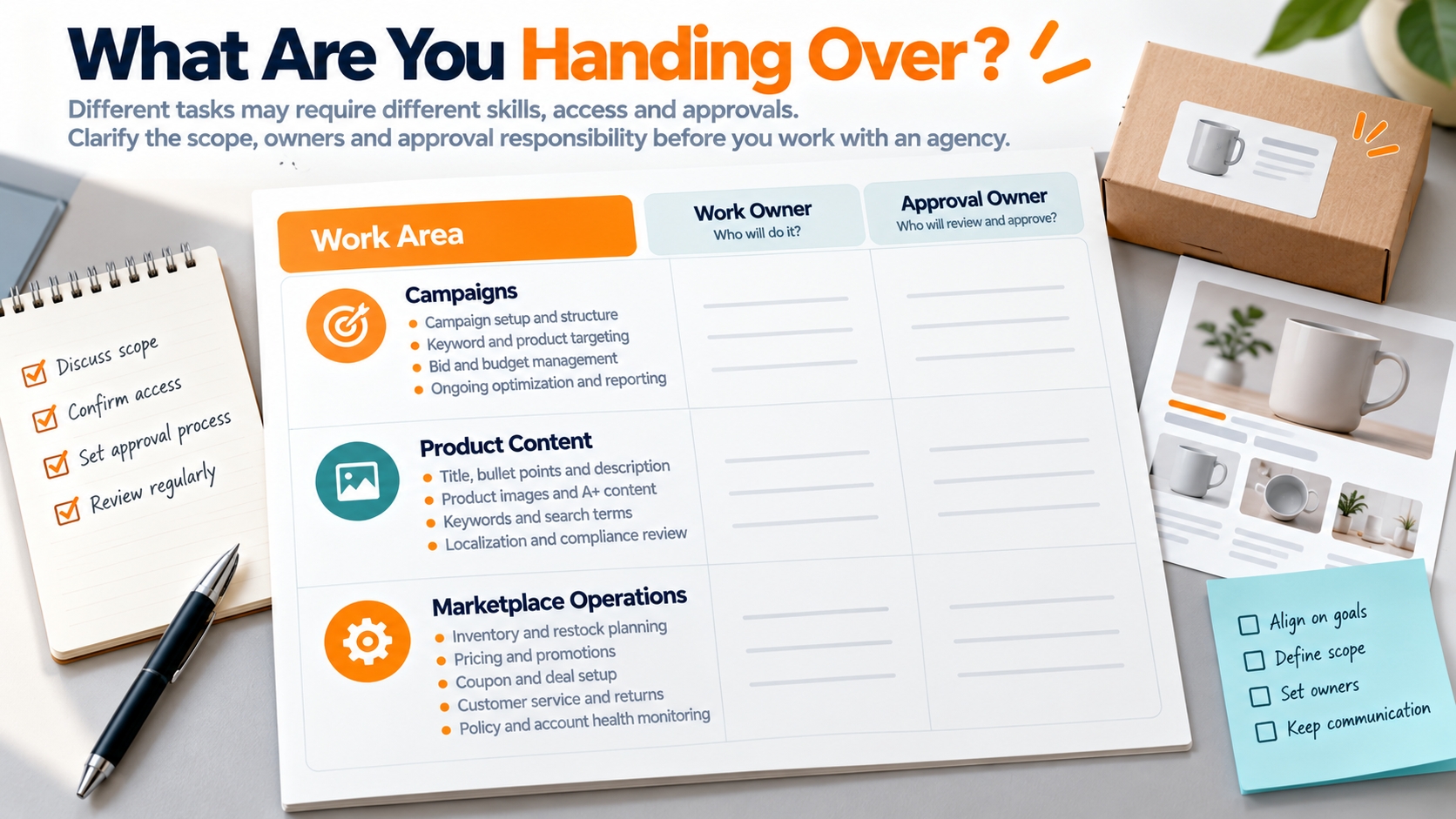
One proposal says "PPC management." Another promises "full-service Amazon growth." Both may include keyword research and a monthly meeting. The difference becomes important when a listing needs new images, inventory runs low, or someone has to explain why sales increased but earnings did not.
Amazon Ads describes its partners as third-party companies supporting areas including media, retail, creative work, and measurement. They are not automatically Amazon employees or a replacement for your own marketplace team.
Separate the work before comparing prices
PPC MANAGEMENT
Specify the ad products, marketplaces, campaign work, bid and budget decisions, search-term reviews, and reporting. Do not assume listing photography or catalog repairs are included.
MARKETPLACE MANAGEMENT
Define which listing, catalog, promotional, account-support, and inventory-coordination tasks the agency owns. "Full service" still needs exclusions, deliverables, and approval rules.
SPECIALIST SUPPORT
Creative production, Brand Stores, programmatic media, measurement, and software implementation may be separate projects. Confirm whether the quote buys tools, human management, or both.
Amazon's partner guidance distinguishes agencies, technology providers, and other specialists. Some technology providers also offer managed services. Ask who performs the work rather than assuming a software subscription includes a dedicated strategist.
Sometimes a narrower engagement is the better purchase
A seller with a small, stable catalog may need an audit and training rather than ongoing full-service management. A larger brand with capable internal operators may need only creative production or specialist advertising support.
Conversely, an agency cannot compensate indefinitely for missing product facts, uncertain margins, or unreliable replenishment. Assign an internal owner who can approve claims, prices, and stock decisions. Outsourcing execution should not leave those decisions without an owner.
Verify the Team Behind the Proposal
A useful shortlist starts with service fit. A firm built around large media campaigns may not be the right team to resolve a small catalog's targeting and conversion problems.
The Amazon Ads Partner Directory is one place to find providers by their advertised services, expertise, and supported markets. Use it to build a relevant shortlist, then verify the details directly with each firm.
A partner badge is a credential, not your forecast
Amazon publishes criteria for verified and advanced partner status. Check the provider's current directory profile instead of relying only on a badge in its presentation. Treat the status as one screening input, not proof that the proposed team will achieve your target return.
Ask to meet the person responsible for your account. Discuss their relevant category experience, workload, backup coverage, and escalation process. Find out whether strategy, daily campaign changes, creative work, and reporting are handled by the same people or different teams.
Read case studies with the missing context in mind
A sales-growth chart becomes useful when you know the starting point, period, media spend, product mix, and work performed. Ask whether pricing, promotions, stock availability, or branded demand changed at the same time.
Request an anonymized example and, where possible, a client-approved reference from a comparable business. You do not need another client's confidential campaign export. You do need an explanation that separates what the agency changed from what it merely observed.
A revealing interview question: "Tell us about a campaign you chose not to scale. What did the evidence show, and what did you recommend instead?"
Give Finalists the Same Product Brief
The easiest way to compare proposals is to give finalists the same small problem. Ask for a limited diagnostic or pay for a time-boxed audit when the work requires substantial analysis. A focused assignment is more informative than requesting an entire unpaid strategy.
Suppose your product is an expandable drawer organizer. Provide its ASIN, verified dimensions, material, intended use, margin assumptions, stock constraints, and business objective. For an existing account, supply an agreed report period through appropriately limited access or a redacted export.
Ask for the reasoning between research and budget
- Define the buying problem. The agency should identify who needs the organizer and which fit or material requirements matter, rather than beginning with a generic "kitchen accessories" campaign.
- Choose defensible competitor ASINs. Ask why each product is comparable and how organic visibility differs from observed sponsored visibility. Competitor exposure is not proof of profitable advertising.
- Assign a purpose to the target groups. Launch discovery, brand defense, competitor conquest, and long-tail acquisition should have clear objectives. They do not necessarily require four separate campaigns.
- Explain how a test becomes a funded target. Ask what evidence would justify moving a discovered query into manual phrase or exact targeting, and what would make the agency reduce or stop spending.
- Show the ongoing review process. Request an example of a search-term review, a negative-target decision, and a change log that records the reason for the action.
Amazon supports automatic, manual keyword, product, and negative targeting within Sponsored Products. The agency's value is in choosing and adjusting those tools for your product, not merely demonstrating that it knows where the settings are.
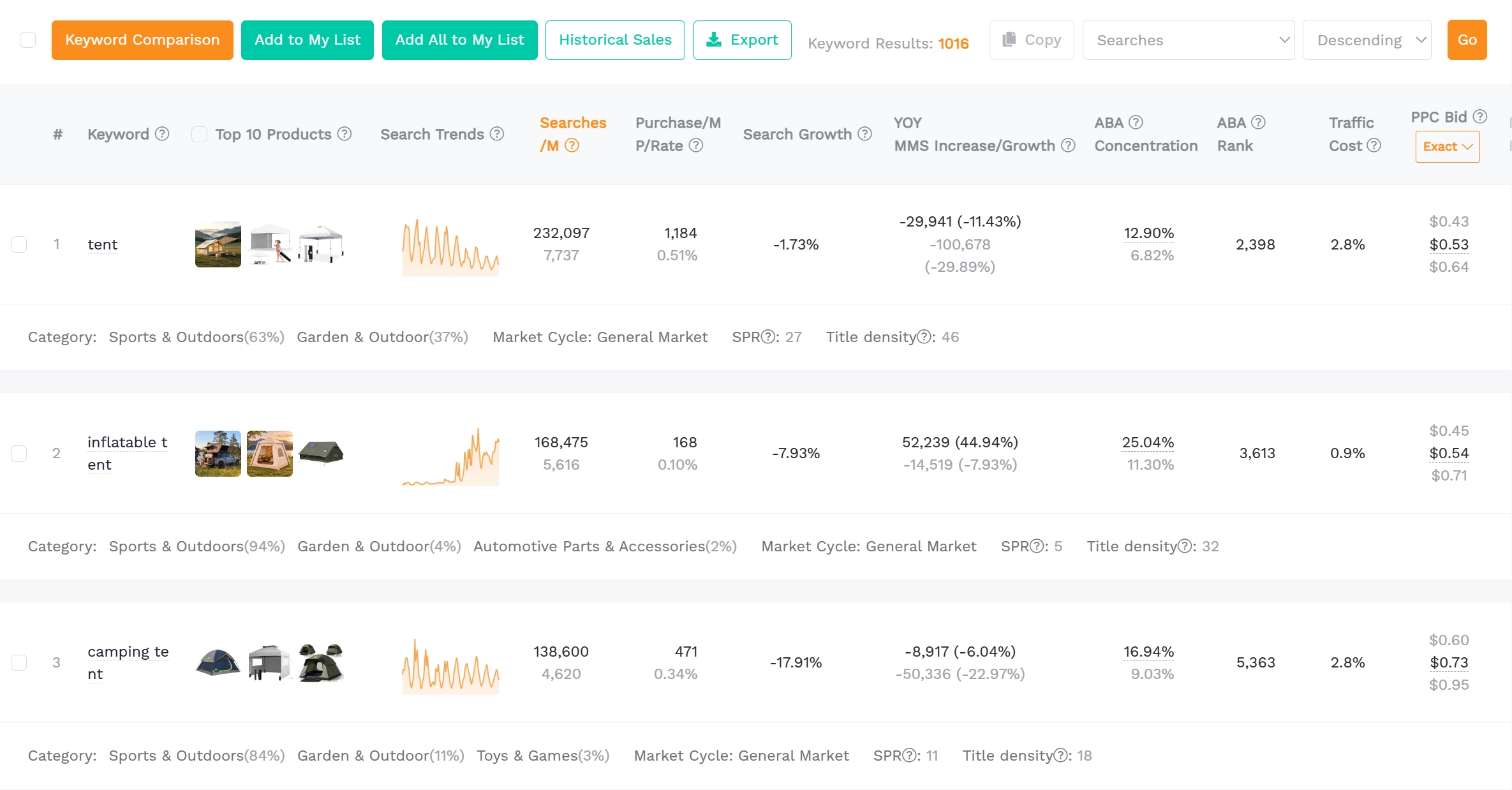
Use SellerSprite to check the research behind the recommendation
SellerSprite Keyword Research lets a team select a marketplace and period, examine search demand, and review estimated PPC bids. Reverse ASIN adds product-specific keyword research and organic or sponsored visibility for selected competitors.
Ask the agency to provide a short target sheet containing the keyword or ASIN, source period, product-fit explanation, campaign purpose, proposed test limit, and any exclusion reason. The supporting SellerSprite keyword-selection walkthrough offers a practical reference for moving from candidate terms to a relevant shortlist.
Do not accept marketplace purchase indicators as your campaign's conversion rate, or estimated bids as your affordable CPC. Use research to prioritize tests; use your own campaign results to evaluate execution.
Compare the Full Invoice at Two Spending Levels
Amazon's partner guidance identifies project fees, flat monthly fees, spend-based or sales-based commissions, and custom arrangements. These are pricing structures, not a standard rate card for every agency.
Ask finalists to quote the same marketplaces, ad products, catalog workload, reporting needs, and creative deliverables. Then calculate what each agreement would cost at your current spending level and a plausible expansion level.
A percentage can look cheaper until the other lines arrive
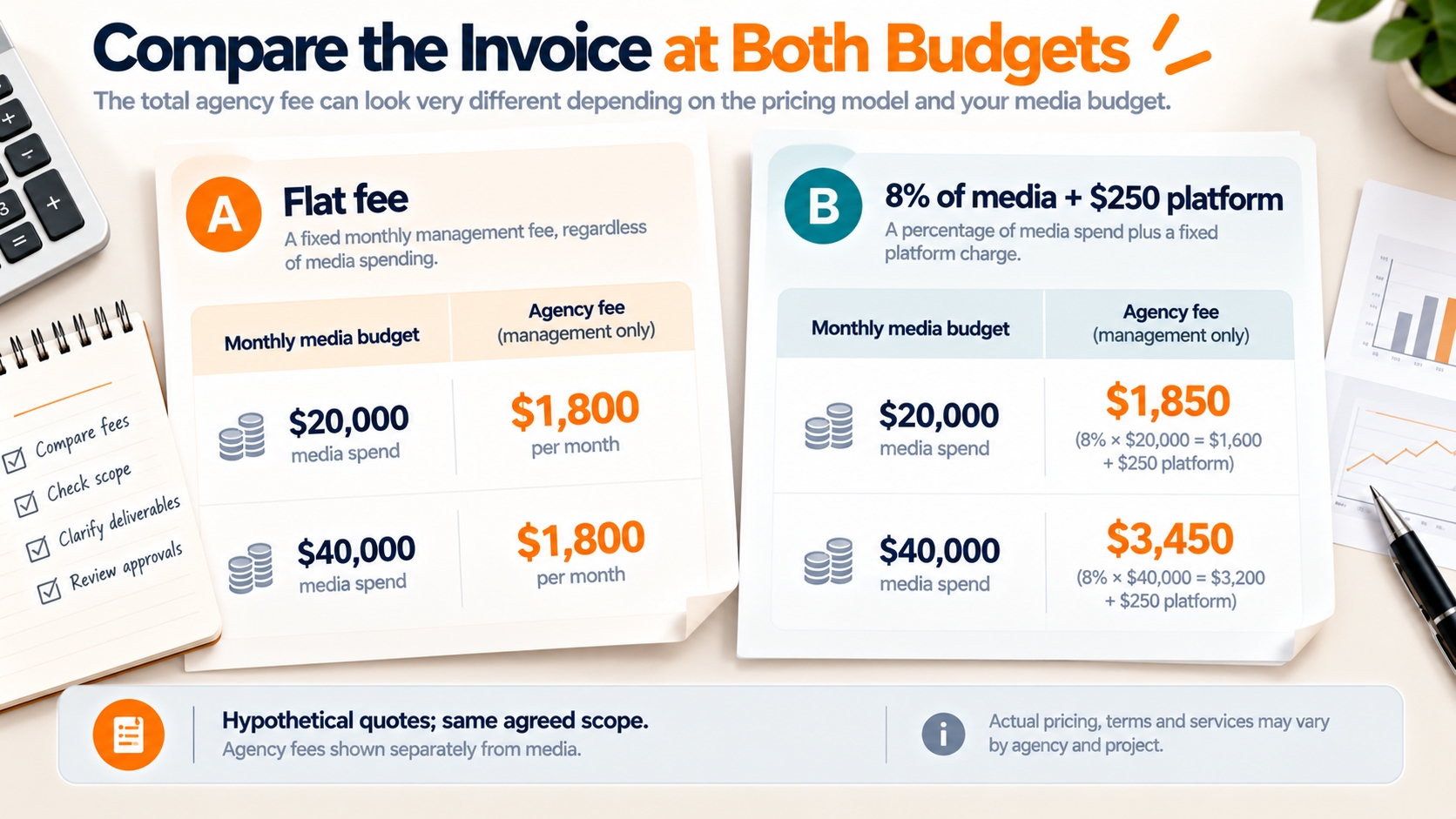
Consider two hypothetical quotes for the same agreed scope. Agency A charges a flat $1,800 monthly fee. Agency B charges 8% of media spend, subject to a $1,200 minimum, plus a $250 monthly platform charge.
| Monthly media spend | Agency A: flat fee | Agency B: percentage plus platform |
|---|---|---|
| $20,000 | $1,800 | $1,600 + $250 = $1,850 |
| $40,000 | $1,800 | $3,200 + $250 = $3,450 |
These are invented proposals, not market averages. The example assumes Agency A's fee remains fixed at both spending levels and that the agreed scope does not change. Onboarding, tax, and extra creative work are excluded.
The comparison does not establish which agency is better. It shows why an advertised "8% management fee" does not tell the whole story. At $20,000 in monthly media spend, Agency A charges a fixed management fee of $1,800, while Agency B charges $1,850 in total service-related fees, including its $250 platform charge. At $40,000 in media spend, Agency A's fee remains $1,800, while Agency B's increases to $3,450. These figures exclude the advertising spend itself, onboarding, taxes, and additional creative costs.
Define exactly what the percentage applies to
For spend-based fees, specify the channels included, minimums, tiers, and treatment of credits. For sales-based fees, define whether the base is total retail sales, ad-attributed sales, or a measured increase, and how discounts, cancellations, and returns are handled.
A performance bonus also needs an agreed baseline and exclusions for events such as price changes or restored inventory. Do not pay twice for the same result because different reports use different attribution rules.
Ask for one complete cost schedule: Media, management, onboarding, software, creative production, usage rights, extra marketplaces, and exit support. For programmatic media, request any applicable platform, audience, or service charges separately rather than accepting an unexplained all-in percentage.
Ask for a Report You Can Reconcile
A monthly report should let you trace a conclusion back to the relevant account records. If the only evidence is a screenshot of a percentage improvement, ask what changed in the underlying spend and sales.
Agree on report definitions before the agency starts. Otherwise, the first disagreement may be about what "growth" meant rather than what the team delivered.
Keep media efficiency, agency cost, and business earnings separate
ACOS divides advertising spend by ad-attributed sales; ROAS reverses that relationship. Neither calculation, by itself, establishes profitability after product costs and agency fees.
Ask for separate views of branded and non-brand activity, major advertised products, and agreed campaign objectives. A lower blended ACOS could reflect more spending on existing branded demand rather than better acquisition.
At business level, compare product contribution with media, agency, and other relevant costs. A total-spend-to-total-sales ratio can add context, but label it clearly and keep the marketplace, catalog, and period consistent. Do not rename it Amazon ACOS.
Make attribution assumptions visible
Amazon's attribution rules differ by campaign and advertiser type. Sponsored Products seller campaigns currently use a seven-day click window; other formats can use different windows or include view-attributed conversions. Require the agency to identify the basis of each result before combining them.
Also ask which purchased products contribute to the reported sales. Attributed revenue may include products other than the advertised ASIN, and recent dates can continue to change as conversions are recorded.
"New-to-brand" needs a definition, not a sales label
For supported campaigns, Amazon's new-to-brand purchase measurement checks whether the customer purchased from the brand during the preceding 12 months. It does not mean the person has never bought the brand anywhere, nor does it prove that advertising alone caused the purchase.
Ask which report supports any acquisition claim. Amazon's current sponsored-ads documentation does not provide new-to-brand data for Sponsored Products. An agency's own inferred metric should be labeled as an estimate rather than presented as that native measurement.
The question every report should answer: "What did you change, what happened, what else might explain the result, and what decision do you need from us?"
Put Permissions and Exit Terms in the Agreement
Discuss access before the first campaign change, not when the relationship ends. The agreement should state which accounts, data, creative files, and reports remain available to your business.
Keep your own authorized administrator and an internal record of the agency's access. Use supported permission and account-linking processes rather than sharing the primary login or multi-factor authentication codes.
Grant the permissions required for the agreed work
Amazon distinguishes employee access from service-provider access in its Seller Central permissions guidance. Follow the current provider-authorization process available to your account and limit access to the work commissioned.
Advertising manager-account links and software authorizations are separate access paths. Amazon documents restrictions on unlinking certain advertiser accounts created under a manager account. Confirm the account structure and exit route before a provider opens a new programmatic advertising account for you.
Ask which third-party applications will connect to your data. Seller-authorized SP-API applications can be disabled through Manage Your Apps; removing an agency user is not the same action as revoking a separate application's authorization.
Define the approval boundaries
Set approval requirements for spending increases, new marketplaces, price changes, major listing revisions, and new software connections. Ask who can pause campaigns when stock or product issues arise, and how urgent decisions reach your team.
Creative review should include product accuracy, not only design quality. Amazon requires advertisers to ensure that claims are accurate and supply factual substantiation when requested. An agency-written or AI-generated claim still needs support.
Be equally specific about review-related work. Amazon's customer-review policy covers employees and third-party partners acting for sellers, including violations committed without the seller's knowledge. Reject proposals that depend on purchased reviews or compensation tied to customer reviews outside permitted Amazon programs.
Agree on a usable handover
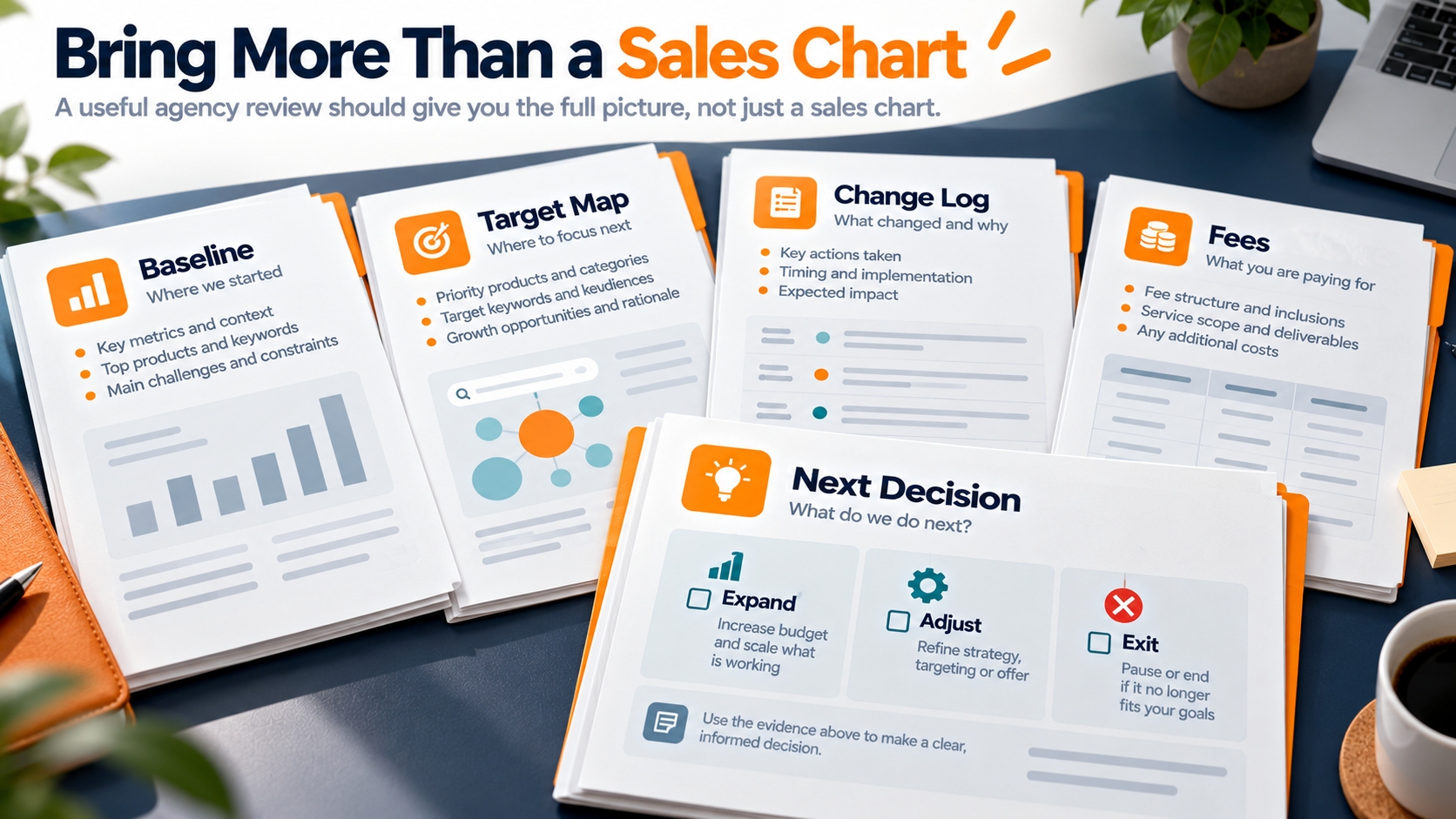
Specify notice periods, renewal terms, outstanding fees, and the exports to be delivered at exit. Include campaign and target records, negative lists, test history, unresolved issues, and any creative files or usage rights included in your agreement.
Separate your purchased deliverables from the agency's proprietary software or licensed third-party assets. Ask what will remain usable without its dashboard, and document data-return, retention, and deletion obligations.
A practical warning sign: An agency needs enough access to do its job. It should also be able to explain why each permission is necessary and how your business will continue operating after that access ends.
Make the First 90 Days an Acceptance Test
The first review should compare delivered work with the proposal, not simply ask whether sales are up. Establish the baseline before changing campaign structure, naming conventions, or reporting definitions.
The following 90-day schedule is a sample operating plan, not an Amazon requirement or a guaranteed time to profitability. Adjust it for traffic, seasonality, creative production, and the scope of the engagement.
DAYS 1–15 / ESTABLISH THE BASELINE
Confirm access, scope, campaign inventory, costs, reporting definitions, stock constraints, and approval rules. Deliver a prioritized audit and preserve historical reports. Correct urgent problems, but document the reason before making a broad rebuild.
DAYS 16–45 / RUN CONTROLLED CHANGES
Deliver the target map, agreed campaign changes, search-term decisions, and scheduled creative work. Record hypotheses and test limits. The client supplies product approvals and inventory updates; the agency documents execution and exceptions.
DAYS 46–90 / REVIEW THE WORK AND THE ECONOMICS
Evaluate mature campaign results, completed deliverables, agency fees, and the next spending decision. Explain which tests succeeded, which failed, and which remain inconclusive. Check that reports and assets can be handed over in the agreed form.
Evaluate service delivery before waiting for a perfect sales result
A low-volume product may need more time to produce a reliable performance comparison. That does not prevent you from checking whether the agency supplied the audit, maintained the change log, respected approvals, and explained its targeting decisions.
Likewise, do not attribute every weak result to the agency if the client delayed essential creative approvals or ran out of stock. Record those dependencies. A fair review makes both sides' responsibilities visible.
Decide whether to expand, correct the scope, or leave
Expand when the team delivers reliable work and can explain where additional spend or scope should go. Correct the engagement when a specific capability or approval bottleneck is holding it back. Consider an orderly exit when reporting remains unverifiable, boundaries are repeatedly ignored, or the agency cannot account for its decisions.
Sign for the Work You Can Recognize
The strongest proposal makes the engagement understandable before it begins: a named team, a defined scope, a credible product-level plan, a complete fee schedule, and a reporting process your business can verify.
You are not buying the possibility of a better-looking dashboard. You are buying the time and judgment to make better marketplace decisions. The contract, the first work sample, and the ongoing reports should all make that work visible.
FAQs
What do Amazon advertising and marketing agencies do?
They can provide advertising management, creative work, retail support, measurement, or technology services. Some combine several disciplines. Specify the actual deliverables because an advertising-only engagement does not automatically include catalog, inventory, or customer-service management.
How much does an Amazon agency cost?
Pricing can use project fees, monthly retainers, spend-based or sales-based commissions, or a custom combination. Request quotes for the same scope and calculate minimums, software, creative, and onboarding separately. The dollar amounts in this article are hypothetical, not an industry rate range.
Does Amazon Ads partner status mean the agency works for Amazon?
No. Amazon Ads partners are third-party businesses. Their directory presence and applicable partner status can help with screening, but the service agreement, assigned team, and promised work still need independent evaluation.
Should a small seller hire an agency or manage advertising in-house?
Compare the recurring workload, internal skill gaps, and cost of specialist help. A limited audit or consulting engagement may be enough for a small account. Ongoing management is easier to justify when there is meaningful work to delegate and an internal owner who can supply product and business decisions.
What should an agency audit deliver?
Expect a documented baseline, product and offer constraints, a relevant keyword and ASIN shortlist, prioritized campaign actions, and a test plan. Each recommendation should identify its evidence, intended outcome, spending boundary, and decision owner.
Is a lower ACOS enough to prove an agency is performing well?
No. Review the underlying spend, sales mix, campaign objectives, attribution basis, and agency cost. ACOS measures advertising spend relative to attributed sales; it does not by itself establish profit or incremental customer acquisition.
Does an agency need my primary Amazon password?
Use Amazon's supported user, service-provider, and account-linking processes instead. Grant the permissions needed for the agreed work, retain your own administrator, and review separate software authorizations. Document how each access path will be removed at exit.
How long should I give an agency to show results?
Set early deadlines for the audit, access setup, target plan, and reporting. Allow performance tests enough traffic and time for the relevant attribution window. A 90-day review can organize the engagement, but it is not a universal deadline for proving profitability.
References
- Amazon Ads: Find the Right Partner for You View
- Amazon Ads: Advertising Support, Partner Types, and Pricing Models View
- Amazon Ads: Verified and Advanced Partner Status View
- Amazon Ads: Targeting with Sponsored Products View
- SellerSprite: Keyword Research New User Guide View
- SellerSprite: Reverse ASIN for Beginners View
- SellerSprite: How to Select the Right Keywords View
- Amazon Ads: ACOS, ROAS, and Profit Considerations View
- Amazon Ads: Ad Campaign Attribution View
- Amazon Ads: Sponsored Ads New-to-Brand Metrics View
- Amazon Seller Central: Set and Edit User Permissions View
- Amazon Ads: Add and Unlink Accounts in a Manager Account View
- Amazon Selling Partner API Documentation: Revoke Authorizations View
- Amazon Ads: Claims and Substantiation View
- Amazon Seller Central: Customer Product Reviews Policies View
- Amazon Ads: Pricing Transparency and Applicable Media Fees View
By SellerSprite Content Team
The SellerSprite Content Team combines Amazon marketplace research, keyword analysis, and e-commerce editorial expertise. Our ongoing research covers shopper demand, ASIN-level competition, advertising measurement, and the practical use of marketplace data by sellers and agencies. We focus on how research becomes a testable campaign decision, including the limits of competitor estimates and the reporting needed to evaluate commercial results.
Last reviewed: October 23, 2026