TL;DR: Yes, Amazon search rankings can vary significantly by geographic location. Understanding geo-ranking helps sellers optimize for local demand, improve visibility in specific regions, and leverage tools like SellerSprite to track regional performance and refine their Amazon strategy.
Key Takeaways
- Amazon product rankings are not uniform across the U.S.—they can differ by state, city, or even ZIP code due to localized demand, shipping networks, and customer behavior.
- Geographic ranking factors such as local search volume, regional competition, and proximity to fulfillment centers influence how products appear in location-based search results.
- Sellers can use geo-targeting strategies—like optimizing keywords for regional preferences and leveraging localized advertising—to boost visibility in high-potential markets.
- Tools like SellerSprite enable sellers to monitor regional keyword performance and adapt listings based on real-time geo-ranking data.
- New or growing brands should consider multi-region optimization early to build momentum during the honeymoon period and avoid being outcompeted in key markets.
Table of Contents
- What Is Geo-Ranking on Amazon?
- Why Geo-Ranking Matters for Amazon Sellers
- How Amazon Uses Location Data to Influence Rankings
- Key Geographic Ranking Factors You Should Know
- How to Track Regional Keyword Performance
- Strategies for Multi-Region Optimization
- Common Geo-Targeting Mistakes to Avoid
- FAQ
- References
Note on marketplaces: This guide is specifically optimized for the US market.
What Is Geo-Ranking on Amazon?
Geo-ranking refers to the phenomenon where search engine or marketplace results—including Amazon product listings—appear differently depending on the user's geographic location. While many sellers assume that Amazon rankings are consistent nationwide, the reality is far more nuanced. Search results can shift based on a buyer’s city, state, or even ZIP code, influenced by localized demand patterns, inventory availability, and fulfillment logistics.
For example, a search for “portable camping grill” might show different top-ranking products in Phoenix, Arizona, versus Portland, Maine. In Phoenix, where outdoor activity peaks during cooler months, seasonal trends may favor certain models earlier in the year. In contrast, Portland buyers might prioritize grills made of weather-resistant materials due to the city's higher rainfall. These subtle but impactful differences mean that a one-size-fits-all SEO strategy often falls short.
Understanding geo-ranking is especially critical for sellers aiming to scale across diverse U.S. markets. Whether you're a new seller testing product-market fit or a brand managing national distribution, recognizing how location shapes visibility allows you to tailor your approach and capture higher-converting traffic.

Why Geo-Ranking Matters for Amazon Sellers
If you’ve ever wondered why your product ranks well in some areas but disappears from page one in others, geo-ranking is likely the culprit. For Amazon sellers, this isn’t just an academic curiosity—it has direct implications for sales, advertising ROI, and long-term brand growth.
First, consumer behavior varies significantly across regions. Climate, cultural preferences, income levels, and even local regulations affect purchasing decisions. A winter coat optimized for Minnesota winters may not resonate with consumers in Florida, even if the keyword match is perfect. Amazon’s algorithm picks up on these signals and adjusts rankings accordingly to serve the most relevant products.
Second, Amazon’s fulfillment network plays a major role. Products stored in nearby fulfillment centers tend to rank higher for local searches because they offer faster delivery—a key ranking signal. This means two identical listings could perform differently based solely on inventory placement. Sellers using Fulfillment by Amazon (FBA) can gain a geo-ranking advantage by strategically distributing stock across multiple fulfillment centers.
Finally, competition intensity varies by region. In densely populated areas like California or New York, competition for popular keywords is fierce. Meanwhile, the same product might dominate in less saturated markets like Idaho or Nebraska. By identifying underserved regions, sellers can allocate ad spend more efficiently and capture market share before competitors do.
How Amazon Uses Location Data to Influence Rankings
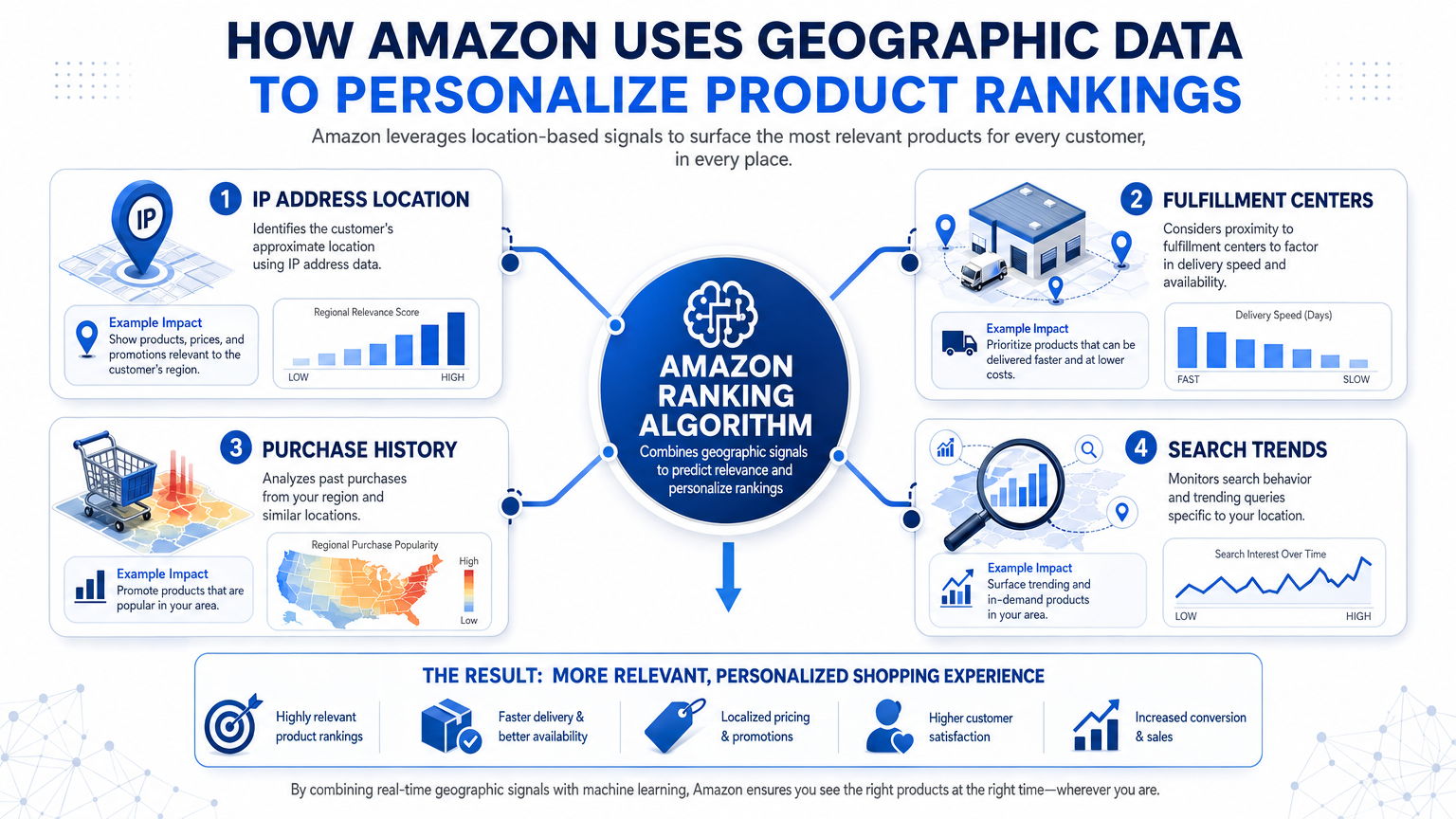
Amazon leverages a combination of user-level and system-level data to personalize search results. When a shopper performs a search, Amazon considers several location-based signals to determine which products to surface:
1. Buyer’s IP Address and Device Settings
Amazon detects the approximate location of a user through their IP address, GPS (on mobile), and account settings (such as default shipping address). This allows Amazon to prioritize products that are likely to ship quickly and meet local demand.
2. Inventory Proximity and Fulfillment Network
Products stored in fulfillment centers close to the buyer are more likely to be ranked higher due to faster delivery times. Amazon’s A9 algorithm favors listings that can offer Prime-eligible two-day or same-day shipping, which is easier when inventory is regionally distributed.
3. Historical Purchase Patterns by Region
Amazon analyzes past buying behavior within geographic areas to predict future demand. If customers in Texas frequently buy large-capacity coolers, Amazon will boost similar products in searches originating from that state—even if those items aren’t top sellers nationally.
4. Localized Search Trends and Seasonality
Search volume for certain keywords fluctuates by region and season. For instance, “snow blower” sees spikes in northern states during winter, while southern states show minimal interest. Amazon adjusts rankings dynamically to reflect these trends, giving seasonal relevance a strong weighting.
These factors combine to create a dynamic, location-aware ranking environment. As a result, sellers must move beyond national-level assumptions and adopt a granular, geo-informed strategy.
Key Geographic Ranking Factors You Should Know
To effectively compete in a geo-differentiated marketplace, sellers need to understand the core factors that drive regional ranking variations. Below are the most influential geographic ranking factors on Amazon:
1. Local Search Volume and Demand
Not all keywords perform equally across regions. Some terms are more commonly searched in specific areas due to cultural or environmental reasons. For example, “rugged hiking boots” may have high search volume in Colorado and Washington but low interest in urban centers like Miami. Tools like SellerSprite’s rank tracking allow sellers to compare keyword performance across states and identify high-opportunity regions.
2. Regional Competition Intensity
Competitor density varies widely by location. In major metropolitan areas, hundreds of sellers might compete for the same keywords. In rural or less-populated regions, competition is often lighter, offering easier entry points for new brands. Monitoring regional competition helps you decide where to focus your PPC campaigns and organic optimization efforts.
3. Fulfillment Center Proximity
As mentioned earlier, proximity to Amazon’s fulfillment network directly impacts delivery speed and, consequently, ranking. Sellers who use Amazon’s Multi-Channel Fulfillment (MCF) or distribute inventory via Seller Fulfilled Prime (SFP) can gain a geo-ranking edge by ensuring faster shipping options in targeted regions.
4. Customer Reviews and Local Seller Ratings
While Amazon doesn’t publicly segment reviews by location, there’s evidence that localized customer satisfaction influences regional trust signals. Products with strong review velocity in a particular area may see improved rankings there, especially if those reviews mention local use cases (e.g., “perfect for beach days in San Diego”).
5. Advertising Performance by Region
Amazon DSP and Sponsored Products allow geo-targeting, enabling sellers to run location-specific ad campaigns. High click-through and conversion rates in certain regions signal strong relevance, which can feed back into organic rankings. This creates a positive feedback loop: better ads → more sales → higher rankings → more visibility.
How to Track Regional Keyword Performance
You can’t optimize what you can’t measure. To succeed in a geo-differentiated environment, sellers need tools that provide granular, location-specific insights into keyword rankings and performance.
Here’s a step-by-step process to monitor and analyze regional keyword performance:
Step 1: Choose Target Regions
Start by identifying the states or cities most relevant to your product. Consider factors like population density, climate, lifestyle, and existing sales data. For example, a seller of snow shovels should prioritize northern states like Michigan, Wisconsin, and Vermont.
Step 2: Use Geo-Specific Rank Tracking Tools
Standard rank trackers often report national averages, masking regional disparities. Instead, use advanced tools like SellerSprite, which allows you to track keyword positions in specific U.S. locations. This reveals whether your product ranks on page one in Dallas but drops to page three in Seattle.
Step 3: Analyze Regional Search Trends
Cross-reference your rank data with Amazon search trend tools or Google Trends to understand seasonal fluctuations. For instance, “pool float” searches peak in June in Arizona but may start as early as April in Florida. Aligning your inventory and promotions with these trends boosts regional relevance.
Step 4: Compare Competitor Performance by Region
Identify who ranks well in each region and analyze their strategies. Are they using localized keywords? Offering faster shipping? Running geo-targeted ads? Reverse-engineering competitor success helps you refine your own regional approach.
Step 5: Adjust Listings and Ads Accordingly
Based on your findings, update product titles, bullet points, and backend keywords to reflect regional language and preferences. For example, “sneakers” might be called “tennis shoes” in the South. Launch targeted Sponsored Brands campaigns to reinforce visibility in underperforming areas.
Strategies for Multi-Region Optimization
Winning on Amazon isn’t just about ranking nationally—it’s about dominating in the right regions at the right time. Here are proven strategies for optimizing across multiple geographic markets:
1. Customize Listings for Regional Preferences
While you can’t have different ASINs for each region, you can tailor your content to resonate locally. Use regional synonyms in backend search terms (e.g., “bubbler” for “drinking fountain” in Wisconsin). Highlight use cases relevant to specific climates or lifestyles in your bullet points and A+ Content.
2. Leverage Amazon DSP for Geo-Targeted Advertising
Amazon Demand-Side Platform (DSP) allows precise geographic targeting. Run video or display ads promoting your product to users in high-potential regions. For example, target coastal areas with ads for marine-grade waterproof speakers. This builds brand awareness and drives conversions in specific markets.
3. Distribute Inventory Strategically
Work with Amazon’s inventory placement service or manually allocate stock to fulfillment centers in key regions. This reduces shipping times and increases the likelihood of winning the Buy Box in local searches. Monitor FBA inventory reports to avoid stockouts in high-demand areas.
4. Run Location-Based Promotions
Use coupons or lightning deals targeted to specific states. For instance, offer a discount on patio heaters during an unexpected cold snap in Texas. These time-sensitive offers can spike sales and boost rankings in that region.
5. Monitor and Respond to Regional Feedback
Pay attention to reviews and Q&A from customers in different areas. If multiple buyers in humid regions mention mold issues, consider updating product materials or packaging. Addressing regional pain points improves satisfaction and strengthens long-term ranking potential.
Common Geo-Targeting Mistakes to Avoid
Even experienced sellers can misstep when navigating geo-ranking. Here are common pitfalls and how to avoid them:
Mistake 1: Assuming National Rankings Reflect Local Performance
Relying solely on national rank averages can blind you to regional weaknesses. Always drill down into state-level data to uncover hidden opportunities or threats.
Mistake 2: Ignoring Regional Keyword Variants
Failing to include local terminology in your keyword strategy limits discoverability. Use tools like SellerSprite’s keyword research module to identify region-specific search terms.
Mistake 3: Overlooking Inventory Distribution
Concentrating all inventory in one fulfillment center may save costs in the short term, but it hurts geo-ranking. Balance cost efficiency with strategic distribution to maintain competitive delivery times nationwide.
Mistake 4: Running One-Size-Fits-All Ad Campaigns
Generic campaigns miss the mark in diverse markets. Segment your Sponsored Products campaigns by region and adjust bids based on local performance metrics like ACOS and conversion rate.
Avoiding these mistakes positions your brand for sustainable, location-aware growth on Amazon.
FAQ
How does geographic location affect Amazon product rankings in the US?
Geographic location affects Amazon product rankings by influencing search relevance, delivery speed, and local demand. Amazon’s algorithm prioritizes products that are likely to convert based on the buyer’s location, including proximity to fulfillment centers, regional search trends, and historical purchase behavior in that area. This means the same keyword can yield different top results in different states.
Do Amazon search rankings vary by state or city for the same keyword?
Yes, Amazon search rankings can vary significantly by state or city for the same keyword. Factors like local competition, inventory availability, and consumer preferences cause these differences. For example, a product might rank #1 in Chicago but #15 in Miami due to varying demand, shipping options, or regional marketing efforts.
Can sellers optimize their listings for specific regions to improve local visibility?
Yes, sellers can optimize for specific regions by using location-relevant keywords, running geo-targeted ads, distributing inventory strategically, and tailoring product content to regional needs. Tools like SellerSprite help track regional performance and guide data-driven optimizations for improved local visibility.
Next Steps
- Sign up for SellerSprite to start tracking your product’s geo-specific rankings across the U.S.
- Review your current keyword strategy and identify opportunities to incorporate regional search terms.
- Explore Amazon DSP or Sponsored Products to launch your first geo-targeted ad campaign.
References
- Amazon A9 Algorithm Overview View
- How to Boost Ranking for New Products – Honeymoon Period View
- Why Your Product Is Not Ranking for Your Main Keyword View
By SellerSprite Success Team
The SellerSprite Success Team combines deep expertise in Amazon marketplace dynamics, data analytics, and e-commerce growth strategies. With years of experience helping thousands of sellers—from beginners to enterprise brands—optimize their listings, track performance, and scale profitably, our team is committed to delivering actionable, evidence-based insights grounded in real-world results.