TL;DR: Amazon reimbursement services help sellers identify, investigate, and recover eligible losses involving FBA inventory and related transactions. Some reimbursements are issued automatically; others require a supported claim with the correct documentation. Before using a third-party service, check Amazon's own Inventory Defect and Reimbursement portal, understand the applicable claim window, and verify how reimbursement value is calculated. A worthwhile service should recover additional eligible funds, maintain a clear audit trail, and charge fees only on the basis agreed in its contract.
Key Takeaways
- An inventory discrepancy is not automatically a valid reimbursement claim. The loss must fall within the applicable Amazon policy and be supported by the required evidence.
- Amazon already automates certain FBA reimbursements. Review claims that are eligible, under investigation, and resolved before paying someone to recover them.
- Claim deadlines depend on the event. Fulfillment-center losses, customer returns, inbound shipments, removals, and valuation disputes have different processes and timing rules.
- Reimbursement value is not always the retail selling price. Eligible pre-order inventory losses generally use sourcing cost; qualifying post-order losses follow a separate valuation method.
- Evaluate what a recovery service actually adds. Look at approved incremental recoveries, commissions, reversals, documentation quality, and account access rather than the size of its initial opportunity estimate.
Table of Contents
- A Reimbursement Is Not an Extra Sale
- First, Identify Where the Inventory Problem Happened
- The Claim Clock Depends on the Event
- Why a $35 Product May Not Receive a $35 Reimbursement
- Audit Your Own Account Before Hiring a Recovery Service
- What Third-Party Reimbursement Services Actually Do
- The Commission Should Follow the Money Actually Recovered
- Questions to Ask Before Granting Account Access
- Build a Reimbursement Process That Survives the Next Policy Change
- Recovery Begins with Reconciliation
- FAQs
- References
Policy scope: This article focuses on US Amazon sellers using Fulfillment by Amazon (FBA). It addresses eligible inventory-loss and damage claims, reimbursement reconciliation, and third-party recovery services. It does not treat seller-fulfilled SAFE-T claims, Multi-Channel Fulfillment claims, or every disputed Amazon fee as part of the same FBA inventory reimbursement policy. Amazon may update policies, eligibility windows, and account interfaces; verify current instructions in Seller Central for each claim.
A Reimbursement Is Not an Extra Sale
A seller notices that inventory quantities have changed, but the expected units are not available for sale. Another seller finds a reimbursement credit in a settlement report but cannot identify which loss it covers. Both situations deserve investigation, although neither automatically establishes that Amazon still owes the seller money.
Amazon reimbursement services are third-party tools or managed services that help sellers examine eligible losses, reconcile account records, prepare supporting documents, and pursue valid reimbursement claims.
The underlying reimbursement comes from Amazon when a claim qualifies under the relevant policy. The external provider does not create a separate entitlement to compensation.
Four Terms That Should Not Be Interchanged
Customer refund
Money returned to a buyer. A customer refund does not automatically establish that Amazon owes the seller an FBA inventory reimbursement.
FBA inventory reimbursement
Eligible compensation or replacement inventory provided when a loss or damage event falls under Amazon's FBA reimbursement policy.
Fee adjustment
A correction to a particular charge or fee. It requires its own evidence and applicable procedure rather than automatically qualifying as lost-inventory compensation.
Reimbursement reversal
A previously issued credit that Amazon later reverses, including situations in which reimbursed inventory is found and returned to the seller's stock.
Amazon's FBA inventory reimbursement policy describes eligibility, reimbursement methods, calculation rules, and exclusions. It also states that a valid claim may be resolved through replacement inventory rather than a cash payment.
This distinction matters when reviewing a service provider's results. A recovered inventory unit, a cash reimbursement, and a proposed claim should not appear as three separate cash recoveries for the same incident.
First, Identify Where the Inventory Problem Happened
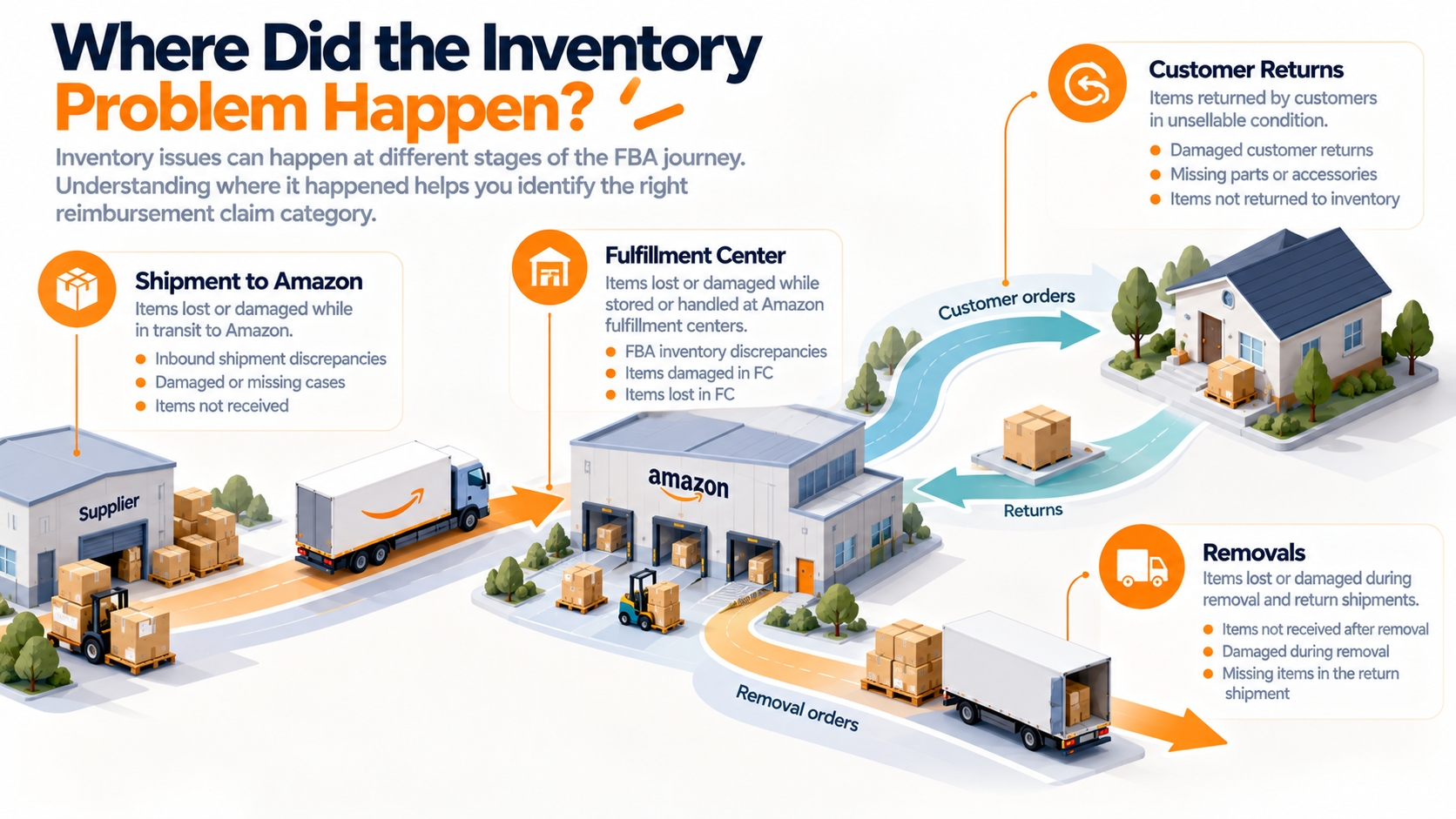
A reimbursement audit begins with the event, not the missing dollar amount. Amazon separates claims according to where inventory was lost or damaged during the fulfillment process.
The distinction determines which records matter, which eligibility requirements apply, and when the claim can be submitted.
| Claim category | Example issue | Initial evidence to check |
|---|---|---|
| Shipment to Amazon | Fewer eligible units received than the quantity documented in an inbound shipment. | Shipment ID, shipping plan, proof of ownership, delivery records, and reconciliation status. |
| Fulfillment-center operations | An eligible item is reported lost or damaged while under Amazon's control in its fulfillment network. | Inventory Defect and Reimbursement status, Inventory Ledger events, FNSKU, and transaction details. |
| FBA customer returns | An eligible refunded item is not returned or is lost or damaged in circumstances covered by Amazon's policy. | Order ID, refund or replacement date, returned-unit status, and responsibility for the condition. |
| Removal orders | Eligible inventory is lost or damaged while being removed from Amazon's fulfillment network. | Removal order ID, shipment and tracking details, delivery evidence, photographs, and item labels. |
Not Every Unfulfillable Return Is Amazon's Responsibility
A returned product may be classified as unsellable because it was damaged by the customer, arrived defective, or violated applicable product requirements. Those classifications do not automatically make the loss eligible for reimbursement.
The relevant question is not simply whether the unit can be sold again. It is whether Amazon accepts responsibility for the specific loss or damage under the applicable policy.
Seller-Fulfilled Claims Are a Separate Process
Seller-fulfilled order disputes may involve the SAFE-T claim process rather than the FBA inventory reimbursement process. Amazon announced that the US SAFE-T filing window changed to 30 days effective February 16, 2026, with a distinct start-date rule for eligible seller-fulfilled events.
Do not ask a provider to apply FBA warehouse-loss rules to an FBM return or use SAFE-T instructions for an FBA inventory claim. The fulfillment method and event type must be established first.
The Claim Clock Depends on the Event
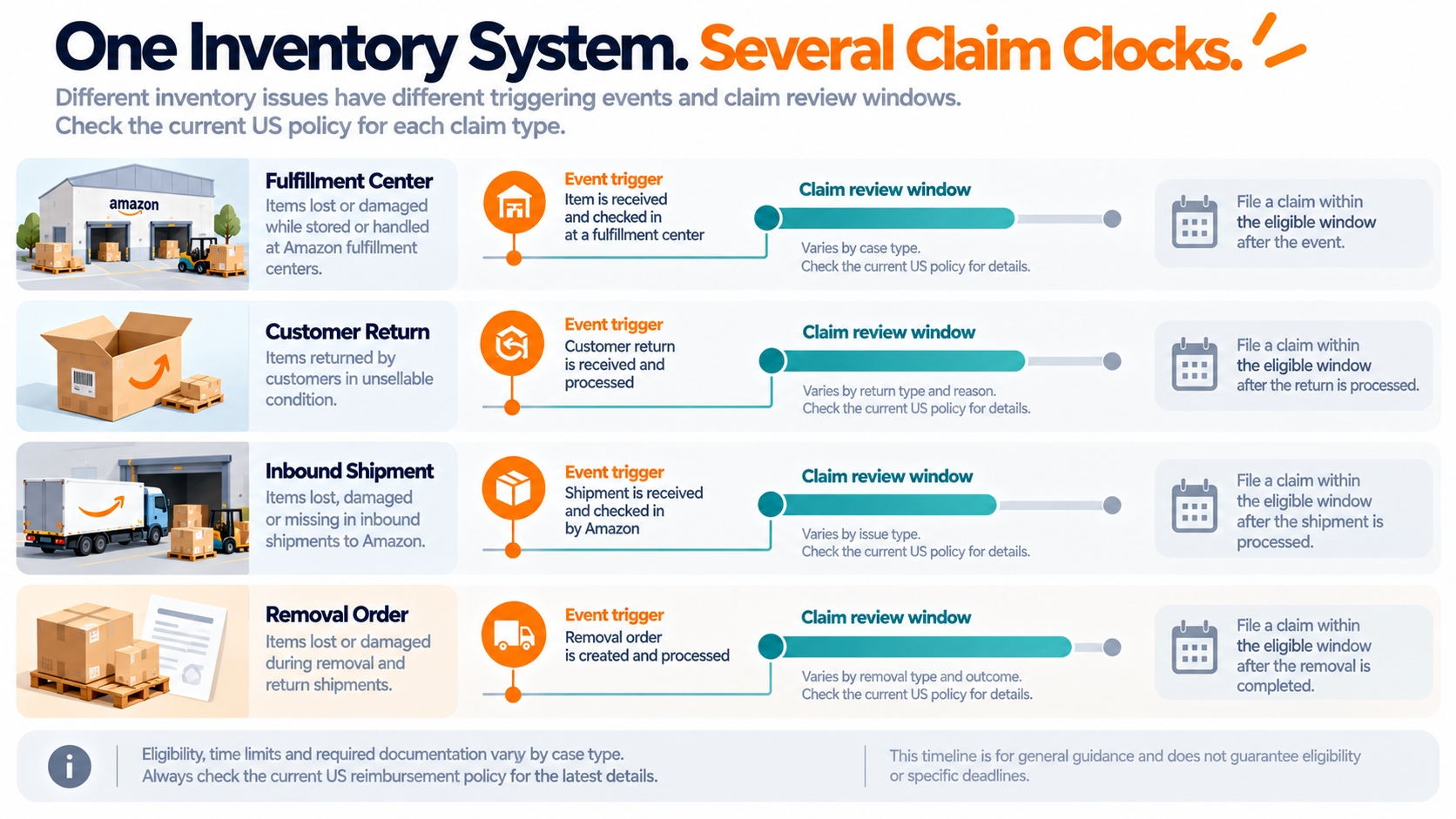
Filing too early can be as unproductive as filing too late. Amazon may need time to reconcile an inbound shipment or complete its customer-return process before a seller can submit an eligible claim.
Amazon has also revised claim windows over time. A service provider claiming to recover inventory losses simply because they occurred within the last 18 months is not applying a reliable universal rule.
The Published Windows Are Not One Universal Deadline
Amazon announced the following FBA claim-window changes effective October 15, 2025. These are useful reference points for auditing historical and ongoing cases, but they must be checked against the current claim-specific Seller Central instructions for the US marketplace.
| Event | Announced filing window | Timing reference |
|---|---|---|
| Fulfillment-center loss or damage | Within 60 days | Date the loss or damage was reported |
| FBA customer returns | Days 45 through 105 | Customer refund or replacement date |
| Removal orders lost | Days 15 through 135 | Removal shipment creation date |
| Removal orders damaged | Within 120 days | Shipment delivery date |
| Removal grading disputes | Within 120 days | Date the item was removed from the fulfillment network |
| Claim re-evaluation requests | Within 90 days, as announced | Initial claim |
Important verification: This table records Amazon's October 2025 announcement, not a promise that every currently displayed account workflow uses exactly those numbers. Earlier and later help content has used different windows for certain claim types. For example, the current US reimbursement valuation guidance separately instructs sellers to dispute a reimbursement amount within 60 days of its issuance.
Before filing, confirm the current claim-specific policy, event date, claim eligibility status, and applicable re-evaluation procedure in Seller Central. Do not substitute the 90-day re-evaluation announcement for the separate 60-day valuation-dispute requirement.
Inbound Shipment Claims Have Their Own Process
For a shipment to Amazon, the seller must first check whether the shipment is eligible for investigation in the Contents section of the shipping workflow. The publicly indexed US help page describes a claim deadline of nine months after the verified delivery date, subject to the shipment's eligibility and the applicable policy instructions.
Do not apply that inbound rule to losses that occurred later during fulfillment-center operations. Also avoid importing a deadline from a different Amazon marketplace; Amazon has announced separate regional changes to inbound claim procedures.
Record when the shipment becomes eligible for investigation and file within the deadline shown for that particular shipment. Reconciliation and proof-of-ownership requirements still apply.
Use a Deadline Register, Not an Old Lookback Claim
For each issue, record the event category, event date, date claim submission becomes eligible, deadline, source policy, current status, and assigned owner.
A provider advertising that it audits 18 months of transactions may legitimately review historical records for analysis. That does not mean every historic discrepancy remains eligible for a new claim.
Why a $35 Product May Not Receive a $35 Reimbursement
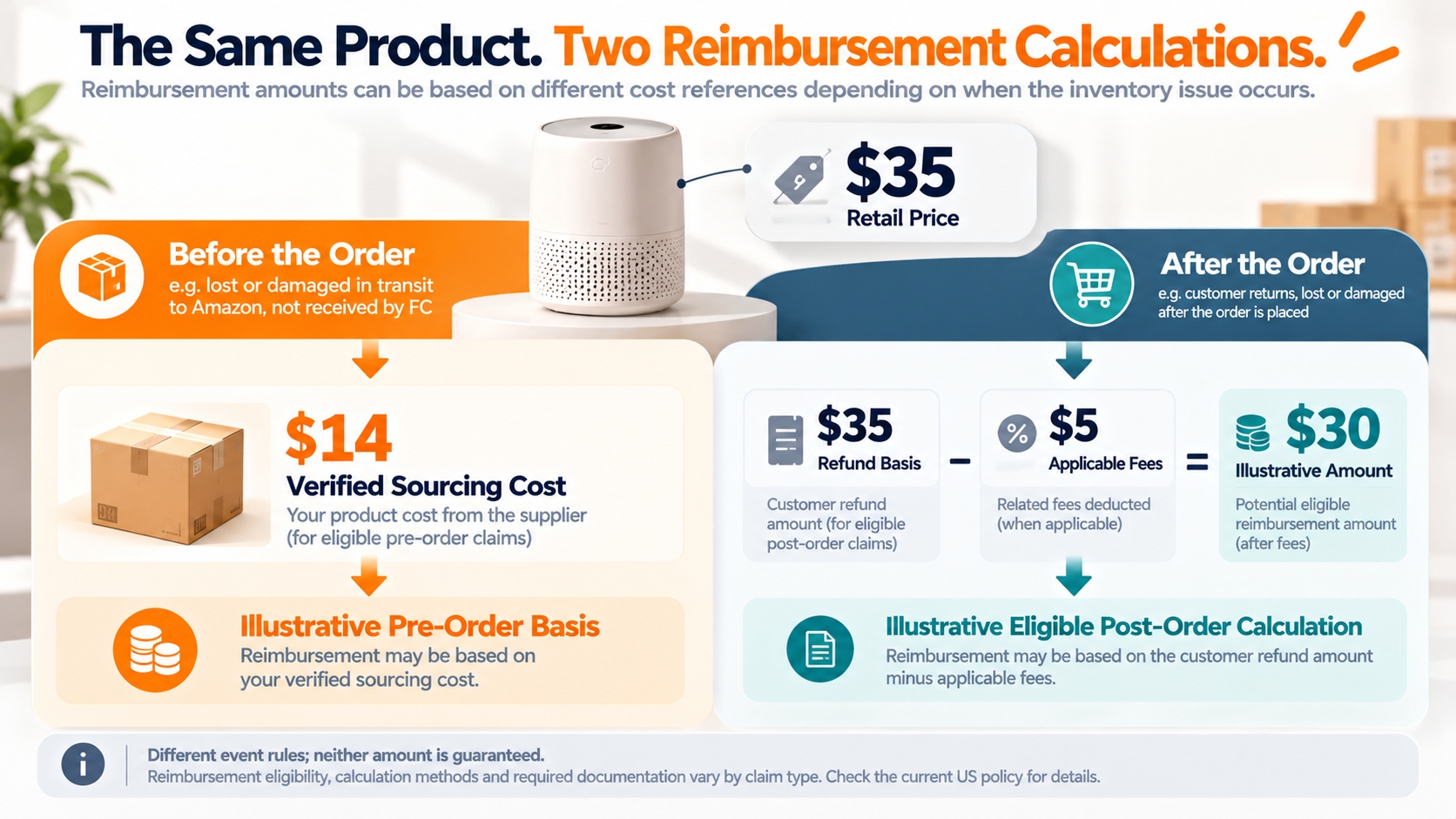
Claim eligibility and reimbursement amount are separate questions. Even when Amazon accepts responsibility for a loss, its compensation is calculated under the policy for that event.
The current US FBA policy distinguishes losses occurring before a customer order from eligible losses associated with an order or return.
Before an Order: The Sourcing-Cost Basis
For eligible pre-order inventory losses, Amazon generally bases compensation on the product's sourcing cost. This includes the amount paid to obtain the product from a manufacturer, wholesaler, or reseller, or the applicable production cost when the seller manufactures it.
Amazon excludes expenses such as shipping, handling, and customs duties from that defined sourcing-cost amount. The policy also provides for reduced estimated values in certain cases involving inventory already in unsellable condition.
If a seller has not submitted its own sourcing cost, Amazon may use an estimate derived from comparable-product information. Sellers can review and manage those values through the Manage Your Sourcing Cost section of the Inventory Defect and Reimbursement portal.
After an Order: A Separate Refund-Based Calculation
For qualifying post-order customer-return claims, Amazon bases reimbursement on the refund or replacement associated with the original FBA order, minus applicable fees.
This does not mean every customer refund generates a seller reimbursement. A returned sellable unit can go back into available inventory, while a customer-damaged or defective unit may be ineligible under the relevant conditions.
Hypothetical Product Economics
PRE-ORDER LOSS
$14
Illustrative verified sourcing cost for a product with a $35 retail selling price.
ELIGIBLE POST-ORDER LOSS
$30
Illustrative $35 refund or replacement basis, less $5 in assumed applicable fees.
These figures illustrate two different policy calculations. They are not current Amazon fee quotes, guaranteed reimbursement amounts, or interchangeable claim outcomes.
The $14 sourcing-cost illustration does not reimburse the seller's expected retail margin. It also does not imply that the separate shipping, import, and preparation costs are recoverable under the sourcing-cost calculation.
A provider estimating recoveries simply by multiplying missing units by retail price can therefore materially overstate the potential value.
Review Sourcing-Cost Values Before a Loss Occurs
Keep purchase invoices and other accepted proof-of-value documents organized by the relevant product or FNSKU. If Amazon's estimated sourcing cost does not reflect your actual eligible cost, review the process for submitting and validating the correct amount.
The US policy currently sets a maximum FBA reimbursement value of $5,000 per eligible unit and specifies a 60-day window after reimbursement issuance for disputing a unit valuation. Review the applicable case instructions before submitting a dispute.
Reimbursement and commercial profitability remain different calculations. A seller may receive the policy-defined compensation and still incur unrecovered expenses or lost contribution.
Audit Your Own Account Before Hiring a Recovery Service
Before paying for outside recovery, examine the tools Amazon already provides. Sellers can use the centralized Inventory Defect and Reimbursement portal to review detected inventory defects and their current resolutions.
Amazon describes the portal as combining information from multiple reports and applying its reimbursement eligibility checks. That makes it a more appropriate starting point than treating every negative inventory adjustment as a recoverable loss.
Read the Three Portal States
ELIGIBLE FOR CLAIM
The portal identifies defects for which seller action may be needed under the applicable policy.
IN PROGRESS
The issue is already being investigated or processed. A new duplicate request may not be appropriate.
RESOLVED
Amazon records the resolution and reasoning, including reimbursements, reconciliation, or ineligibility.
A resolved case is not necessarily a paid claim. It may have been reconciled through an inventory adjustment or determined ineligible. Review the resolution type rather than counting every closed issue as a recovery.
Reconcile the Inventory Ledger with the Reimbursements Report
Inventory records show movements and adjustments. Reimbursement records show the compensation transactions Amazon has issued. They answer related but different questions.
A useful audit links the relevant FNSKU, transaction, claim or case ID, date, quantity, and resolution. For inbound discrepancies, reconcile the shipment contents and proof of ownership before alleging a loss.
- Identify the event and its current eligibility status.
- Find the corresponding quantity in the Inventory Ledger, shipment records, or relevant returns and removals reports.
- Check for automatic or previously requested reimbursements.
- Confirm whether Amazon has already restored inventory or otherwise reconciled the discrepancy.
- Prepare one supported claim for the unresolved eligible event using the required documentation and filing procedure.
Keep a Case-Level Evidence Record
Store the event type, ASIN or FNSKU, affected quantity, policy basis, relevant dates, supporting documents, case reference, Amazon response, and eventual financial or inventory resolution.
This makes the next review substantially easier. It also gives a third-party provider a documented baseline rather than inviting it to duplicate claims the seller has already resolved.
A useful audit principle: A discrepancy is an investigation candidate. An eligible claim is a documented request. An approved claim is a decision. A net recovered amount is the final value after actual credits, reversals, and applicable service charges. Report these stages separately.
What Third-Party Reimbursement Services Actually Do
Reimbursement providers differ in how much of the process they handle. One may identify potential cases and prepare evidence. Another may file and follow eligible cases on a seller's behalf through an appropriately authorised arrangement.
Those are materially different services. The pricing and account permissions should reflect the work being performed.
Self-Service Audit Software
Audit software may inspect authorized records, identify potential discrepancies, create checklists, and generate claim information for the seller to review and submit.
This can work well for sellers with an internal operations team. The software reduces investigation effort, while the seller retains responsibility for assessing eligibility and completing any required submissions.
Managed Reimbursement Services
A managed provider may review case eligibility, gather evidence, submit permitted claims, monitor responses, and handle follow-up requests within the agreed scope.
A seller considering this arrangement should ask which claim categories the provider covers, what remains the seller's responsibility, and whether the provider performs every stage it advertises.
Audit and Advisory Services
Some engagements are designed to review historical transactions or advise an internal finance and operations team. They may deliver a reconciliation report without managing ongoing claims.
This can be appropriate when the business needs to understand the quality of its existing records, investigate a specific discrepancy, or redesign its monitoring process.
| Service model | Typical provider role | What the seller should verify |
|---|---|---|
| Self-service software | Identify candidates and prepare supporting information. | Submission responsibility, coverage, software fees, and permitted data access. |
| Managed recovery | Investigate, submit permitted claims, and monitor case resolution. | Commission basis, eligible claim types, authorizations, and follow-up obligations. |
| Audit or advisory | Deliver findings, reconciliation analysis, and recommended next steps. | Scope, deliverables, handover, fixed fees, and whether filing is excluded. |
A provider's software can identify useful discrepancies without making every suggestion eligible. Amazon's own claims process, evidence requirements, and final reimbursement decisions still govern the result.
Avoid services that promise to recover every missing unit, guarantee a specific percentage of sales, or rely on repeated unsupported submissions. Amazon explicitly warns against insufficiently researched, premature, or excessive claim requests that interfere with support operations.
The Commission Should Follow the Money Actually Recovered
A percentage-based fee can be reasonable when the provider performs substantial investigation and follow-up work. But the percentage alone does not tell you how the contract treats automatic reimbursements, replacement units, reversals, or credits generated by previous claims.
Ask the provider to define precisely what counts as a successfully recovered reimbursement and when that amount becomes billable.
Potential, Approved, and Recovered Are Different Amounts
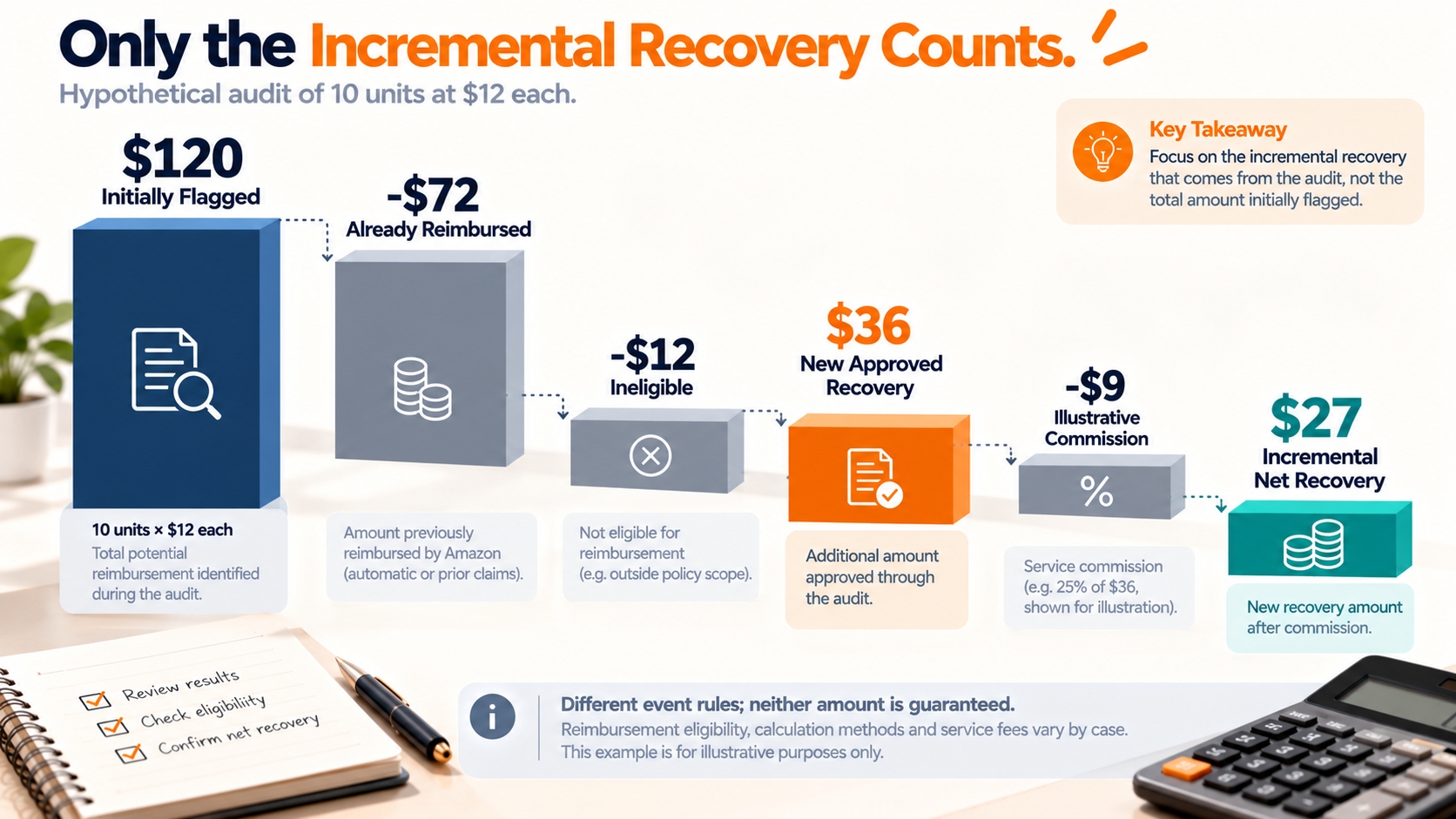
Consider a hypothetical audit of ten inventory units with a verified sourcing cost of $12 each. All ten initially appear as possible discrepancies, creating a preliminary $120 investigation value.
After reconciliation, the seller discovers that six units have already been automatically reimbursed, three additional units qualify for a new supported claim, and one unit is determined ineligible.
Hypothetical Recovery Reconciliation
Initially flagged
$120
Already reimbursed
$72
New approved recovery
$36
Ineligible
$12
Assumed commission: 25% of the $36 newly recovered amount = $9.
Incremental recovery after commission: $36 - $9 = $27.
The 25% rate is an illustrative contractual assumption, not an industry average. The $72 already reimbursed was not created by the new claim and should not automatically be treated as an incremental recovery.
Whether a provider may charge for automatically processed cases depends on the agreement. Sellers should evaluate that provision explicitly before signing rather than assume that every service uses the same definition of recovery.
Ask How Reversals Affect Commission
Amazon may reverse a reimbursement if it was issued incorrectly or if previously lost inventory is later found and restored.
If a recovery service already charged commission on the original credit, its contract should explain how that fee is adjusted following a reversal. Otherwise, the seller may pay for compensation that it no longer retains.
Distinguish Recovery Value from Business Profit
Recovering the sourcing cost of lost inventory can reduce a financial loss. It does not necessarily restore the original retail margin, advertising investment, inbound expenses, or opportunity cost of unavailable stock.
Report reimbursements separately from customer sales and ordinary product profitability. This keeps recovery performance visible without inflating the apparent operating performance of the product.
Questions to Ask Before Granting Account Access
A reimbursement provider may need access to sensitive seller-business information, including inventory movements, reimbursement transactions, and supporting procurement documents.
That access should be appropriate to the services the business has authorized. A provider that only produces a report does not necessarily need the same permissions as one that submits permitted claims.
Verify Coverage Before Pricing
Ask which marketplaces and claim types are supported. Confirm whether inbound shipment discrepancies, fulfillment-center losses, customer returns, and removal claims are all included or handled differently.
Some software may identify issues but require the seller to submit the claim manually. Other providers may have managed filing and monitoring capabilities. The proposal should explain those differences without implying all workflows are automatic.
Confirm the Data Connection and Permissions
Amazon's Selling Partner API provides authorized access to seller-business information through defined applications, roles, and permissions.
Review the official SP-API authorization requirements when considering a connected service. Public applications serving multiple sellers use an authorization process, and the developer must have the appropriate permissions for the operations performed.
Ask exactly which data categories are accessed, how long information is retained, whether purchase invoices are stored, who can view those documents, and how the connection is revoked.
Ask for a Claim-Level Audit Trail
A service should be able to connect each billed recovery to the related inventory event, submitted claim or case, Amazon decision, reimbursement transaction, and applicable commission.
Without this trail, a seller cannot reliably distinguish newly recovered funds from automatic credits, previous recoveries, or later reversals.
Provider Evaluation Checklist
- Coverage: Which eligible claim types and Amazon marketplaces are included?
- Submission: Does the provider file claims, prepare documents, or only identify opportunities?
- Commission: Are fees charged on newly recovered amounts, all credited amounts, or another contractual basis?
- Reversals: What happens when Amazon retracts a reimbursement?
- Evidence: Who supplies invoices, shipment documentation, photographs, and responses to Amazon's requests?
- Access: What permissions are needed, and how are they revoked?
- Exit: Can the seller export its cases, stop submissions, and understand any commission still owed after cancellation?
Do Not Let Volume-Based Claims Damage Support Quality
Amazon's policy cautions against insufficiently researched or premature requests, as well as excessive requests that interfere with its ability to support sellers.
A responsible provider should investigate the event and confirm supporting evidence before filing. Automated detection does not justify opening multiple cases for the same inventory issue.
Ask how the provider prevents duplicate claims and how it handles a case already marked In Progress or Resolved in Amazon's portal.
Build a Reimbursement Process That Survives the Next Policy Change
An occasional historical audit can identify past issues, but it cannot replace a process that responds to current deadlines and account activity.
For active FBA businesses, reimbursement monitoring belongs alongside inventory reconciliation and financial reporting. That does not require opening more claims. It requires identifying legitimate exceptions earlier.
Review Exceptions on a Defined Schedule
A weekly review may be practical for sellers with consistent FBA activity, while higher-volume businesses may need more frequent monitoring. Set the cadence around the shortest applicable claim window and the rate at which new events occur.
The review should cover newly eligible defects, approaching claim deadlines, unresolved cases, reimbursement credits, reversals, and sourcing-cost records requiring attention.
Record the Metrics That Actually Matter
| Metric | What it measures | Interpretation caution |
|---|---|---|
| Eligible unresolved value | Estimated value of documented issues still requiring a resolution. | Not guaranteed compensation. |
| Approved recoveries | Value of approved claims, identified by cash or inventory resolution. | Confirm settlement and watch for reversals. |
| Net cash recovery | Actual eligible cash credits less reversals and applicable external service charges. | Keep restored inventory value separate. |
| Deadline compliance | Whether eligible claims were filed within their applicable windows. | The correct start event differs by claim type. |
| Audit effort | Investigation, documentation, submission, and follow-up time. | Include human review and provider fees. |
Use Prevention Findings as Well as Recovery Results
A reimbursement audit can also reveal recurring operational problems. Repeated inbound discrepancies may justify examining supplier packing accuracy or shipment documentation. Removal-related losses may point to weaknesses in receiving procedures.
These patterns deserve investigation, but do not assume that every discrepancy was caused by a specific supplier, warehouse, or carrier without supporting evidence.
Preventing a recurring loss may be more valuable than recovering it after the event. The two benefits should nevertheless be measured separately.
Recovery Begins with Reconciliation
Amazon reimbursement services can save useful investigation time and help sellers pursue eligible claims. Their value is not established by the number of discrepancies they identify or the size of an estimated recovery report.
Start with Amazon's current policy and claim status. Determine where the event occurred, whether the loss qualifies, what evidence supports it, and whether compensation has already been issued. Then decide whether the remaining workload justifies self-service software or an external managed provider.
The strongest reimbursement process is one that can explain every claimed unit, every deadline, every Amazon decision, and every dollar ultimately retained.
FAQs
What are Amazon reimbursement services?
Amazon reimbursement services are tools or third-party managed services that help sellers identify, investigate, document, and pursue eligible losses under Amazon's applicable reimbursement policies. They do not issue compensation themselves or guarantee claim approval.
Does Amazon automatically reimburse lost FBA inventory?
Amazon proactively reimburses certain eligible losses, including inventory reported lost within its fulfillment network. Not every possible loss or adjustment is automatically compensated. Sellers should review the Inventory Defect and Reimbursement portal and Reimbursements report before filing another claim.
How much will Amazon reimburse for a lost FBA product?
The amount depends on the loss category. Eligible pre-order inventory losses generally use the product's sourcing cost. Qualifying post-order return claims use a separate refund- or replacement-based method, less applicable fees. Amazon's policy also provides exclusions, reduced values for some unsellable items, and a maximum reimbursement per eligible unit.
How far back can I claim Amazon FBA reimbursements?
There is no universal lookback period for every claim. Amazon uses different filing windows for fulfillment-center events, customer returns, inbound shipments, and removal orders. The 2025 claim-window announcement shortened or revised several categories. Check the current claim-specific instructions in US Seller Central rather than relying on a provider's advertised historical audit period.
Where can I check whether a reimbursement claim is eligible?
Start with Seller Central's Inventory Defect and Reimbursement portal. It provides Eligible for Claim, In Progress, and Resolved views, together with relevant defect and transaction information. For inbound shipments, also review the Contents section of the shipping workflow and its investigation eligibility.
Can I claim reimbursement for a customer-damaged FBA return?
Customer damage alone does not generally make a return eligible for FBA inventory reimbursement. Amazon evaluates responsibility for the condition of the item under its policy. Sellers need evidence that the particular loss or damage falls within a covered event.
How do Amazon reimbursement service providers charge?
Providers may use software subscription fees, managed-service commissions, project fees, or combinations. The contract should define when recovery is billable, whether automatically issued reimbursements count, and how reversals or replacement inventory are treated. Do not assume a quoted percentage applies only to newly recovered cash unless the agreement states that.
Do I need a third-party reimbursement service?
Not necessarily. Amazon already provides reimbursement status and reporting tools, and sellers can investigate eligible cases themselves. A third-party provider may be worthwhile when the volume of unresolved issues, documentation work, and monitoring requirements justify the additional cost and account access.
Can Amazon reverse a reimbursement already paid?
Yes. Amazon reserves the right to reverse credits issued in error or when inventory previously considered lost is subsequently found and restored. Sellers should reconcile reversals and check how any external commission is adjusted.
Is a SAFE-T claim the same as an FBA reimbursement claim?
No. SAFE-T claims address certain seller-fulfilled refund and return situations under a separate policy. Amazon announced a 30-day US SAFE-T filing window effective February 16, 2026. Sellers should use the procedure appropriate to the fulfillment method and incident.
Does SellerSprite provide Amazon reimbursement claim filing?
SellerSprite's established product and marketplace research capabilities are different from a dedicated FBA reimbursement filing service. Sellers should use Amazon's official reimbursement tools or an appropriately authorized provider for claim investigation and submission. Marketplace research estimates are not a substitute for Seller Central inventory and reimbursement records.
References
- Amazon Seller Central: FBA Inventory Reimbursement Policy View
- Amazon Seller Forums, Official Announcement: Update to FBA Inventory Reimbursement Claim Windows, October 2025 View
- Amazon Seller Central: FBA Inventory Reimbursement Policy, Shipment to Amazon Claims View
- Amazon Seller Central: FBA Inventory Reimbursement Policy, Fulfillment Center Operations Claims View
- Amazon Seller Central: FBA Inventory Reimbursement Policy, Removals Claims View
- Amazon Seller Forums, Official Announcement: US SAFE-T Filing Window Changes, February 2026 View
- Amazon Developer Documentation: Onboarding as a Selling Partner API Developer View
- Amazon Developer Documentation: Selling Partner API Seller Use Cases and FBA Report Types View
By SellerSprite Content Team
The SellerSprite Content Team researches Amazon marketplace operations, FBA inventory data, seller reporting systems, and the policies that shape day-to-day selling decisions. Our editorial work draws on marketplace research, financial and operational metric analysis, and primary-source documentation.
Last reviewed: October 23, 2026