TL;DR: A resale lot is not an opportunity until you know which units you can legitimately list, how much usable stock will remain after inspection, and what buyers will pay for that exact condition. Amazon Resale, ordinary Used offers, and Amazon Renewed are different contexts. Verify eligibility and sourcing first, grade the inventory, and calculate costs across saleable units rather than every item on the invoice.
Key Takeaways
- Buy against a permitted listing, not a promising barcode. Product, brand, condition, and program approvals must match the offer you intend to create.
- Refurbished is not a self-awarded Amazon credential. Renewed has qualification and quality requirements; an inspected used item does not automatically belong in that program.
- A low lot price can hide a high usable-unit cost. Inspection failures, missing parts, repairs, and unsold grades can absorb the apparent discount.
- ASIN demand is not your guaranteed share. Compare competing offers in the same condition and test your own sell-through before committing to repeat purchases.
Table of Contents
- Amazon Resale, Used, and Renewed: Three Different Labels
- Check Listing Permission Before the Purchase Price
- Buy the Paper Trail Alongside the Product
- Grade What Arrived, Not What the Manifest Promised
- What Changes When You Sell Through Amazon Renewed
- Research the Offer You Will Actually Compete With
- The Real Unit Cost Starts After Sorting
- Make the First Batch Earn the Second
- What to Put on the Purchase Approval
- FAQs
- References
Scope: US Amazon sellers, wholesale buyers, and operators evaluating pre-owned or refurbished stock. This guide distinguishes published requirements from suggested purchasing controls. A supplier invoice, a live competing listing, or a research-tool estimate does not by itself establish permission to sell your particular units.
Amazon Resale, Used, and Renewed: Three Different Labels
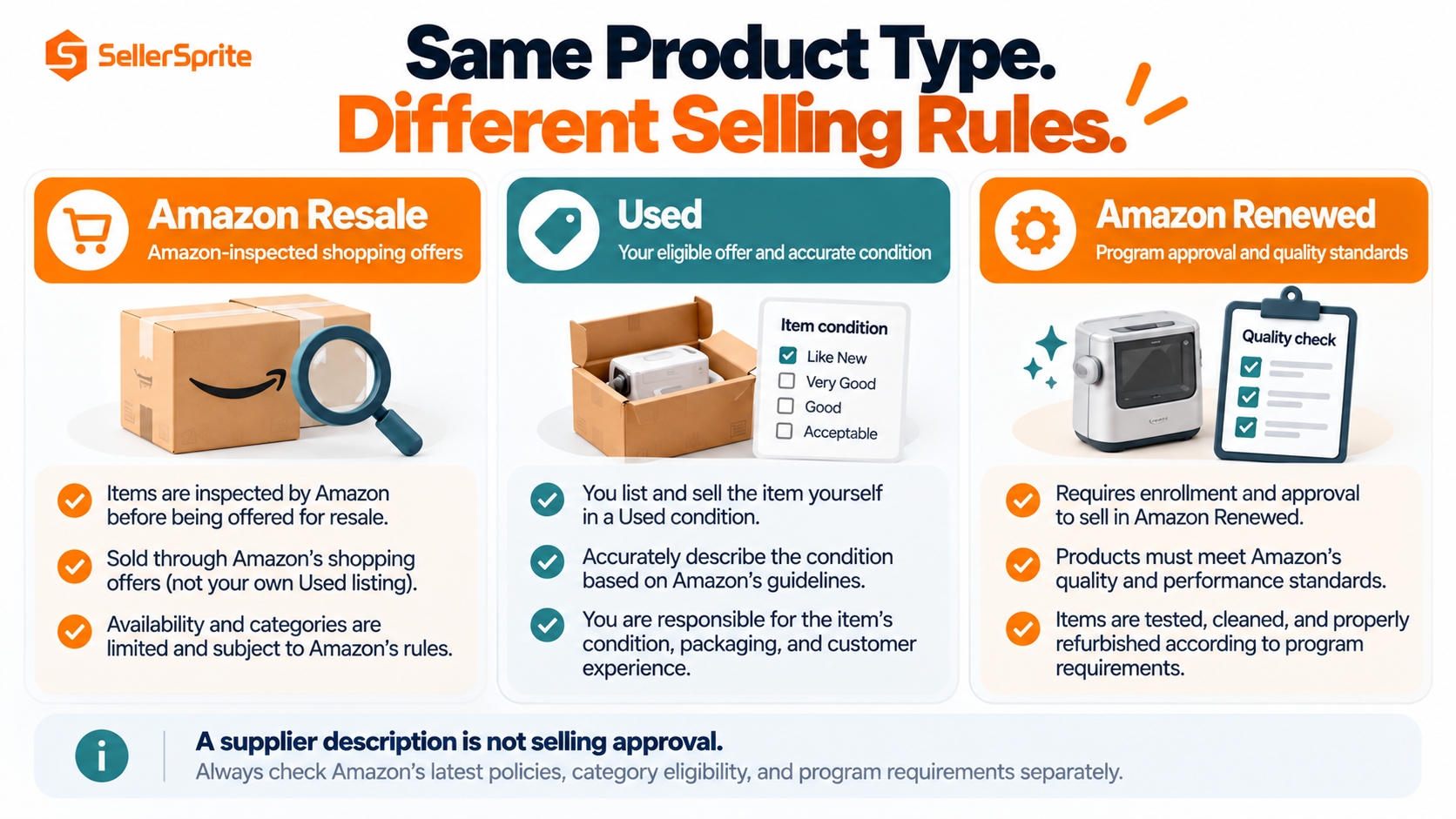
When evaluating Amazon resale and refurbished products, first separate Amazon's own shopping offer from the conditions and programs available to independent sellers. The same physical item can require different checks depending on how it is represented.
Amazon Resale
Amazon's shopping offer for inspected and graded used or open-box products. It is not the generic name for every independent reseller. Seeing an item there does not confer Amazon's inspection status on inventory you later acquire.
Used-condition offers
Independent sellers may offer eligible pre-owned products under the applicable condition rules. The category and actual item determine which grades are appropriate; a supplier's "open-box" description is not your final assessment.
Amazon Renewed
An approval-based program for qualifying pre-owned and refurbished products. Sellers must meet program standards, not simply add "Renewed" to an ordinary offer.
Reselling itself can involve new, used, or refurbished goods. Retail arbitrage and wholesale describe how you source; Used and Renewed describe different selling conditions or program contexts. Treat those as separate decisions rather than assuming one sourcing method guarantees one condition.
Start with the unit you can defend: Can you connect this product to an eligible offer, a reliable source, a documented condition assessment, and a price supported by comparable offers? If one answer is missing, a bigger discount does not repair the gap.
Check Listing Permission Before the Purchase Price
Check the exact product in your own seller account before committing money. A competitor's permission is not evidence that your account, product condition, or intended brand relationship has been approved.
Match the Product and Select the Intended Condition
In Seller Central, use Catalog > Add Products to find the exact product and select its intended condition. Amazon may show an Apply to sell step or a brand application. Follow that request before buying a quantity you cannot list; some applications require a manufacturer or distributor invoice or brand authorization.
Confirm model, generation, region, capacity, color, pack count, and included accessories. A nearly matching ASIN is not a safe shortcut. Amazon requires accurate product identity and restricts duplicate or misleading detail pages; a condition note cannot turn a different model into the product shown.
Treat Safety and Rights as Stop Conditions
Check brand or intellectual-property concerns separately from physical authenticity. Do not assume owning a genuine unit grants permission to use any branded image, modify its description, or claim manufacturer authorization. Follow the applicable listing rules and seek qualified advice for a rights dispute rather than relying on a general resale argument.
Products subject to recalls are prohibited from sale on Amazon. Check the product and batch against relevant notices, and hold affected stock for the prescribed remedy instead of assuming a cosmetic repair or lower condition grade makes it sellable.
Buy the Paper Trail Alongside the Product
The documentation question belongs in supplier selection, not at the end of an authenticity complaint. Agree on what the supplier can provide, what the goods actually are, and what happens when the delivery does not match the purchase.
An Invoice, a Manifest, and Authorization Answer Different Questions
An invoice records a completed purchase. A manifest describes a lot's stated contents. Authorization documents a particular permission from a rights holder. One document does not automatically perform all three jobs.
Amazon's Responsible Sourcing requests can require documents tracing the full supply chain to the manufacturer, including supplier contact information and records matching sales volume. The requirements of that request are not identical to a category application or a Renewed application. Read the actual request; do not assume one receipt is accepted everywhere.
Keep authentic source files, purchase and payment records, product identifiers, quantities, and supplier correspondence linked to the stock received. Do not create or alter invoices to fill a gap. Follow any explicitly permitted redaction instructions for the particular Amazon request, and preserve the original.
Choose a Sourcing Route You Can Verify Again
For wholesale, verify the supplier's identity, product provenance, repeat availability, and replacement or rejection terms. For retail or online arbitrage, keep purchase records but check whether the documents meet the requirements of your intended selling route. SellerSprite's retail and online arbitrage sourcing guide covers the deal-finding workflow; the additional question here is whether the acquired stock supports the condition and evidence you need.
Liquidation needs a separate channel check. Amazon states that its contracted FBA liquidators are restricted from directly reselling FBA-liquidated inventory on Amazon. That does not establish identical terms for every downstream lot, but it makes written provenance and resale restrictions essential before assuming Amazon is an available exit.
Dropshipping is a fulfillment arrangement, not a documentation exemption. Amazon requires you to be the seller of record and responsible for customer returns. Another retailer shipping an order with its own seller identity on the paperwork or packaging can violate that policy. A compliant supplier agreement also needs a workable way to control condition before the item reaches the buyer.
Grade What Arrived, Not What the Manifest Promised
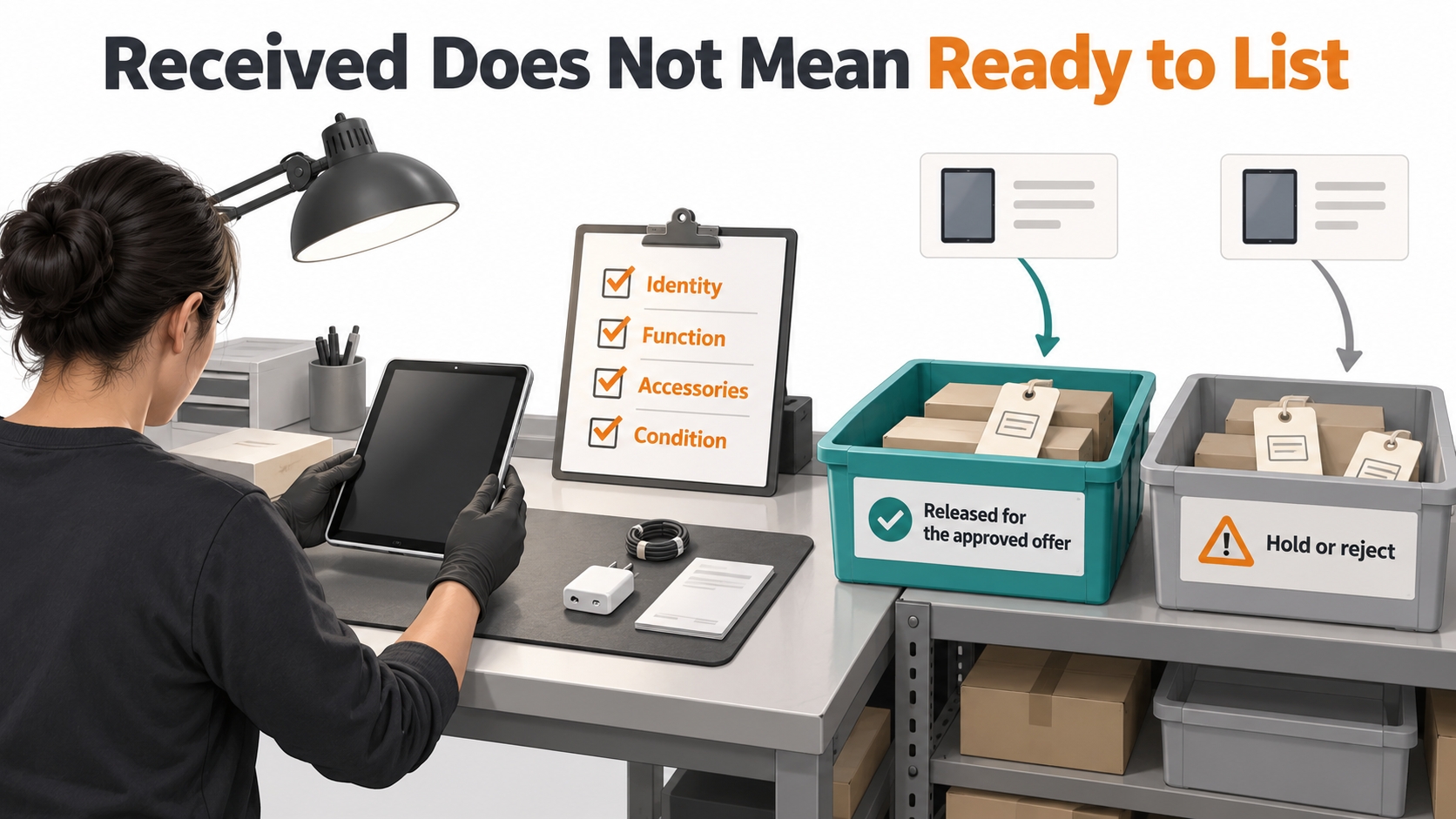
A pallet labeled "customer returns" tells you how the stock entered the lot, not whether every unit works. Establish a receiving process that separates inventory ready to list from inventory needing investigation, repair, or rejection.
Use the Category Rules, Not a Supplier Grade Translation
Apply Amazon's condition guidance to the individual item. Used - Like New is still Used, not New. Functional condition, packaging, accessories, and visible wear matter, and some categories do not allow the same used-condition options.
Amazon's general guidelines exclude items still requiring repair or service, items missing essential parts, and other unacceptable conditions. "Acceptable" does not mean "for parts". Hold an item that needs work until it can legitimately meet the intended listing requirements; a disclaimer does not fix ineligibility.
Build a Unit Record Before the Unit Goes Into Sellable Stock
- Identify it: Match the physical model, serial number where appropriate, configuration, and accessories to the intended offer.
- Test it: Use a product-appropriate functional checklist, not just a power-on check. Document the actual results and any work performed.
- Grade it: Record cosmetic wear, packaging, completeness, and the condition the evidence supports. Keep graders working from the same criteria.
- Release or hold it: Only release units that pass both the product checks and the selling-route checks. Keep unresolved units physically and digitally separate.
For data-bearing electronics, verify that prior user data and ownership locks have been removed through legitimate procedures. A reset is not a substitute for confirming ownership and usable functionality. Renewed's quality policy includes category-specific diagnostics and data-sanitization requirements; apply the relevant requirements rather than a generic "refurbished" sticker.
Keep item-specific condition information in the appropriate offer fields. Do not rewrite a shared detail page to describe one unit's scratches, missing packaging, or seller-specific warranty, and do not claim a warranty you cannot substantiate.
What Changes When You Sell Through Amazon Renewed
Renewed adds program obligations to the sourcing and grading process. It is designed for qualifying products and sellers with demonstrable refurbishment capability, not as a label any reseller can select after cleaning a return.
Qualification Comes Before the Renewed Offer
Review the current Amazon Renewed application requirements for your seller type and product category. The public checklist requires qualifying purchase evidence and sample product and packaging images; it specifically excludes retail receipts, order confirmations, manifests, and pro forma invoices as application purchase proof. Those restrictions concern this application, not every Amazon documentation process.
For US reseller applications, the program overview currently specifies $50,000 in qualifying refurbished purchases over 90 days, with a 180-day window for specified categories. Apple requirements differ, and other eligibility checks still apply. Verify the current criteria before building a buying plan around the threshold; spending the amount does not guarantee acceptance.
The Unit Needs Testing, and the Sale Needs Support
The Renewed quality policy covers professional testing against the applicable specifications, condition grading, accessories, packaging, and category or brand-specific exceptions. It can also require condition evidence after shipment. Turn those obligations into receiving and release records instead of relying solely on the upstream refurbisher's marketing description.
Follow the program's listing process rather than attaching refurbished stock to the new-product offer. Amazon also requires Renewed pricing at least 5% below the new counterpart and makes sellers responsible for obligations under the Renewed Guarantee. Both the price relationship and support exposure belong in your purchase decision.
Research the Offer You Will Actually Compete With
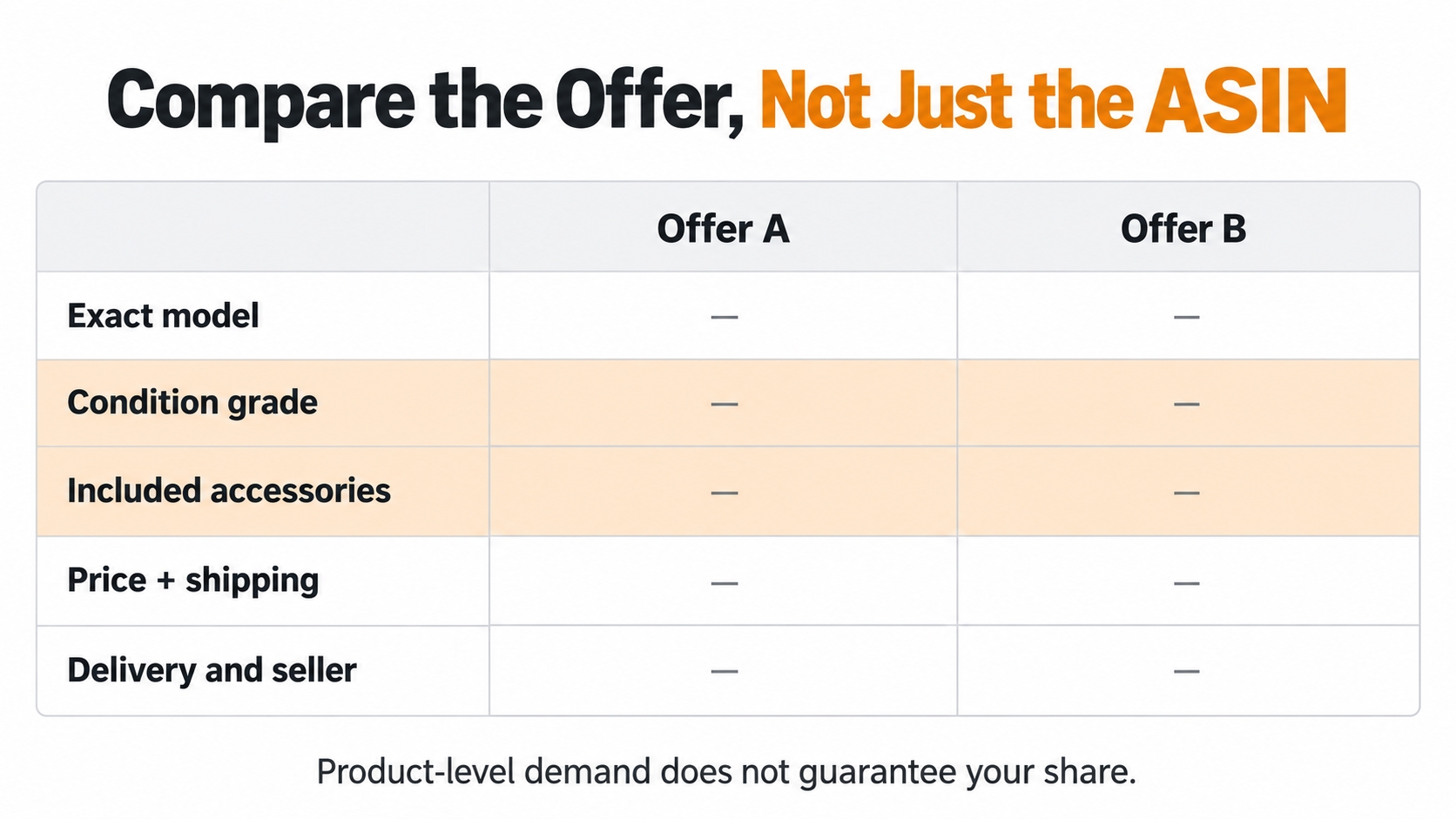
A product may sell quickly while your particular grade sells slowly. Analyze the exact offer you expect to put in front of customers, not just the product name or a prominent new-item price.
BSR Indicates Product Demand, Not Your Allocation of Orders
Best Sellers Rank is a relative sales ranking, not a seller-specific unit forecast. Review its history alongside price changes and promotions, and verify whether any third-party estimate covers the parent listing, a child ASIN, or a particular condition. Do not divide estimated ASIN sales by the seller count and call the result your expected sales.
Compare the Seller Mix Within a Relevant Condition
Record total price including shipping, grade, accessory completeness, fulfillment method, delivery promise, and seller identity. Treat the current new-product price as an alternative available to the customer, not automatically the price your used stock can command.
The Featured Offer, often called the Buy Box, is the offer associated with Add to Cart or Buy Now. Amazon evaluates offer competitiveness using factors including total price, delivery, order experience, and available stock. Neither being the cheapest nor using FBA guarantees selection. Offers can also differ by delivery destination.
In the SellerSprite extension, the free tool Keepa Trends can add historical price and BSR context. Read each series' definition: its Price series represents the lowest new offer excluding shipping, while Buybox Price includes shipping. A new-offer chart is not a verified price history for your used-condition units.
Build your downside case around a comparable price you could realistically receive, then test actual sell-through. A temporary stockout by a strong competitor should not be the only reason the deal appears to work.
The Real Unit Cost Starts After Sorting
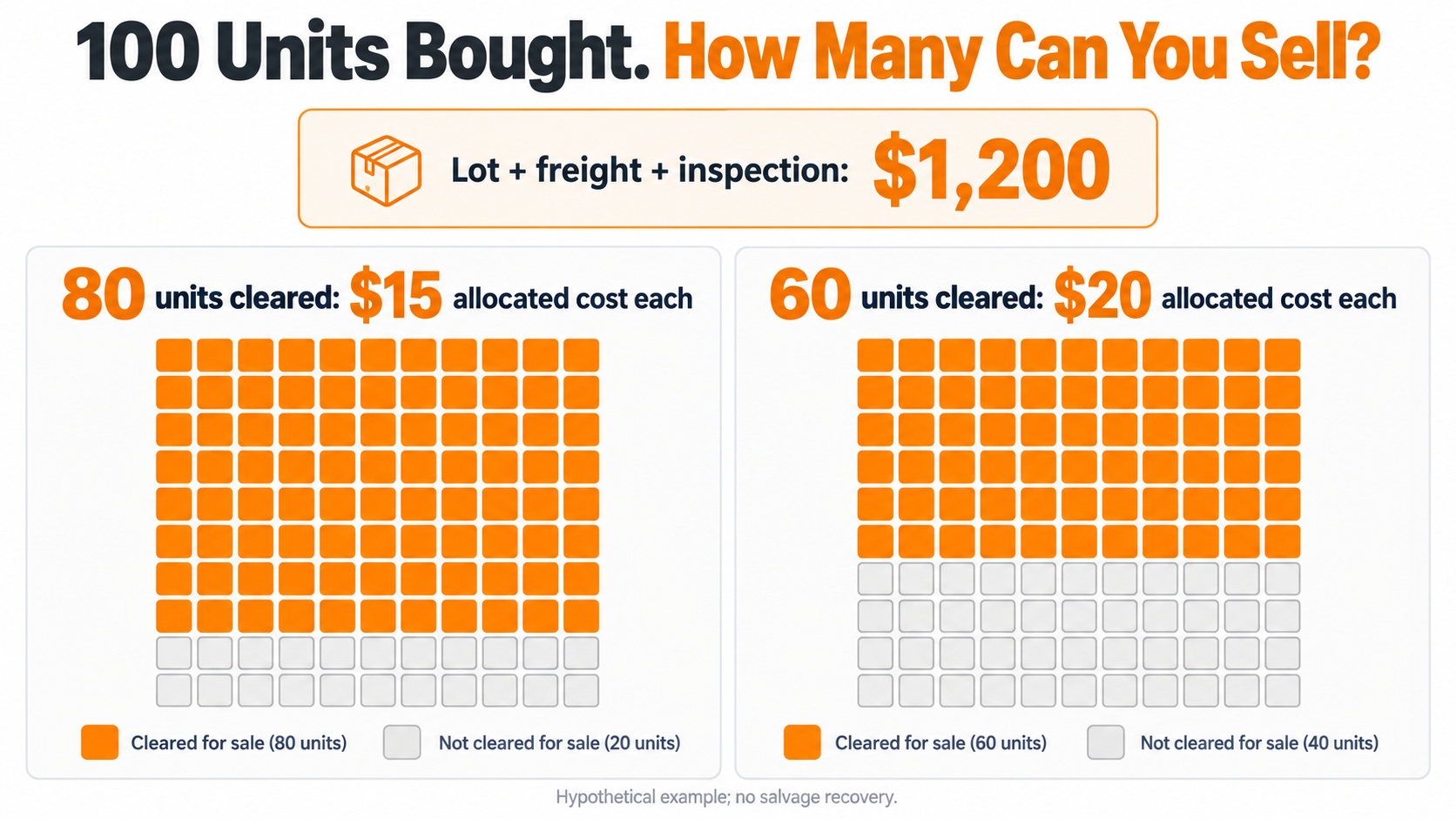
The supplier may quote cost per item received, but your pricing must recover costs from the units you can actually sell. Define saleable yield as units cleared for the intended selling route divided by units acquired, and keep it separate from the percentage that eventually sells.
Allocated lot cost per saleable unit = total non-recoverable acquisition and lot-processing costs ÷ units cleared for sale
Hypothetical lot: You buy 100 units for $1,000, pay $100 inbound freight, and spend $100 inspecting the batch. The $1,200 is incurred whether 80 or only 60 units pass. Assume no salvage proceeds or supplier credits for rejected units, and no extra disposal cost.
| Per-unit measure unless stated | 80 units cleared | 60 units cleared |
|---|---|---|
| Lot cost allocated across saleable units | $1,200 / 80 = $15.00 | $1,200 / 60 = $20.00 |
| Additional repair or preparation per cleared unit | $3.00 | $3.00 |
| Assumed selling and fulfillment costs | $8.00 | $8.00 |
| Expected net return and support allowance | $2.00 | $2.00 |
| Assumed selling price | $35.00 | $35.00 |
| Expected contribution before fixed overhead and tax | $7.00 | $2.00 |
These are planning assumptions, not Amazon fee quotes. The cost allowance must be replaced with the actual category, condition, fulfillment, and fee-period inputs. Include advertising if used, account for refunds and recoveries without double-counting, and distinguish any promotion from a lasting cost advantage.
At a $31 sale price, holding the example's cost assumptions constant, contribution becomes $3 in the 80-unit case and negative $2 in the 60-unit case. Actual price-linked fees should be recalculated. The point is the combined exposure: lower saleable yield and a falling market can erase the discount together.
Allocating cost across cleared units also assumes those units can ultimately be sold. Unsold grades, extra holding time, further failures, or lower realized prices can reduce the batch result. Track the cash tied up in unresolved units instead of celebrating margin on only the first successful sales.
Make the First Batch Earn the Second
Use a small initial purchase to test the assumptions that determine the next order. This is an operational trial, not permission to sell restricted stock while waiting to see whether Amazon objects.
| Decision | Record | Reason to pause |
|---|---|---|
| Can the stock be traced and listed? | Documents, account permissions, model match, and intended condition. | Missing provenance or unresolved eligibility. |
| Did the lot grade as expected? | Cleared units, repair hours, parts consumed, and rejection reasons. | Yield below the purchase assumption or inconsistent grading. |
| Can your offer win enough orders? | Actual sell-through by grade, realized price, competing offers, and time in stock. | The model depends on all ASIN demand or a vanished price spike. |
| Did the orders retain contribution? | Fees, returns, support costs, recoveries, and remaining stock. | Early margin disappears after post-sale costs. |
| Can the supplier repeat the result? | Lead time, model consistency, documents, and yield across batches. | The next lot has a different grade mix or cannot be documented. |
Reinspect returned units before releasing them again. Keep your internal defect and return analysis tied to the relevant batch and enough follow-up time; a listing's average star rating cannot isolate your own units or refurbishing process.
Decide whether the result supports a repeatable business or only a one-off purchase. A profitable clearance find is useful, but it should not become a replenishment forecast unless the supplier, condition mix, buying price, and competitive selling price can be repeated.
What to Put on the Purchase Approval
Approve a resale purchase with the intended ASIN and condition, evidence requirements, inspection plan, expected saleable yield, downside selling price, and a maximum acceptable capital commitment. Name the person responsible for resolving failed units and supplier discrepancies.
The strongest reason to buy is not that the stock is discounted. It is that you can explain how it becomes compliant, accurately described inventory that sells at a defensible return. If the evidence, condition, or demand assumptions do not hold, reducing the purchase quantity may be wiser than negotiating another dollar off the lot.
FAQs
Is Amazon Resale the same as Amazon Renewed?
No. Amazon Resale is Amazon's inspected and graded used-product shopping offer. Renewed is a separate program for qualifying pre-owned and refurbished products and approved sellers. An ordinary Used offer is not automatically part of either.
Can I sell used products without Amazon Renewed approval?
Eligible pre-owned products can be offered under the applicable Used condition without representing them as Renewed. Check product, brand, account, and category requirements first; some categories restrict which conditions are allowed.
Can an open-box or returned product be listed as New?
Not simply because it looks unused or has been repackaged. Assess the actual unit against the New condition requirements, including the applicable packaging and original manufacturer warranty conditions. Use a supported Used grade when that is what the evidence and category rules permit.
Will a retail receipt qualify me for Amazon Renewed?
Amazon's public Renewed application guidance excludes retail receipts as qualifying purchase proof. It asks for qualifying invoices and other application evidence. Different Amazon documentation requests can have different requirements, so do not generalize that rule to every process.
Can Amazon return pallets always be resold on Amazon?
No. Check the lot's source, contract, condition, safety, and your listing eligibility. Amazon's contracted FBA liquidators face direct-resale restrictions, and a downstream buyer should not assume the marketplace is permitted without checking the applicable terms.
Does a strong BSR mean I will sell a fixed share of the listing?
No. BSR describes relative product sales, not an allocation among sellers or conditions. Compare your grade, delivered price, competing offers, and fulfillment promise, then use actual sales from a limited test to evaluate your opportunity.
Can I use FBA for Renewed inventory?
Amazon allows qualifying Renewed products to use FBA or merchant fulfillment. That does not transfer your program-quality or guarantee obligations to the warehouse. Verify the product and fulfillment requirements before shipping.
What is the most useful cost measure when buying a mixed lot?
Start with total non-recoverable lot and processing costs divided by units cleared for the intended selling route. Then add per-unit preparation, fees, fulfillment, and expected post-sale costs. Track unsold inventory separately; saleable yield is not sell-through.
References
- Amazon: How Amazon Resale Works View
- Amazon: Product Condition Guidance View
- Amazon Seller Central: Amazon Renewed Program Overview View
- Amazon: Reselling Branded Products and Listing Approvals View
- Amazon Seller Central: Product Detail Page Rules View
- Amazon Seller Central: Intellectual Property Policy View
- Amazon Seller Central: Recalled Products Information View
- Amazon Seller Central: Responsible Sourcing Documentation View
- Amazon Seller Central: FBA Liquidations View
- Amazon Seller Central: Drop Shipping Policy View
- Amazon Seller Central: Condition Guidelines View
- Amazon Seller Central: Amazon Renewed Quality View
- Amazon: Renewed Application, Listing, and Seller Requirements View
- Amazon: Estimate Selling and Fulfillment Costs View
By SellerSprite Content Team
The SellerSprite Content Team brings together Amazon marketplace researchers, data analysts, and e-commerce content specialists. The team studies product demand, seller competition, pricing trends, and sourcing strategies across Amazon marketplaces. Its research into resale and wholesale focuses on how supplier reliability, product condition, inventory turnover, and marketplace requirements influence purchasing decisions and long-term business viability.
Last reviewed: October 19, 2026