TL;DR: AI listing writers generate copy fast, but they do not rank your listing; SEO editors optimize keywords, indexing, and compliance, but they do not write persuasive copy. US sellers get the best ROI by running both in one workflow — this guide shows how to choose, combine, budget, and measure them.
Key Takeaways
- AI writers and SEO editors solve different problems: copy generation versus keyword verification. Treating them as substitutes is the most expensive mistake in listing tooling.
- AI listing writer tools win on speed, volume, tone, and localization. Amazon SEO editor software wins on keyword accuracy, indexing control, compliance checks, and rank tracking.
- The strongest setup for US sellers is hybrid: mine keyword data first, draft with AI inside a keyword map, then human-edit and verify indexing after publishing.
- Tool pricing scales with seats, tracked SKUs, and usage limits rather than output quality — always confirm current vendor pricing and calculate cost per optimized listing before you commit.
- Judge your stack by indexed keyword coverage, click-through rate, and conversion rate at the ASIN level — not by how polished the generated copy sounds.
Table of Contents
- Why the AI Writer vs. SEO Editor Debate Matters in 2026
- AI Writers vs. SEO Editors at a Glance
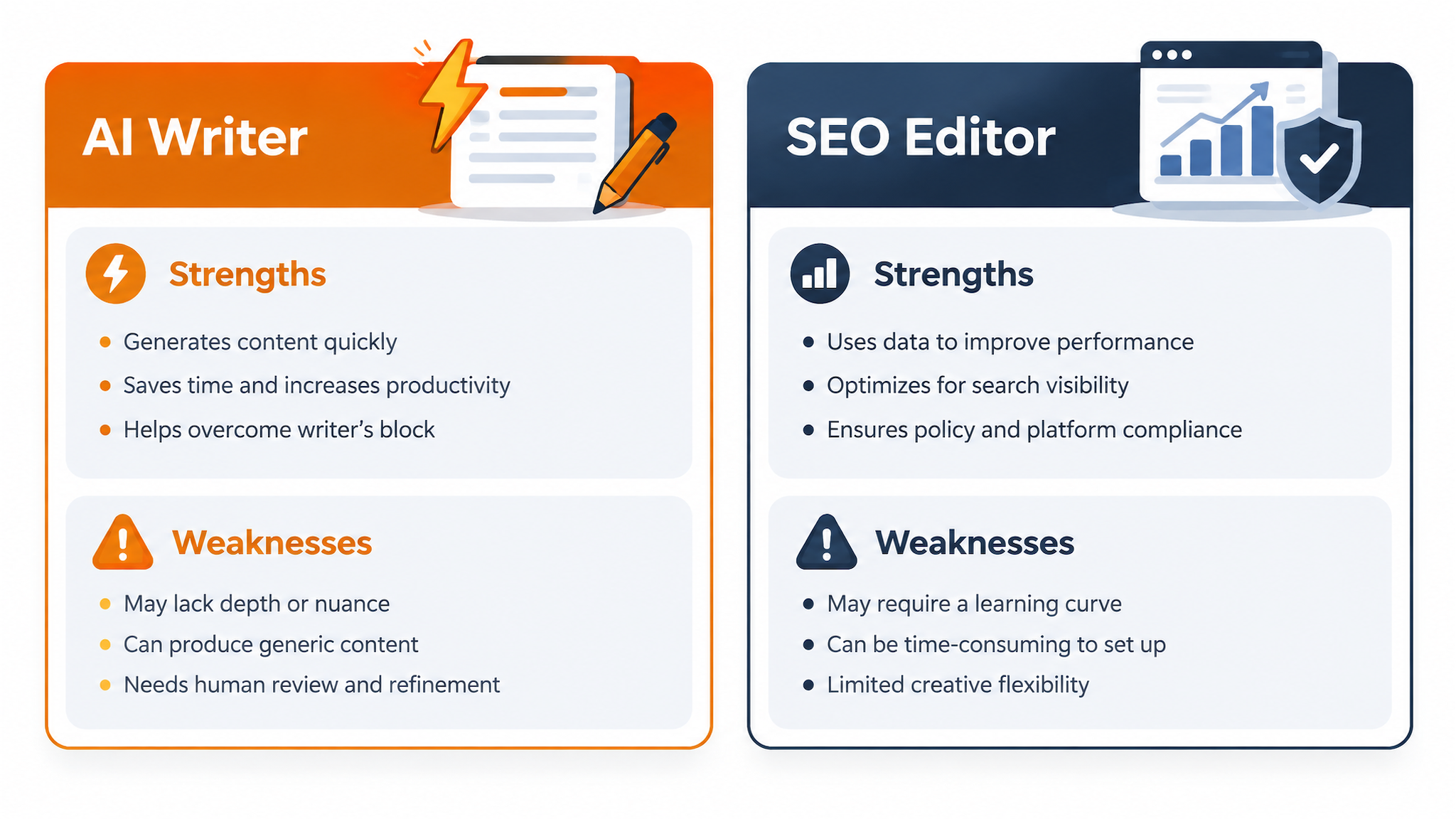
- Copy Generation vs. SEO Editing: Strengths and Weaknesses
- Which Tool Type Fits Your Seller Stage
- The Hybrid Workflow: 7 Steps from Keyword Data to Published Listing
- US-Market Buyer’s Checklist
- What AI Writing and SEO Editing Tools Cost in the US
- Common Mistakes That Wreck Listing Tool ROI
- How to Measure Whether Your Stack Is Working
- FAQ
- Next Steps
- References
Note on marketplaces: This guide is specifically optimized for the US market.
Why the AI Writer vs. SEO Editor Debate Matters in 2026
Amazon’s US marketplace now rewards listings that are simultaneously relevant to a search query and easy to understand once a shopper lands on them. Relevance still comes from keywords that match real search behavior, while the shopper-side signals — click-through, conversion, dwell, and returns — decide whether that relevance is rewarded with more visibility. Vague titles and unsubstantiated superlatives no longer hide behind keyword density, and AI shopping assistants that summarize or answer questions about products raise the cost of a messy detail page even further.
At the same time, generative AI has made listing copy effectively free and endlessly abundant. Any seller can produce fifty bullet-point variations in under a minute, which means polished sentences are no longer a competitive advantage on their own. The advantage now sits in two places: knowing which exact terms are worth targeting, and being able to prove that your listing actually carries and indexes those terms. That is precisely the gap between AI writers and SEO editors.
The comparison is usually framed as a head-to-head contest, which is where most sellers go wrong. These two tool categories were built to perform different jobs in the same pipeline, and buying one while expecting it to behave like the other produces the familiar complaints: “the AI copy sounds generic” or “the keyword tool doesn’t write anything I can publish.” Both are true, and neither is a defect.
The three tool categories you will actually shop
- AI listing writer tools — generative engines that turn a short prompt, an image, or a competitor ASIN into a draft title, bullet set, description, or A+ copy. Their value is throughput: first drafts, tone matching, localization, and rapid variation testing.
- Amazon SEO editor software — keyword research and verification platforms that report search volume, competitive difficulty, competitor keyword gaps, indexing status, and rank movement. Their value is accuracy: they tell you what to target and whether the listing is actually covered.
- Hybrid listing optimization platforms — tools that combine keyword intelligence with AI-assisted drafting and post-publish tracking inside one dashboard. These are increasingly what growing and enterprise sellers standardize on, because hand-offs between disconnected tools are where mistakes happen.
When you evaluate any vendor claiming to offer “listing optimization,” ask one diagnostic question: does this tool tell me which keywords to use and whether my listing is indexed for them, or does it only write sentences? A serious platform answers both, and shows you the evidence for each.

AI Writers vs. SEO Editors at a Glance
The table below compares the two categories on the dimensions that actually affect your P&L. Read it as a division of labor, not a scoreboard — each row shows where one category is structurally stronger and why.
| Dimension | AI listing writer tools | Amazon SEO editor software |
|---|---|---|
| Primary job | Generate publishable copy | Identify, verify, and track keywords |
| Core output | Titles, bullets, descriptions, A+ modules | Keyword lists, gap reports, rank and index status |
| Speed | Seconds per draft, near-unlimited variations | Minutes to hours for research and audits |
| Keyword accuracy | Depends on the prompt; cannot verify volume or relevance | Built on search data, competitor mining, and trend signals |
| Index verification | Not available | Core feature — confirms whether terms are indexed |
| Compliance safety | Can invent specs or claims if unconstrained | Flags restricted terms and character-limit violations |
| Brand voice | Strong when trained with style examples | Neutral; enforces rules but does not write |
| Catalog scale | Excellent for bulk first drafts across hundreds of SKUs | Excellent for batch audits and prioritization |
| Post-publish tracking | Usually none | Rank and visibility monitoring over time |
| Main risk | Publishing inaccurate or generic copy at scale | Great data, no persuasive copy to publish |
| Pricing driver | Seats, word or credit allowances | Seats, tracked ASINs, data depth |
Notice that not a single row says “better overall.” An AI writer with no keyword layer optimizes for readability and misses discoverability. An SEO editor with no writing layer gives you a perfect keyword map and no listing. The practical question is never which category wins — it is which one you are missing, and in what order you should add them.
Copy Generation vs. SEO Editing: Strengths and Weaknesses
The cleanest way to understand the trade-off is to separate the two job functions rather than the two products. Copy generation is a linguistic task: producing clear, benefit-led, on-brand language. SEO editing is an analytical task: deciding which terms matter, checking whether they are present and indexed, and enforcing the rules that keep a listing live. Here is an honest assessment of each.
AI listing writer tools: where they genuinely shine
- They eliminate the blank page. For a new seller with forty SKUs and no copywriting budget, a usable first draft in seconds is a real, measurable time saving.
- They produce variations cheaply. Testing three different benefit angles in your bullet set used to require a copywriter and a week of turnaround. It now takes minutes.
- They adapt tone on demand. The same product can be written for a premium outdoor audience, a budget-conscious parent, or a professional tradesperson without a new brief.
- They localize. If you expand beyond the US marketplace later, machine-assisted translation with tone control is far cheaper than finding native copywriters for every locale.
- They handle repetitive catalogs. Twenty color variants of the same product no longer require twenty separate writing sessions.
AI listing writer tools: where they fail
- They cannot verify search demand. An AI model will happily write “premium insulated hydration vessel” because it sounds plausible, even if almost nobody searches that phrase.
- They hallucinate specifications. Attributes such as capacity, material grade, warranty length, and certifications must come from your product data, not from a language model’s guess.
- They inherit your keyword assumptions. If your prompt does not include a researched keyword map, you get fluent copy that reinforces the wrong targeting.
- They may mirror competitor phrasing. Feeding a rival’s listing into a generator risks paraphrasing marketing claims you cannot substantiate, which creates both compliance and intellectual-property exposure.
- They stop at publish. No AI writer will tell you whether the term you added last week is now indexed and ranking.
Amazon SEO editor software: where it earns its seat
- It grounds decisions in data. Search volume, competition, seasonal trends, and related-term clusters replace intuition about what shoppers type.
- It finds gaps. Reverse-ASIN analysis shows which high-value terms competitors rank for and you do not — the single highest-leverage output in listing optimization.
- It verifies indexing. Publishing a keyword is not the same as being indexed for it; an SEO editor confirms coverage so you stop paying for optimization that is not live.
- It enforces rules. Character limits, prohibited terms, restricted claims, and category-specific formatting requirements get caught before submission.
- It tracks outcomes. Rank and visibility history lets you attribute movement to a specific listing change instead of guessing.
Amazon SEO editor software: where it falls short
- Dashboards do not write. A keyword report will never produce a hook that makes a shopper stop scrolling.
- Data requires interpretation. High-volume terms with brutal competition are often worse choices than mid-volume terms you can actually rank for.
- Insight without execution stalls. Teams that buy keyword tools without a writing process end up with excellent spreadsheets and unchanged listings.
- Coverage is not persuasion. A listing can index perfectly and still convert poorly because the benefits are buried.
The honest split: two skills, one pipeline
Copy generation and SEO editing are as different as writing and editing in traditional publishing. A novelist and a copy editor are not interchangeable, and no publisher would hire one and expect the other’s output. The same logic applies here: AI writers excel at the creative, high-volume, language-first half of the job, while SEO editors excel at the analytical, verification-first half. Sellers who treat them as rivals spend months switching tools instead of compounding results; sellers who sequence them build a pipeline where data constrains the copy and the copy is validated by data.
If you want a deeper look at how these layers fit into a full optimization program, the step-by-step breakdown in our Amazon listing optimization guide walks through the research-to-publish cycle in detail.
Which Tool Type Fits Your Seller Stage
Your catalog size, team structure, and reporting obligations should decide the order in which you buy these tools — not the vendor with the loudest demo. Here is how the recommendation shifts as you grow.
New sellers (roughly 1–50 active SKUs)
At this stage your bottleneck is simply having complete, coherent listings, so an AI writer delivers the fastest visible improvement. Pair it with the most affordable keyword data you can access, because writing for guessed terms wastes the draft entirely. Prioritize tools with a usable free tier or low entry plan, and treat every generated claim as unverified until you check it against your supplier documentation. Sellers building niche or print-on-demand catalogs should also study how promotion and keyword discovery work for those listing types, as covered in our guide to promoting Merch on Demand listings.
Growing sellers (roughly 50–500 SKUs)
This is where SEO editing becomes non-negotiable. With a catalog this size, the cost of mis-targeted keywords compounds across hundreds of listings, and you can no longer personally remember which terms each ASIN targets. Buy keyword research with competitor gap analysis and indexing checks, then use AI for bulk drafting on top of that keyword map. Start tracking rank for a defined set of priority terms so you can tell whether edits are working.
Operations and marketing managers
Your requirements shift from capability to coordination. Look for role-based permissions, approval workflows, change history, bulk editing, and exportable reports you can bring to a leadership review. Tool cost justification becomes a reporting exercise: the tool needs to show before-and-after keyword coverage and rank movement per ASIN, not just generate text. If your team already owns an analytics stack, confirm the listing tools export cleanly rather than trapping data in a dashboard.
Brands and large sellers
At brand scale, governance matters more than any single feature. You need brand-voice consistency across parent-child variations, protected claim libraries, marketplace-level compliance rules, API or feed integration for bulk updates, audit trails for regulated categories, and localization support for expansion. Many enterprise teams run a hybrid platform for keyword intelligence plus a specialized AI writing layer for A+ and Brand Story content, with a human reviewer signing off on anything that touches substantiated claims.
The Hybrid Workflow: 7 Steps from Keyword Data to Published Listing
This sequence works whether you are a solo seller with twenty SKUs or a team managing a thousand. The order matters: data first, generation second, verification last.
- Mine keyword data before writing a single word. Pull search volume and competition for your seed terms, then reverse-engineer the keywords your top three competitors rank for. Save the raw list; you will reuse it for every future edit.
- Build a keyword map per ASIN. Assign one primary term, three to five secondary terms, and a set of long-tail phrases. Mark terms as “must appear in title,” “bullets only,” or “backend search terms.” This map is the brief for the AI writer.
- Prompt the AI writer with constraints, not just a description. Supply the keyword map, your verified specifications, a brand-voice sample, and an explicit list of claims you are not allowed to make. Constrained prompts produce dramatically more usable drafts than “write me a listing for a water bottle.”
- Edit for relevance and compliance. Remove any keyword that does not honestly describe the product, delete unsubstantiated superlatives, confirm every specification against source documentation, and check character limits for the title and bullets.
- Publish and verify indexing. After the listing goes live, confirm that your priority terms are actually indexed. If they are not, adjust placement or field usage rather than adding more repetitions of the same phrase.
- Test one variable at a time. Change the title, or the first two bullets, or the main image — not all three. Track click-through rate and conversion rate against a defined observation window so you can attribute the movement.
- Systematize what worked. Turn your winning prompt structure, keyword-map template, and compliance checklist into a documented SOP, then schedule a recurring audit cadence for the whole catalog.
Illustrative walkthrough (not a client result)
Imagine a US seller with a stainless steel insulated tumbler that ranks for generic terms but not for the occasion-driven phrases shoppers use in the fall. Step one, the keyword tool reveals several mid-volume long-tail terms tied to gifting and commuting that the top competitors index for and this listing does not. Step two, those terms enter the keyword map with a note that two of them are only relevant if the product genuinely keeps drinks cold for the stated duration. Step three, the AI writer produces a title and bullet set using the mapped terms and the verified specification list. Step four, the seller removes one term that implies a certification the product does not hold, tightens the first bullet, and confirms the title length. Step five, two weeks after publishing, an indexing check confirms the new terms are live and rank tracking shows upward movement on the priority phrase. The value here comes from the sequence, not from any single tool.
US-Market Buyer’s Checklist: What to Look For
Use this checklist during trials. Score each tool honestly — a gap in the “must-have” list will cost more than a missing convenience feature ever saves.
Must-have capabilities
- ✓ Fresh US keyword data with visible search volume and competition metrics
- ✓ Competitor reverse-ASIN keyword mining, not just seed-term expansion
- ✓ Indexing verification for your live listing after each edit
- ✓ Character-limit and field-format validation before submission
- ✓ Restricted-term and prohibited-claim flagging for US categories
- ✓ Rank tracking for a defined set of priority terms per ASIN
- ✓ Bulk editing or export so you can work across dozens of listings
- ✓ Transparent pricing with a trial or free tier you can test on real listings
Strong differentiators
- ✓ Brand-voice training from your existing copy samples
- ✓ Role-based permissions and approval workflows for teams
- ✓ Change history and audit trail for regulated products
- ✓ Seasonal and trend signals for US shopping peaks
- ✓ Support for AI shopping assistant visibility, covered in our notes on Alexa for Shopping and listing optimization
- ✓ Helpful onboarding, documentation, and responsive human support
A practical scoring method: run the same three live listings through every candidate tool during the trial. Paste your real keyword map, your real specifications, and your real brand-voice sample. Tools that only look impressive on demo data will show their limitations immediately, and you will save yourself a painful annual contract.
What AI Writing and SEO Editing Tools Cost in the US
Pricing in this category changes frequently and varies by seat count, catalog size, and usage limits, so treat any figure — including a vendor’s own page from last quarter — as something to re-verify before budgeting. What stays stable is the structure of the pricing, and that is what you should plan around.
| Pricing model | Usually seen in | Watch out for |
|---|---|---|
| Free or freemium tier | AI writers and entry keyword tools | Low generation caps, limited or delayed keyword data |
| Per-seat subscription | Both categories, especially team plans | Costs rise quickly as you add VAs or agency partners |
| Usage or credit based | AI copy generation and bulk rewrite features | Large catalog refreshes can exhaust a monthly allowance |
| Tracked-ASIN or data-depth tiers | SEO editors and rank trackers | Rank tracking limits that only surface as you scale |
| Annual commitment discount | Most established platforms | Lock-in before you have validated the workflow |
Calculate cost per optimized listing, not cost per seat
A simple formula makes vendor comparisons honest. Take the monthly cost of the tool, divide it by the number of listings you realistically update each month, and divide again by the expected monthly orders for those listings. That yields a cost-per-order figure you can compare against your contribution margin. If a tool costs more per order than the margin it helps protect, it is not a bargain no matter how impressive the demo was. Conversely, a slightly pricier platform that prevents a suppressed listing or a compliance takedown often pays for itself in avoided downtime alone.
For most US sellers, the pragmatic sequence is: start on free or entry tiers to validate your workflow, upgrade the keyword intelligence layer once you exceed roughly fifty active SKUs, and only then add paid AI generation capacity at the volume you actually consume. Buying enterprise seats before you have a working SOP is the most common way sellers waste budget in this category.
Common Mistakes That Wreck Listing Tool ROI
- Publishing AI output without verification. Generated specifications, certifications, and comparative claims are the fastest route to a compliance problem. Every factual statement needs a source in your product documentation.
- Treating keywords as decoration. Sprinkling a term into a bullet does not guarantee indexing. Placement, field choice, and relevance all matter, and only verification tells you which one is failing.
- Reusing one AI draft across all variations. Color and size variants often serve different search intents. Duplicated copy across a parent-child family dilutes relevance instead of reinforcing it.
- Feeding competitor listings directly into a generator. Beyond the risk of copying claims you cannot substantiate, you may import the competitor’s positioning mistakes along with their keywords.
- Skipping indexing checks. Many sellers spend months optimizing terms that were never indexed in the first place, then conclude that “SEO doesn’t work.”
- Changing everything at once. Simultaneous edits to title, bullets, images, and price make attribution impossible, so you cannot repeat what worked.
- Buying tools without a workflow owner. Subscriptions without a named person responsible for keyword maps, prompts, and audits quietly become shelfware within a quarter.
- Ignoring the assistant era. Listings that answer real questions in plain language are increasingly valuable as AI shopping features summarize products on the shopper’s behalf.
How to Measure Whether Your Stack Is Working
Tool quality should be judged on outcomes, not outputs. Generated word count is irrelevant; indexed coverage and conversion are not. Track these metrics at the ASIN level and review them on a fixed cadence.
| Metric | What it tells you | Review cadence |
|---|---|---|
| Indexed keyword coverage | Whether your priority terms are actually live | Within days of every publish |
| Organic rank for priority terms | Whether visibility is improving over time | Weekly to biweekly |
| Click-through rate | Whether title and main image earn the click | Two to four weeks after a change |
| Conversion rate | Whether bullets and images persuade | Two to four weeks after a change |
| Time from brief to publish | Whether the AI layer is genuinely saving labor | Monthly |
| Claim-related returns or complaints | Whether generated copy overpromised | Monthly |
If indexed coverage is rising but conversion is flat, your keyword layer is working and your copy layer is not — usually a benefit-clarity problem. If conversion is strong but coverage is thin, you have a discoverability ceiling and need deeper keyword work. That diagnostic split is the entire reason to run both tool types rather than choosing a side. For a broader view of how listing tools fit alongside research, advertising, and analytics platforms, see our roundup of the best Amazon seller tools.
FAQ
Are AI writers better than SEO editors for optimizing Amazon listings?
Neither is better in isolation, because they perform different jobs. AI writers are better at producing publishable language quickly — titles, bullets, descriptions, A+ copy, and variants. SEO editors are better at deciding which keywords are worth targeting, confirming whether your live listing is indexed for them, and tracking rank over time. The best results come from using the SEO editor first to define the keyword map, then the AI writer to draft against that map, then a human to verify claims and compliance. If you can only afford one tool today, buy keyword intelligence first: it tells you whether any of your other optimization work is actually landing.
What should I look for in listing optimization tools for the US market?
Prioritize fresh US keyword data with visible volume and competition metrics, competitor reverse-ASIN keyword mining, indexing verification after publishing, character-limit and field-format validation, restricted-claim flagging, and rank tracking for a defined set of priority terms. On the writing side, look for brand-voice training, bulk generation for catalogs, and clear controls that stop the model from inventing specifications. For teams, add role-based permissions, approval workflows, and exportable reporting. Test every candidate on three of your real live listings during the trial period rather than judging it on demo data.
How much do AI writing and SEO editing tools cost for ecommerce sellers?
Pricing varies widely and changes often, so verify current rates directly on each vendor’s pricing page before you budget. What is consistent is the structure: free or freemium entry tiers, per-seat subscriptions for teams, usage- or credit-based pricing for AI generation, tracked-ASIN limits for keyword and rank tools, and annual discounts for committed plans. Rather than comparing headline prices, calculate cost per optimized listing by dividing your monthly subscription by the number of listings you actually update, then dividing again by expected monthly orders. A high-priced tool that protects a listing from suppression can be cheaper than a low-priced one that generates copy nobody publishes.
Can Amazon detect AI-written listing copy?
Marketplace policies focus on accuracy, truthfulness, and formatting compliance rather than the tool used to produce the text. Practically, this means the risk is not the origin of the words but whether the copy contains unsubstantiated claims, inaccurate specifications, restricted terms, or misleading comparisons. The reliable safeguard is a human review step that checks every factual statement against your product documentation and confirms the listing meets current US category requirements, which you should verify in Seller Central Help before publishing.
Is it safe to feed competitor listings into an AI writer?
It is a common practice for inspiration, but it carries two risks. First, competitors market with claims they can substantiate and you may not, so copied phrasing can create compliance exposure for your brand. Second, importing competitor positioning can push your copy away from what your own audience actually searches for. A safer approach is to mine competitors for keyword structure and content topics using a reverse-ASIN keyword tool, then write original copy from your own specifications and benefit evidence, with an editorial review before publishing.
Do I still need a human editor if I use both tool types?
Yes, for anything factual or regulated. Software can validate character limits, flag restricted terms, and verify indexing, but it cannot confirm that your product truly lasts twelve hours, holds a specific certification, or beats a named competitor. A human reviewer also catches brand-voice drift and awkward phrasing that survives automated checks. The efficient division of labor is: SEO tool defines the target, AI drafts the language, human approves the facts and the final tone.
Next Steps
- Audit your current stack: do you have keyword intelligence, copy generation, and indexing verification, or are you missing a layer?
- Pick three live ASINs and run them through the seven-step hybrid workflow above, including post-publish indexing checks.
- Set up rank tracking for five priority terms per ASIN so you can attribute results to specific edits.
- Create a free SellerSprite account to run US keyword research, competitor reverse-ASIN analysis, and indexing checks on your own listings before you commit to any paid plan.
References
- Amazon — Selling tools and services for growing your business View
- Amazon Seller Central Help — Listing requirements and product detail page rules (confirm current US requirements here before publishing copy) View
- Google Search Central — Creating helpful, reliable, people-first content View
- U.S. Federal Trade Commission — Endorsement Guides: What People Are Asking (relevant to claims and testimonials in listing copy) View
- SellerSprite Blog — Amazon listing optimization: a step-by-step framework for 2026 View
By SellerSprite Content Expert
Amazon seller tools and marketplace SEO specialist.
Editorial process: AI-assisted draft prepared for human fact-checking, source verification, and brand review before publication.